On “Heritage Americans”
Are some of us more American than others?
As promised in my post from a couple of days ago, On Whiteness: Protecting Culture or Maintaining Supremacy?, here are some thoughts on the concept of “Heritage American” that has been in the air of late. So what does it mean and why does it matter?
There are a number of places to look for discussions of the topic, including the following, both pro and con:
- Via Politico: The Online Right’s Favorite Nativist Slogan Is Gaining Traction in the Real World.
- Via CATO at Liberty: Heritage Doesn’t Make Somebody an American.
- Via The Atlantic: Are You a ‘Heritage American’?
- From Ben Crenshaw at American Reformer, Heritage America.
Politico provides the following definition:
in its most basic sense, the phrase refers to present-day Americans who trace their ancestral roots to the colonial period, or shortly thereafter. Depending on whom you ask, the category also includes the offspring of Indigenous Americans and the ADOS, or “American descendants of slavery.” But at its most fundamental, said Engel, “heritage American” refers to the offspring of the Anglo-Protestant and Scotch-Irish settlers — in other words, the white people — who populated the original colonies before heading west to settle the American frontier.
The CATO post does a good job of showing how the American public looks at what makes an American (spoiler: it is mostly based on abstract ideas, not ethnicity, et al).
The Atlantic piece has the following definition:
In August, a guest on Tucker Carlson’s podcast said something that immediately caught his interest. The United States faces a fundamental rift “between heritage Americans and the new political class,” Auron MacIntyre, a columnist for Blaze Media, argued. “Heritage Americans—what are those?” Carlson asked.
“You could find their last names in the Civil War registry,” MacIntyre explained. This ancestry matters, he said, because America is not “a collection of abstract things agreed to in some social contract.” It is a specific set of people who embody an “Anglo-Protestant spirit” and “have a tie to history and to the land.” MacIntyre continued: “If you change the people, you change the culture.” “All true,” Carlson replied.
As well as this remarkable and telling interchange (emphasis mine):
When I called Engel to ask him about all of this, he told me that he does not believe that genetics are “the chief explanation” for how Anglo-Protestant ideals are transferred from generation to generation—but added that “there is an ethnic or racial correlation” between who embodies such ideals and who doesn’t. Our conversation was polite, but strange at times. I mentioned that as a half-Iranian American who was born and raised in the U.S., I share more in common ideologically with the Anglo-Protestant Founders of the United States than I do with Middle Eastern theocrats. “I would also contend that there is something deep inside of you that is attracted to or finds familiar portions of Iranian history,” he said, as though I am genetically predisposed to find the conquests of Darius the Great uniquely moving. I don’t, and told him as much.
The Crenshaw piece gives one a really good at to what a Hillsdale education looks like. It also provides the following definition:
What does it mean to be an American? Heritage America is best understood as involving seven inheritances: the English language, Christianity, self-government, Christian government, liberty, equality under the law, and relationship with the physical land.
The key elements here being, of course, the English language, Christianity, and “Christian government” whatever that might mean. Also telling: a “relationship with the physical land.”
If one wants an example of the notion in the wild just this week, here’s Ann Coulter:
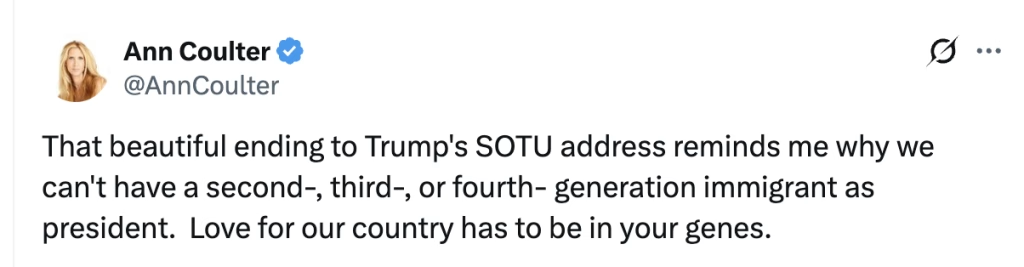
This tweet was so, well, stupid (given that Trump is second-generation on his mother’s side, and third on his father’s) that part of me thinks that she is trying to make a joke or something(?). However, I have seen nothing to suggest that it isn’t what it appears to be on face value.
A better place to go to think about all of this, because of its proximity to the center of both the federal government and the Republican Party, is JD Vance’s speech from July 2025 to the Claremont Institute (the text of which is here, but I would note that the published text and the actual speech given are not identical).
If you follow that logic of America as a purely creedal nation, America purely as an idea, that is where it would lead you. But at the same time, that answer would also reject a lot of people that the A.D.L. would label as domestic extremists, even though those very Americans had their ancestors fight in the Revolutionary War and the Civil War. And I happen to think that it’s absurd — and the modern left seems dedicated to doing this — to saying: You don’t belong in America unless you agree with progressive liberalism in 2025. I think the people whose ancestors fought in the Civil War have a hell of a lot more claim over America than the people who say they don’t belong.
There are a number of logical fallacies in this presentation. First, no one is advocating for the notion that if you simply believe in the creedal statement in the Declaration, you should then be automatically a citizen. He is smart and educated enough to know this. The idea of the US as a “creedal nation” is that the core of America is its ideas and ideals, not the ethnicity of the population. One can be an Israeli citizen, to pick an easy example, not because of adherence to a creed, not even the religious texts of Judaism, but because of ancestry. If you are an ethnic Jew, you have the right to be an Israeli citizen under the 1950 Law of Return.
The core of America as a creedal nation is found in places like the Gettysburg Address, where Lincoln spoke of “a new nation, conceived in Liberty, and dedicated to the proposition that all men are created equal.” Or when Hamilton noted, in Federalist 1, “that it seems to have been reserved to the people of this country, by their conduct and example, to decide the important question, whether societies of men are really capable or not of establishing good government from reflection and choice, or whether they are forever destined to depend for their political constitutions on accident and force.”
The notion of the US as a creedal nation is about its founding and the fact that that founding was not based on language, ethnic identity, or even shared history. We weren’t like the countries of Europe, founded on lengthy connections of certain peoples to specific soil and ancestry.
Yes, the early Americans were predmoninantly English speaking Chrisitans. But there were also Germans and Dutch. Oh, and a rather substantial number of Africans from various locations, who often somehow get ignored by people like JD Vance. Over time, there were also a large number of Hispanics added to our population via westward expansion. And, of course, we have to remember the native peoples in this discussion.
But the point being, the founding, as Lincoln noted and as Hamilton knew at the time, was about ideas, not ethnicity, nor specific lands, nor one’s ancestors. The first Americans became Americans by choice and in basic agreement with the stated creeds of the new American republic.
A second fallacy that Vance engages in above is that when the ADL declares a group to be domestic terrorists, they are not suggesting that they be stripped of their citizenship; they are declaring that they should be held to account for their actions.
A third fallacy is his invocation of the notion that somehow having long-term ancestry makes you a more advanced American. To repeat, “ I think the people whose ancestors fought in the Civil War have a hell of a lot more claim over America than the people who say they don’t belong.”
While he doesn’t use the term in this speech, he is evoking the notion of what many national conservative types refer to as “heritage Americans” as defined above.
Let me note that I don’t care if you can trace your lineage back to the first Anglo to step foot in North America; if you are in the Proud Boys, and you participated in J6, you not only belong in prison, but you are attacking the very government founded in 1789. I don’t think that would make you someone who should be stripped of their citizenship. I think it makes you a criminal, or a Criminal American, if you prefer. Note to JD Vance, that is why the ADL uses the term domestic terrorist. I think that at Yale Law, they teach the difference between domestic and foreign actors.
The notion that being descended from those who came over on the Mayflower or that you can trace your family back to specific wars makes you special is an idea that I think I picked up from TV or the movies as a child. More often than not, the person on screen espousing such a view was an old white lady of means with a somewhat snooty accent and mien (a recent example would be Christine Baranski’s character on The Gilded Age). Such a character was almost always coded as being pretentious and unduly self-important. The message I received, whether intended or not, was that, sure, it might be cool to be able to trace your lineage back to the original settlers, but otherwise being obsessed with such things is just silliness.
Indeed, while I have always had some passing interest in genealogy (an interest that is, for the most part, more hypothetical than anything else), I also saw it as simply a way of knowing about the past, not as a way of defining who I am now, and certainly not as some kind of measure of my Americanness.
Part of the point of Article I, Section 9 of the US Constitution, and arguably an underappreciated aspect of the American Revolution, is that your bloodline has no special legal or social significance. It states, simply, “No Title of Nobility shall be granted by the United States.” Couple this with the guarantee in Article IV, section 4, that “The United States shall guarantee to every State in this Union a Republican Form of Government,” and you create a system wherein, at least on some levels, each generation stands on its own. This is further reinforced by birthright citizenship in the Fourteenth Amendment.
And yes, it is certainly the case that the social and economic status of one’s parents has a profound effect on one’s life prospects, but while one may be born into wealth or poverty, everyone is a citizen at birth, and all one can claim is bragging rights because their great-great-great-whatever did this or that.
All of this got me thinking about my own family. On my side of the family tree, and going down each branch, I am honestly not sure when we first got here, but I can trace certain branches quite a way back.
On my mother’s side, I can trace my family line back to two Revolutionary War veterans, William Chandler Penn and his son, Stephen Penn, who may have been related (no proof in the documents I have) to the same Penn family that founded Pennsylvania. At a minimum, my great-whatever-grandfather Stephen came to what was then the Mississippi territory near what is now Huntsville, AL, around 1817. While it is largely happenstance that I became a denizen of Alabama, my family has a history here that is older than the state itself (1819).
This makes me, as much as I hate to use the term, about as much of a “Heritage American” as it gets, save being able to snootily say my family came over on the Mayflower.
I have other documents that trace both sides of my family well into the mid-19th century, although with fewer specifics on my father’s side.
For the most part, I have always treated this stuff as just personal trivia.
But, I guess, according to people like JD Vance and others in the NatCon movement, I am more of an American than my wife, whose father was born in Germany and whose mother’s mother was born in Canada. Indeed, am more American than my friend and co-blogger, James Joyner, whose mother was also from Germany. I think that means if he and I disagree about something on the blog, I win!
Surely I am, therefore more of an American than Trump, whose mother was Scottish and whose grandparents on his father’s side were German. My deep roots in the soil should elevate me above all of JD Vance’s kids, as well as all but one of Trump’s.
All of this is, of course, absurd.
And it also speaks to the beauty of the 14th Amendment. Simple birthright citizenship takes away the power from the government to adjudicate who is a “real” American and who isn’t.
I also think it is important not to define “American” as being about the past. We live in the now, and our present moment is based on the evolution and development of society. One of the tricks of a certain kind of conservatism is to extoll the virtues of the past without acknowledging that power in the past was often based on unjust realities, and how such injustices can compound over time (being descended from white property owners, for example, likely means you are in a better position than someone descended from slaves). Looking to the past to inform the present can simply solidify past injustice. Indeed, this often is the goal.
Ultimately, it isn’t hard to see what is going on here, as it is simply part of the white supremacy game. As Scott Greer wrote a few months ago at The American Conservative:
It has its merits. It evokes a term–heritage—with mostly positive connotations. Liberals look stupid when they freak out over such an anodyne term. People like the idea of American heritage, which the Trump administration likes to trumpet. The ambiguity of the term also adds to its value. Ian Ward notes that the term could just be a euphemism for white people and critics charge that it is a way to “to launder white nationalism with facially neutral language.” Liberals will always claim that but its advocates can dismiss it by simply saying they prize our national heritage and its culture. Heritage American is more palatable to the public than “white.”
Ultimately, the white supremacy of it all is clear: whites were dominant in the past, and some want to use that as an excuse to dominate now.
Next up: the food question.

So I watched Alysa Liu and this, more than anything, made me think “That girl is an American!” and also “I’m so proud of her” as well as, “Wow, her spirit shines so brightly!”
There’s a bit of regret that I am not a young man who could get to be on more intimate terms with young woman like that. I am not threatened by it, I am delighted. (So, it would seem, are most young men [Well, I just noticed that this is heteronormative. Not sure the best, most graceful way to change this to not be heteronormative would be, though. So I just apologize] of this time. It’s the old farts who are threatened.)
But anyway. Alysa Liu is not a “heritage American”. I don’t care. She gets America. She is America. She is not an immigrant. Which is to say, they often understand it better than natives.
I completely reject Auron MacIntyre. America is not a gene pool. It is an idea. It is a set of ideas. It is habits. It is a spirit of “do your own thing”. It always has been. There was a time when a group could go off into the frontier, start a town and do their own thing there, and nobody would much notice.
The big difference is that now we are in each other’s faces.
The silver lining to the idea that this trash is being platformed and mainstreamed is that it give a guy like me the chance to respond. An opportunity to call it out for the garbage it is. A moment where I can point out that under the formula Irish-Americans and German-Americans are not “heritage Americans”. Nor Italian-Americans.
Geez, is this supposed to be government by the DAR? We made fun of them when I was a kid. Crusty old stick-in-the-muds.
Heritage Americans do not hold a majority, nor should they. The way this might work is through the wisdom of counsel, of influence. But no, they have to wreck things, be in charge, and make everybody do what they say.
Which is the direct opposite of those ancestors they revere wanted and did.
LOL, you are such a Steven come lately.
I’ve been deep into family history ever since COVID. I used the crowd sourced site FamilySearch.com as well as Wikitree.
On my side, I trace back to 1705 when my Anabaptist forbears arrived from the Rhineland and landed in eastern PA. I guess because they are not Anglo-Protestant they don’t count. That’s my Mom’s tree. My Dad was an immigrant albeit a Scottish one.
On the other hand, my wife’s family tree is traced back to the Connecticut Colony (near present day Windsor) in 1640. Pure anglo-protestant.
The icing on the cake is that Dad graduated Hillsdale College in 1951. A high school dropout in 1941, joined the Army, received his citizenship in June, 1944 in Plymouth, England prior to shipping off to the growing Normandy bridgehead. Went to college on the GI Bill. Notice the irony of the freedom loving, anti-government Hillsdale of today surviving because the government funded millions of veterans to attend college. One of the greatest socialist programs of the 20th century.
Only because they’re caught in a trap of their own sloppy language. “So that would also include native americans and Blacks whose ancestry goes back to the Founding?” “Umh, they’re … umh, yeah, uh, … I guess it’d have to.” It’s a classic case of saying something that felt right to them without thinking about it.
One feels compelled to note that Trump is 3rd generation immigrant on his father’s side and 2nd on his mothers, and most of his kids are 2nd on their morher’s side.
Yeah. What Steven said. In my family tree is a man named Stephen Hopkins. He represented Rhode Island in the Continental Convention. He signed the Declaration of Independence.
ALSO in my family tree is Jesse James – the criminal, murderer and outlaw. The guy who decided that the Civil War wasn’t over for him, and he was going to Stick It To The Man (who was clearly a Yankee). I do not think Jesse was cool, but that was a school of thought.
Funnily enough, my dad once showed me some diagrams from that side of the family including one union (not my direct ancestor) was mixed race. Post war, so it was consensual, it seems.
And my great-grandfather came over to the US from Luxembourg, leaving there in 1848. So, does that negate my “heritage American” status? It’s all bullshit. What you are right here, right now, is what matters.
This is America. This is who we are, and who we have always been, for better and for worse. When shame prevents us from engaging, it holds us back. We should be trying to make things better. At every step, there have always been Americans trying to make things better.
What people like Tucker Carlson are right here, right now, is bad for America. They are making things worse, not better. They want to deny most of the world’s talent a home and a job. Because of their insecurity. Or because they think that they can exploit the insecurity of other people to advance their careers.
Boy, would I love to stomp through that temple turning over tables…
A few years ago there was a bit of a right wing panic regarding personal heritage, when “Real Americans” decided to send a sample of their DNA off knowing that it would prove them to be of pure (western) European stock. More than a handful were shocked to find out that the Germanic surname they were so proud of was bequeathed to them when an ancestor married a German-Jew etc, etc.
If they weren’t so dangerous, it would be best to consider them morons and ignore them.
What I find stupid about all of this is that I’m both a US and UK citizen from birth. I have automatic birthright citizenship in both places. I was born in the US to an English father before 1983. I didn’t have to apply for British citizenship. I just applied for a passport, just like in the US.
Does that make me Super Heritage?
Yeah, except you’ve become a hippy in your retirement and therefore Heritage Lefty, therefore you lose! /s
Because if they admitted America is founded on ideals, then they’d have to admit they are traitors to those ideals.
Keeping your skin color in good standing is far easier.
@Scott:
Ha!
@Beth: Also Ha!
@Kathy: Indeed.
It’s a stupid game, but if they want to play it they should be asked which side of the civil war they mean, the Union or the traitors.
I cannot hear “heritage Americans” without immediately thinking of my CSA offering heritage turkeys at Thanksgiving.
On my mom’s side, we can trace back to an arrival in the late 1600’s, around 1678 I think. One of her ancestors married a Native American woman, which I believe is about 7 generations back (she was either my great-grandmother’s great grandmother, or her grandmother, I can’t remember which).
On my dad’s side, all Germans, who came over in the mid-1800’s (1848 I think).
Does this mean I get to stay?
At any rate, one side has been here since before the revolution, the other side arrived much later. I think the entire argument is more than a bit silly.
Can these people not do math? The majority of American citizens are not ‘heritage’ Americans, especially if you want to exclude descendants of slavery. So, if Carlson et al are looking for a fight between ‘heritage’ and ‘non-heritage’, they are going to lose, particularly as I doubt most heritage folks are on-board with this white supremacist bullshit. And I suspect non-heritage Americans are younger on average. So, they’re looking for a throw-down between old hillbillies and everyone else? I don’t see that working for them.
The states with the lowest percentage of immigrants (not quite the same as heritage) include West Virginia, Montana, Mississippi, Wyoming and the Dakotas. So, quite an economic powerhouse there. The GDPs of these states combined come to less than half the GDP of very immigrant-heavy New York City alone.
@Jay L. Gischer:
What an odd aside. I have to think through the implications of conferring a greater form of citizenship to those that Jay L. Gischer wants to bone. It’s an absurd notion, and we haven’t really defined what that super-citizenship would consist of, but if it limits the impact of elderly white men who have been clinging to power, I don’t think we should dismiss it out of hand.
Are we limiting membership in congress or the presidency to members of this group? It definitely skews to one demographic, but we already have it skewing heavily towards one demographic, so that seems like a wash on inclusion in the short term, though viewed over a larger period, it might be viewed as a correction.
Should we offer citizenship to foreigners who meet this criteria? I’m going to go out on a limb and say “go for it, what’s the worst that can happen?”
I am worried about the longevity of such a solution, however, as you are, sadly, mortal, and this would lead to a Supreme Court attempting to use Originalist ideas to determine who you would have wanted to bone, scouring available records from your internet habits, etc.
But, all in all, I can’t say it’s a worse idea than anything JD Vance is suggesting.
How do you feel about furries? No one has ever tried creating a Furryocracy, and that’s probably a shame, but it is also not a worse idea than anything JD Vance is suggesting.
On my mother’s side, I trace back to farmers in the early 1800’s.
On my father’s side, I’m 2nd generation (my grandparents were immigrants).
When they start kicking out those who aren’t “Real Americans”, will I be forced to straddle the Canadian border? Or is it a Persephone thing, and I’m only allowed in for 6 months a year?
@Gustopher:
I would be down for this so hard.
— signed, not a furry, just an overly enthusiastic ally.
@Jay L. Gischer:
I also thought of Alysa Lui as I read this. She couldn’t have represented the U.S. any better at the Olympics. And winning the gold medal, which was dependent on the Japanese skaters’ performances, was icing on the cake. She and her father Arthur Liu, a first-generation American and political refugee, are among countless great American stories. Alysa’s genealogical heritage is only partly known because Arthur chose to have an anonymous egg donor — a white woman because he wanted mixed race kids. So her biological mother could have ancestry going back to the Mayflower or the Revolutionary War, or she could’ve been a recent arrival to the states. But that doesn’t matter, and has no bearing on how American she is.
If ya left the USA and were in the CSA and fought against the USA, when do those “heritage Americans” start their heritage date? Or do they just get demerits, or depending on their status during revolution times, some type of “pass”….its all just BS. Wilson, Reagan, Kennedy and Trump all had no Revolutionary War time ancestors, are any of them less American than other Presidents?
I’ve never much cared about social genealogy. Who your ancestors were says nothing about who you are. And what your ancestors did says nothing about what you’ve done.
You’d think on the seventh day, Jehovah created ‘Muricans!! Rather than groups of British, Spanish, Dutch Swedes, etc. sent settlers from Europe, and eventually slaves from Africa, and made a hash out of the continent.
Firsts tend to begin at some arbitrary point anyway. Besides, we can all trace ancestry, ultimately, to some slime made of self replicating amino acid chains, which were not even alive. But heritage slime doesn’t sound good, does it?
@Jc:
This point is one among many words and deeds that illustrate that none of the people involved in Trump 2, and many involved in Trump 1, believe what they are saying. It was and is a scam.
And the victims defend them like their life depends upon it.
ETA: by “victim”, I mean the people who are being scammed. Probably not the best word choice. If one prefers, substitute “target”.
@Mu Yixiao: You can only vote on even numbered days. Which is really unfair since there are more odd numbered days. Food Stamps and other government benefits will be prorated for just even day coverage.
Also, all elections will be moved to odd numbered days.
@Jc:
Trump.
Anyone who likes pizza is not a heritage American.
Edit. My comment showed up twice. Didn’t mean to double post. I think I should be more patient after hitting “post comment”.
@Gustopher: You know, I earned that.
AND, I’m just thinking of all these “tradwife” garbage vendors. Why would anybody like that? Why would anybody want that? I’m not rolling back the clock. I like where things are going.
The statement was less about Alysa Liu and more about how what these people want is kind of crazy and almost unintelligible to me. Whether it’s “heritage citizenship” or “tradwife”. Those are bad solutions to a problem I don’t comprehend.
@Eusebio: Thanks, man. You understood where I was going.
@Jay L. Gischer: It’s ironic that many MAGA Republicans were outraged that superstar Eileen Gu (who is anything but the “heritage American” they idealise) chose to compete in the Olympics for China, not the US. How dare she turn her back on her own country!
So many MAGA cultists think “I bet you never served!” is a zinger put-down in conversations about practically anything, I’m a bit surprised a connection with the military and respect for “masculinity” haven’t crept into the concept of the “heritage American”. Maybe they’re embarrassed to do it while Trump still leads the cult.
I don’t think this is going to fly, too many people don’t even know if their ancestors fought in the civil war and will be leery. Not many people have any idea of who all 16 of their great-great grandparents were or what they did. Odds are nearly everyone has at least one of the 16 who had been a recent immigrant when they bred, and fear they will be deemed a sort of mutt for it.
Yet I’m quite sure experimenting for a way to sell white supremacy will continue.
@Ken_L:
I actually do find an interesting contrast between Alysa Liu and Eileen Gu, and I’ll state up front that I think Gu (and her parent) appear to have sold out to a global adversary of her home country. Why? I believe she’s said things about being an ambassador for the sport, but she was the highest paid athlete at the 2026 Olympics, with higher annual earnings than every NHL player who participated. Liu and Gu are each an exceptionally talented athlete, U.S. born and raised, and the daughter of a Chinese immigrant, but their stories are very different.
They both became prominent in their respective sports in the winter of 2019, when Lui won her first U.S. figure skating championship at 13 and Gu won her first freestyle skiing World Cup gold medal as a member of the U.S. team at 15. Some time after that, Gu decided to instead compete for China and did so at the 2022 Beijing Olympics, where she won two gold medals, while also earning millions yearly from endorsements as well as directly from the Chinese government. Liu, meanwhile, won a second national championship and also competed at the Beijing games, where she finished in 6th place at the age of 16. While Gu was celebrated in Beijing, Liu has said that she was followed by agents of the state while at the Olympics and was asked to step inside a building to talk with one of them, which she refused. Due to pandemic restrictions, friends and family were not allowed at the Beijing Olympics, but Alysa’s dad Arthur, a Chinese dissident, likely could not have been there to support his daughter in any case.
Getting Eileen Gu to change her team/country allegiance had to be a huge propaganda win for China. The country has an Olympic Machine for cultivating and developing top talent at thousands of government-run sports schools, yet they were able snag a best-in-the-world American athlete off the shelf. But enough about Gu — this a feel-good story about Alysa Liu, and what she and her family have done to reach this point. And to the extent that we can still call someone America’s Sweetheart without sounding like a sexist fossil, Alysa is it.
@Jay L. Gischer:
Thanks for the heads up on that genealogy site. I just spent a few minutes looking back on my mom’s side and found the Drakes on that side go back to at least 1670 Isle of Wight Nansemond County, Virginia Colony. I’m so heritage.
I’m looking forward to checking out my father’s side. Apparently, a great aunt was doing our genealogy, but stopped and wouldn’t show anyone what she found. I want to find out what scandalized her. She was a very conservative southern woman, so it could be just about anything and it is probably something boring.
On my mother’s side, I can trace my ancestry back to a family that got off a boat in Boston in 1634.
On my father’s side, I can trace my ancestry back to a man and woman who got off a boat in New York in 1927.
Do the intervening 293 years mean I’m Heritage, or not?