As promised in my post from a couple of days ago, On Whiteness: Protecting Culture or Maintaining Supremacy?, here are some thoughts on the concept of “Heritage American” that has been in the air of late. So what does it mean and why does it matter?
There are a number of places to look for discussions of the topic, including the following, both pro and con:
- Via Politico: The Online Right’s Favorite Nativist Slogan Is Gaining Traction in the Real World.
- Via CATO at Liberty: Heritage Doesn’t Make Somebody an American.
- Via The Atlantic: Are You a ‘Heritage American’?
- From Ben Crenshaw at American Reformer, Heritage America.
Politico provides the following definition:
in its most basic sense, the phrase refers to present-day Americans who trace their ancestral roots to the colonial period, or shortly thereafter. Depending on whom you ask, the category also includes the offspring of Indigenous Americans and the ADOS, or “American descendants of slavery.” But at its most fundamental, said Engel, “heritage American” refers to the offspring of the Anglo-Protestant and Scotch-Irish settlers — in other words, the white people — who populated the original colonies before heading west to settle the American frontier.
The CATO post does a good job of showing how the American public looks at what makes an American (spoiler: it is mostly based on abstract ideas, not ethnicity, et al).
The Atlantic piece has the following definition:
In August, a guest on Tucker Carlson’s podcast said something that immediately caught his interest. The United States faces a fundamental rift “between heritage Americans and the new political class,” Auron MacIntyre, a columnist for Blaze Media, argued. “Heritage Americans—what are those?” Carlson asked.
“You could find their last names in the Civil War registry,” MacIntyre explained. This ancestry matters, he said, because America is not “a collection of abstract things agreed to in some social contract.” It is a specific set of people who embody an “Anglo-Protestant spirit” and “have a tie to history and to the land.” MacIntyre continued: “If you change the people, you change the culture.” “All true,” Carlson replied.
As well as this remarkable and telling interchange (emphasis mine):
When I called Engel to ask him about all of this, he told me that he does not believe that genetics are “the chief explanation” for how Anglo-Protestant ideals are transferred from generation to generation—but added that “there is an ethnic or racial correlation” between who embodies such ideals and who doesn’t. Our conversation was polite, but strange at times. I mentioned that as a half-Iranian American who was born and raised in the U.S., I share more in common ideologically with the Anglo-Protestant Founders of the United States than I do with Middle Eastern theocrats. “I would also contend that there is something deep inside of you that is attracted to or finds familiar portions of Iranian history,” he said, as though I am genetically predisposed to find the conquests of Darius the Great uniquely moving. I don’t, and told him as much.
The Crenshaw piece gives one a really good at to what a Hillsdale education looks like. It also provides the following definition:
What does it mean to be an American? Heritage America is best understood as involving seven inheritances: the English language, Christianity, self-government, Christian government, liberty, equality under the law, and relationship with the physical land.
The key elements here being, of course, the English language, Christianity, and “Christian government” whatever that might mean. Also telling: a “relationship with the physical land.”
If one wants an example of the notion in the wild just this week, here’s Ann Coulter:
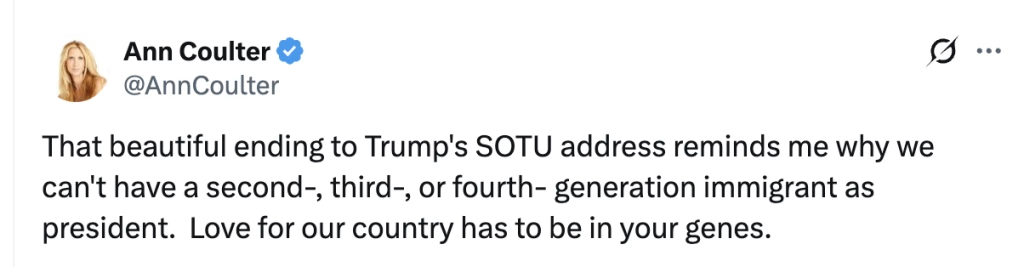
This tweet was so, well, stupid (given that Trump is second-generation on his mother’s side, and third on his father’s) that part of me thinks that she is trying to make a joke or something(?). However, I have seen nothing to suggest that it isn’t what it appears to be on face value.
A better place to go to think about all of this, because of its proximity to the center of both the federal government and the Republican Party, is JD Vance’s speech from July 2025 to the Claremont Institute (the text of which is here, but I would note that the published text and the actual speech given are not identical).
If you follow that logic of America as a purely creedal nation, America purely as an idea, that is where it would lead you. But at the same time, that answer would also reject a lot of people that the A.D.L. would label as domestic extremists, even though those very Americans had their ancestors fight in the Revolutionary War and the Civil War. And I happen to think that it’s absurd — and the modern left seems dedicated to doing this — to saying: You don’t belong in America unless you agree with progressive liberalism in 2025. I think the people whose ancestors fought in the Civil War have a hell of a lot more claim over America than the people who say they don’t belong.
There are a number of logical fallacies in this presentation. First, no one is advocating for the notion that if you simply believe in the creedal statement in the Declaration, you should then be automatically a citizen. He is smart and educated enough to know this. The idea of the US as a “creedal nation” is that the core of America is its ideas and ideals, not the ethnicity of the population. One can be an Israeli citizen, to pick an easy example, not because of adherence to a creed, not even the religious texts of Judaism, but because of ancestry. If you are an ethnic Jew, you have the right to be an Israeli citizen under the 1950 Law of Return.
The core of America as a creedal nation is found in places like the Gettysburg Address, where Lincoln spoke of “a new nation, conceived in Liberty, and dedicated to the proposition that all men are created equal.” Or when Hamilton noted, in Federalist 1, “that it seems to have been reserved to the people of this country, by their conduct and example, to decide the important question, whether societies of men are really capable or not of establishing good government from reflection and choice, or whether they are forever destined to depend for their political constitutions on accident and force.”
The notion of the US as a creedal nation is about its founding and the fact that that founding was not based on language, ethnic identity, or even shared history. We weren’t like the countries of Europe, founded on lengthy connections of certain peoples to specific soil and ancestry.
Yes, the early Americans were predmoninantly English speaking Chrisitans. But there were also Germans and Dutch. Oh, and a rather substantial number of Africans from various locations, who often somehow get ignored by people like JD Vance. Over time, there were also a large number of Hispanics added to our population via westward expansion. And, of course, we have to remember the native peoples in this discussion.
But the point being, the founding, as Lincoln noted and as Hamilton knew at the time, was about ideas, not ethnicity, nor specific lands, nor one’s ancestors. The first Americans became Americans by choice and in basic agreement with the stated creeds of the new American republic.
A second fallacy that Vance engages in above is that when the ADL declares a group to be domestic terrorists, they are not suggesting that they be stripped of their citizenship; they are declaring that they should be held to account for their actions.
A third fallacy is his invocation of the notion that somehow having long-term ancestry makes you a more advanced American. To repeat, “ I think the people whose ancestors fought in the Civil War have a hell of a lot more claim over America than the people who say they don’t belong.”
While he doesn’t use the term in this speech, he is evoking the notion of what many national conservative types refer to as “heritage Americans” as defined above.
Let me note that I don’t care if you can trace your lineage back to the first Anglo to step foot in North America; if you are in the Proud Boys, and you participated in J6, you not only belong in prison, but you are attacking the very government founded in 1789. I don’t think that would make you someone who should be stripped of their citizenship. I think it makes you a criminal, or a Criminal American, if you prefer. Note to JD Vance, that is why the ADL uses the term domestic terrorist. I think that at Yale Law, they teach the difference between domestic and foreign actors.
The notion that being descended from those who came over on the Mayflower or that you can trace your family back to specific wars makes you special is an idea that I think I picked up from TV or the movies as a child. More often than not, the person on screen espousing such a view was an old white lady of means with a somewhat snooty accent and mien (a recent example would be Christine Baranski’s character on The Gilded Age). Such a character was almost always coded as being pretentious and unduly self-important. The message I received, whether intended or not, was that, sure, it might be cool to be able to trace your lineage back to the original settlers, but otherwise being obsessed with such things is just silliness.
Indeed, while I have always had some passing interest in genealogy (an interest that is, for the most part, more hypothetical than anything else), I also saw it as simply a way of knowing about the past, not as a way of defining who I am now, and certainly not as some kind of measure of my Americanness.
Part of the point of Article I, Section 9 of the US Constitution, and arguably an underappreciated aspect of the American Revolution, is that your bloodline has no special legal or social significance. It states, simply, “No Title of Nobility shall be granted by the United States.” Couple this with the guarantee in Article IV, section 4, that “The United States shall guarantee to every State in this Union a Republican Form of Government,” and you create a system wherein, at least on some levels, each generation stands on its own. This is further reinforced by birthright citizenship in the Fourteenth Amendment.
And yes, it is certainly the case that the social and economic status of one’s parents has a profound effect on one’s life prospects, but while one may be born into wealth or poverty, everyone is a citizen at birth, and all one can claim is bragging rights because their great-great-great-whatever did this or that.
All of this got me thinking about my own family. On my side of the family tree, and going down each branch, I am honestly not sure when we first got here, but I can trace certain branches quite a way back.
On my mother’s side, I can trace my family line back to two Revolutionary War veterans, William Chandler Penn and his son, Stephen Penn, who may have been related (no proof in the documents I have) to the same Penn family that founded Pennsylvania. At a minimum, my great-whatever-grandfather Stephen came to what was then the Mississippi territory near what is now Huntsville, AL, around 1817. While it is largely happenstance that I became a denizen of Alabama, my family has a history here that is older than the state itself (1819).
This makes me, as much as I hate to use the term, about as much of a “Heritage American” as it gets, save being able to snootily say my family came over on the Mayflower.
I have other documents that trace both sides of my family well into the mid-19th century, although with fewer specifics on my father’s side.
For the most part, I have always treated this stuff as just personal trivia.
But, I guess, according to people like JD Vance and others in the NatCon movement, I am more of an American than my wife, whose father was born in Germany and whose mother’s mother was born in Canada. Indeed, am more American than my friend and co-blogger, James Joyner, whose mother was also from Germany. I think that means if he and I disagree about something on the blog, I win!
Surely I am, therefore more of an American than Trump, whose mother was Scottish and whose grandparents on his father’s side were German. My deep roots in the soil should elevate me above all of JD Vance’s kids, as well as all but one of Trump’s.
All of this is, of course, absurd.
And it also speaks to the beauty of the 14th Amendment. Simple birthright citizenship takes away the power from the government to adjudicate who is a “real” American and who isn’t.
I also think it is important not to define “American” as being about the past. We live in the now, and our present moment is based on the evolution and development of society. One of the tricks of a certain kind of conservatism is to extoll the virtues of the past without acknowledging that power in the past was often based on unjust realities, and how such injustices can compound over time (being descended from white property owners, for example, likely means you are in a better position than someone descended from slaves). Looking to the past to inform the present can simply solidify past injustice. Indeed, this often is the goal.
Ultimately, it isn’t hard to see what is going on here, as it is simply part of the white supremacy game. As Scott Greer wrote a few months ago at The American Conservative:
It has its merits. It evokes a term–heritage—with mostly positive connotations. Liberals look stupid when they freak out over such an anodyne term. People like the idea of American heritage, which the Trump administration likes to trumpet. The ambiguity of the term also adds to its value. Ian Ward notes that the term could just be a euphemism for white people and critics charge that it is a way to “to launder white nationalism with facially neutral language.” Liberals will always claim that but its advocates can dismiss it by simply saying they prize our national heritage and its culture. Heritage American is more palatable to the public than “white.”
Ultimately, the white supremacy of it all is clear: whites were dominant in the past, and some want to use that as an excuse to dominate now.
Next up: the food question.