
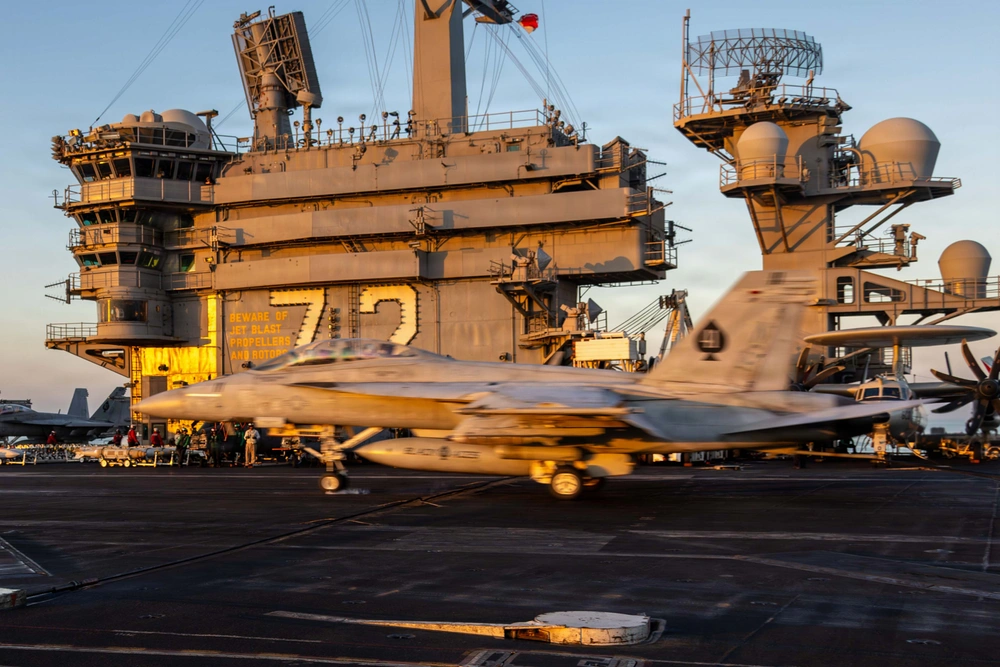
NYT (“Trump Dismisses Reports About Dire Conditions Aboard U.S. Aircraft Carrier“):
President Trump on Friday dismissed concerns about dire conditions reported aboard the U.S.S. Abraham Lincoln, an aircraft carrier that has been deployed for more than eight and a half months, much of it in support of the war against Iran.
Mr. Trump’s comments came in response to a reporter who asked about the reported conditions stemming from the extended deployment, which have included shortages of basic supplies, safety and hygiene issues and deteriorating mental health. When the reporter said that the crew members’ families were concerned, Mr. Trump said, “No, they’re not.”
The president, who was about to depart the Washington area for an event in New York, was asked whether he was concerned about the crew’s mental health and whether he thought the deployment had gone on too long.
“No. No. No,” he said. “Not nearly long enough.”
He acknowledged, however, that the Navy would soon replace the vessel “with another very similar ship.”
The Navy is sending the aircraft carrier George Washington to relieve the Lincoln, according to a U.S. official who spoke on the condition of anonymity for lack of authorization to speak publicly about ship schedules.
Mr. Trump’s remarks were the latest to downplay the consequences of his decision to attack Iran, causing a conflict that has lasted far longer than he initially promised and whose objectives and end have grown more and more elusive.
Mr. Trump has cast the war as a showing of American might. In his multiple declarations of victory, he has detailed successful missions that he claims wiped out Iran’s military capabilities.
He has consistently minimized the costs of the war, including the 18 U.S. servicemembers killed and hundreds of others wounded. He has compared the toll to previous, far longer and more deadly wars, like Vietnam, to argue that the Iran conflict has been relatively bloodless on the U.S. side.
[…]
In a letter on Thursday to Mr. Hegseth and Hung Cao, the Navy’s acting secretary, Senator Richard Blumenthal, Democrat of Connecticut, outlined issues reported on the ship.
“There have been widespread reports of shortages of basic supplies, water contamination, plumbing issues, deteriorating mental health, deck safety concerns and disruptions in the mail system, which have caused many care packages in route to the ship to be lost in transit for months,” he wrote about the problems, many of which were reported earlier by Navy Times and Stars and Stripes.
Later on Friday, while speaking at an event in Garden City, N.Y., Mr. Trump continued to defend the war and boast about its progress.
“Pretty soon I’ll be declaring the Hormuz Strait a territory of the United States,” he told the crowd, referring to a critical maritime route for global oil supplies that Iran effectively blocked over the course of the war. The struggle over control of the strait has rattled global markets, impacted the energy supply and disrupted Mr. Trump’s efforts to end the conflict.
Mr. Trump also asserted, as he has in the past, that his goal — to prevent Iran from obtaining a nuclear weapon — was worth the burdens placed on American, whose wallets have been hit by the rise in the price of gas and other increasing costs rippling out from the war.
“So remember that — when you have to pay a little bit more, you’re at $4, it’s OK,” he said. “I’ll never apologize. I did the right thing.”
We’re less than three months from the midterm elections. President Trump is sitting at minus 19.4 in the RealClearPolitics polling average, with only 39.2 percent approving of his performance. The “direction of the country” numbers are even worse, with 59.9 percent saying we’re on the wrong track. Democrats are currently leading the generic ballot by 6.8 points and lead the Senate races in Alaska, Texas, and Ohio — all deeply red states Trump won three times in a row.
The war is certainly not helping things for Trump’s party. Americans overwhelmingly oppose it, with 56.4 percent against it and only 36.9 percent supporting it. Dismissing the economic impact, particularly the pain people are feeling at the pump, strikes me as unwise. It’s true that the current national average of $4.07 isn’t historically high, especially when adjusted for inflation. But it’s up by 36.5 percent since the start of this war, which was entirely of Trump’s choosing.
Moreover, while the 5000-odd sailors of the Lincoln are all volunteers, dismissing their hardship—hardship caused by the decision to extend their deployment and mire them in a quixotic war effort—comes across as callous. Certainly, Americans support the troops at a higher level than they do Trump or his party.









