More Thoughts on Election Interference
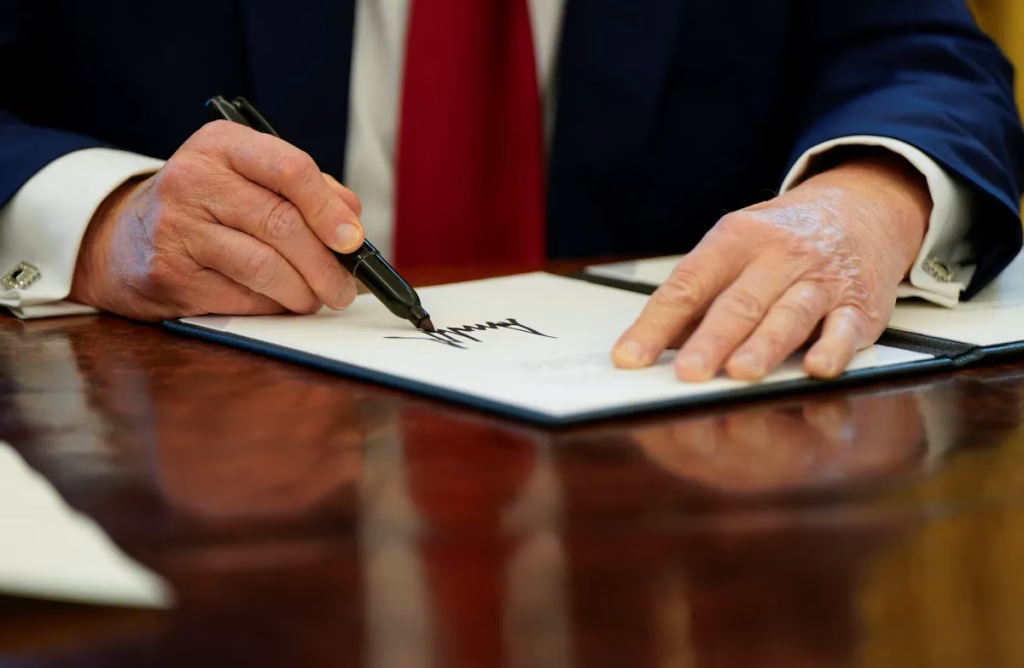
So, the comment section in my previous post has erupted into a good deal of speculation as to what might happen if Trump did issue an EO on the elections on issues like voter ID, mail-in ballots, and hand-counts instead of machine counts.
Such an order would be blatantly unconstitutional (Article I expressly gives the power in question to the states, save where Congress might seek to regulate them). Further, such an order would lack an enforcement mechanism since states run the elections in question. As such, even outside of any judicial action, states could easily ignore the EO. A simple illustration: Trump could issue an EO tomorrow declaring the speed limit to be 47 MHP, but he would have zero ways to force states to enforce that rule.
And yes, before someone says it, I recognize Trump’s lawlessness and his disregard for both the letter and spirit of the law. He has ignored both Congressional appropriations and court orders. But, I would note, there is a difference between abuses of inaction (i.e., not spending appropriated funds) and abuses of action (being able to make states comply with new electoral rules). Moreover, it matters that the areas in which he has engaged in abuses of action (renaming the Kennedy Center, tearing down the East Wing, or deploying ICE to Minneapolis), he does so in the context of federal assets that he has some statutory control over or some other direct proximity, either legal or physical.
One more bit of preface before anyone accuses me of downplaying all of this. Please recall that I have classified Trump as fascist, called him “a cancer on the body politic” in my previous post on this subject, and pretty much every day note some way, large or small, that he is acting like an authoritarian.
Still, I try to assess each threat as rationally as possible.
In that context, let’s consider what the real threat might look like in terms of states that would, in a doom scenario, try to comply with a Trump EO on elections.
There are 25 states with a Republican Secretary of State. BTW, state election administration varies across states, but the elections division typically reports to the Secretary of State. I may be missing some specific variation by using the SoS as the variable. Other relevant actors would include the Attorney General of the State and the Governor.
The table below lists the states in question, shows their current House delegation by party, and the italized and bolded states have Democratic governors. All have Republican AGs.
| D | R | |
| Alabama | 2 | 5 |
| Arkansas | 0 | 4 |
| Florida | 8 | 20 |
| Georgia | 5 | 9 |
| Idaho | 0 | 2 |
| Indiana | 2 | 7 |
| Iowa | 0 | 4 |
| Kansas | 1 | 3 |
| Kentucky | 1 | 5 |
| Louisiana | 2 | 4 |
| Mississippi | 1 | 3 |
| Missouri | 2 | 6 |
| Montana | 0 | 2 |
| Nebraska | 0 | 3 |
| New Hampshire | 0 | 2 |
| North Dakota | 0 | 1 |
| Ohio | 5 | 10 |
| Oklahoma | 0 | 5 |
| Pennsylvania | 7 | 10 |
| South Carolina | 1 | 6 |
| South Dakota | 0 | 1 |
| Tennessee | 1 | 8 |
| Texas | 13 | 25 |
| West Virginia | 0 | 2 |
| Wyoming | 0 | 1 |
I think that having a Democratic governor takes Kansas, Kentucky, and Pennsylvania off the map, so to speak, in terms of a scenario of state-level compliance with a rogue EO. Further, 11 states listed have zero Democrats, making compliance unnecessary.
That leaves us:
| D | R | |
| Texas | 13 | 25 |
| Florida | 8 | 20 |
| Georgia | 5 | 9 |
| Ohio | 5 | 10 |
| Alabama | 2 | 5 |
| Indiana | 2 | 7 |
| Louisiana | 2 | 4 |
| Missouri | 2 | 6 |
| Mississippi | 1 | 3 |
| South Carolina | 1 | 6 |
| Tennessee | 1 | 8 |
The calculation from there, I think, has to take into consideration where competitive seats are because there is no need to upset the applecart to protect seats that are likely foregone winners to begin with.
If we look at the Cook Report, there aren’t many seats that are worth trying to steal in these states (because you don’t steal what you are pretty sure you already have).
Here are the relevant seats in states with Republican Secretaries of State.
Toss-ups
- Two in Iowa (currently R seats)
- Two in Ohio (currently D seats)
- One in TX (currently D)
Lean D
- One in FL (currently D)
- One in Nebraska (currently D)
- One in Ohio (currently D)
- One in TX (currently D)
If we expand out to Likely D/R we could add 1 Likely D in Indiana, two Likely Rs in Florida, one in Iowa, one in Tennessee, and two in Texas (I was eyeballing this, so I may have overlooked something).
So, sure, given the margins, every seat counts. And we have seen some pretty cowardly acquiescence at the state level by Republicans solely to demonstrate their fealty to Trump. For example, Bill renaming Gulf of Mexico to Gulf of America passes Alabama House. But, of course, that is a low-cost symbolic move that costs nothing in the short-term.
But, for the sake of speculation, let’s ask about Texas. There are at currently four seats that are not considered “solid” for their parties. It should be noted that one of the “Likely R” seats was a D seat.
But let’s consider a couple of things. These are not the only offices on the ballot in November in Texas. The list can be found here. Spoiler: it’s long. In 2022, the last mid-term, there were roughly 8 million votes cast. I would further note that attempts at hand-counts at the GOP primary level in Texas have proven difficult to pull off. See, for example, this story from January via NBC News:
Republicans in two Texas counties ditch plans to hand-count ballots. See also this story from 2023: Arizona Republicans wanted to hand-count ballots. Then they saw the price tag — and the errors.
As much as I harp on the importance of partisan identity on this site, I do think that politicians and local officials also make some calculations based on resources, costs, and benefits. Maybe the state of Texas is willing to create headaches for the possibility of winning a few seats, but this seems unlikely.
If, in fact, state officials are willing to throw in for a Trump coup, which is what this would be, then why bother with hand-counts and weird ID rules? Just declare the winners you want and be done with it.
The convoluted nature of the EO, as rumored, coupled with the logical nightmare of trying to selectively apply it, strikes me as making the whole thing unlikely. Again, there are easier ways to foment a coup.
tl;dr version: if you are a state-level official willing to steal elections, there are easier ways to do it than the proposed Trump EO. And following would be a nightmare whose cost would likely outweigh the benefit.
The more I think about it, the more I think that Trump will make a massive strategic blunder if he issues such an EO, as it will demonstrate his anti-democratic bona fides in black and white in a way that even some people with their heads in the sand will find it hard to ignore and will further mobilize Democratic turnout in November.
