The Logistics of Massive Air Defense
Shooting down cheap drones with expensive missiles is problematic in more ways than one.
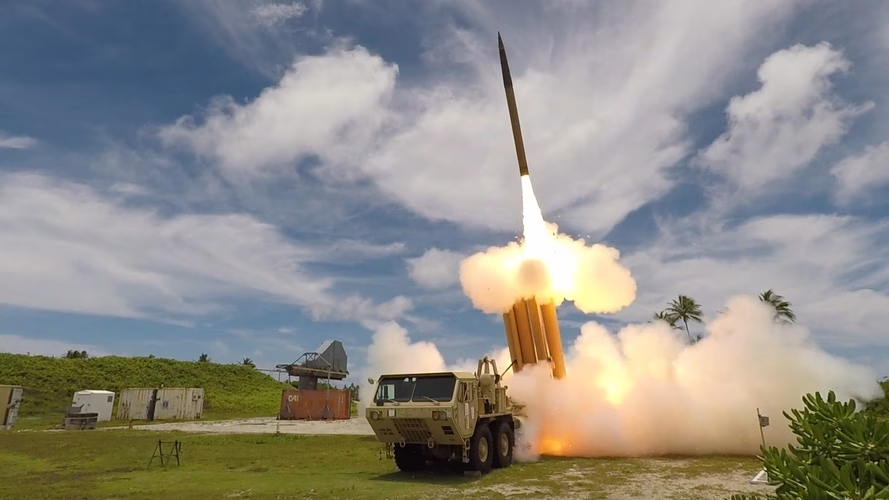
In their WSJ report, “U.S. Races to Accomplish Iran Mission Before Munitions Run Out,” Michael R. Gordon and Shelby Holliday lay out the titular problem facing American forces:
When the U.S. military’s top general laid out the risks to President Trump of launching a major and extended attack on Iran, one of the issues he flagged was America’s stockpile of munitions.
Now that is being put to the test, as the U.S. races to destroy Iran’s missile and drone force before it runs out of interceptors to fend off Tehran’s retaliation, current and former officials and analysts say.
The precise size of the U.S. stock of air-defense interceptors—what the Pentagon calls magazine depth—is classified. But repeated conflicts with Iran and its proxies in the Middle East have been eating into the supply of air defenses in the region.
[…]
“One of the challenges is you can deplete these really quickly,” said Kelly Grieco, a senior fellow at the Stimson Center think tank who used to teach at the Air Command and Staff College. “We’re using them faster than we can replace them.”
The Thaad antimissile system was deployed to Israel in 2024, along with the U.S. Army troops to operate it, as the Biden administration sought to protect the country against Iran. A Thaad has also been deployed to Jordan, where many U.S. combat aircraft are now deployed. A major concern for the Pentagon is to maintain a sufficient stock of interceptors for the Thaad, which U.S. forces also operate in South Korea and Guam, to deter North Korea and China.
The Pentagon is also racing to replenish stocks of Patriot and Standard Missile interceptors, which also take out aerial threats and are being used to defend against Iranian missiles and drones. Patriots take out lower-flying threats, while SM-3s can intercept ballistic missiles above the Earth’s atmosphere.
Air-defense interceptors aren’t the only munitions that are in short supply. The U.S. is also expending sea-launched Tomahawk cruise missiles, widely known as TLAMs, and aircraft-launched weapons against Iranian targets. This comes on the heels of Operation Rough Rider, the U.S. campaign last year when the U.S. used long-range precision weapons against Yemen-based Houthi militants.
There’s quite a bit more to the report, but you get the idea.
Grieco has a thread on the platform formerly known as Twitter detailing the problem. BLUF: it’s not just magazine depth, but comparative cost. I’ve cleaned it up a bit below:
UAE is shooting down ~92% of everything Iran throws at it. That’s extraordinary. Yet the financial toll of sustaining that defense is enormous, raising the prospect that tactical ‘victory’ masks a costly strategic drain.
Since Feb 28, Iran has fired at the UAE: 165 ballistic missiles, 2 cruise missiles, [and] 541 drones. UAE knocked down 152 missiles, both cruise missiles, and 506 drones. A 92%+ intercept rate.
But let’s talk about what that actually costs.
Iran’s bill (estimated):
*165 ballistic missiles @ $1–2M each → ~$165–330M
*541 Shahed drones @ $20–50K each → ~$11–27M
*2 cruise missiles → ~$1.5MIran’s total outlay: ~$177M–$360M
Now the UAE’s side. Each PAC-3 MSE interceptor costs ~$4–5M. Assuming a two-shot doctrine to ensure a kill, 152 ballistic missile intercepts × 2 shots × $4–5M = ~$1.2B–$1.52B To counter ~$165–330M worth of missiles.
The drones are where it gets truly punishing.
Iran spent ~$11–27M on 541 Shahed drones. The UAE fired interceptors averaging $500K–$1.5M per drone kill against 506 of them. UAE drone defense cost: ~$253M–$759M.
UAE spent:
*Ballistic missile defense: ~$1.2–1.52B
*Drone defense: ~$253–759M
*Total: ~$1.45–2.28BThe UAE spent 5–10x more defending than Iran spent attacking.
The drone ratio is the sharpest edge of this problem.
For every $1 Iran spent on drones, the UAE spent roughly $20–28 shooting them down.
This is the core of Iran’s strategy — and it’s not new. It’s the same math Russia has been running against Ukraine for 3 years.
To be clear: the UAE had to intercept. But here’s the strategic trap: every interceptor fired is one that can’t be replaced overnight. PAC-3 MSEs take years to manufacture. Iran’s Shaheds do not.
The UAE has now burned through a significant chunk of an interceptor stockpile that took years to build — in 48 hours.
There’s more but those are the key takeaways. As Economist Middle East correspondent Gregg Carlstrom pithily summarizes, “using Ferraris to intercept e-bikes gets expensive fast.” And Ferraris are much harder to replace.
This, to be sure, is simply the nature of modern war. Defending from aerial attack is getting more expensive, while attacking from the air is getting cheaper.
From a pure cost perspective, the United States, Israel, and regional partners can absorb this. Iran’s economy is devastated by years of sanctions. But it’s quite possible that we’ll run out of exquisite munitions before they run out of cheap and easy-to-replace drones.
And, of course, China is ostensibly the United States’ pacing threat. Our ability to deter their aggression against American allies and interests will be significantly weakened by this drain on our stockpiles.
A few days back (i.e., even before this war kicked off), Christian Brose pointed out what many have been saying for years: “America Needs a Lot More Weapons.”
In a conflict with China, the U.S. would run out of critical munitions in days, according to the results of war games. Recent events strengthen the case for weapons inventory. Ukraine expended a decade’s worth of U.S.-produced antitank and antiaircraft weapons in months of combat against Russia in 2022. In a few days of air-defense operations against Iran last year, the U.S. fired one-fourth of its Terminal High-Altitude Area Defense missiles—billions of dollars of weapons that took years to produce.
[…]
The common refrain is that Washington has underinvested in weapons, and there is truth to this. Over a decade ago, as staff director of the Senate Armed Services Committee, I pressed Obama administration officials on why their budget requests always shortchanged munitions. Not to worry, they argued: Limited resources were better spent on slow-to-produce ships, aircraft and other platforms; in a crisis, the U.S. could rapidly build more weapons.
Congress disagreed and increased budgets for weapons. Since fiscal 2015, annual spending on missiles and munitions has more than tripled. The bigger problem is this increased spending, insufficient to begin with, hasn’t led to commensurate increases in production.
[…]
Our critical munitions were conceived decades ago when many assumed the U.S. could win any war so quickly that we’d never have to expend and regenerate large numbers of weapons through ramped-up production for months or years. Government and industry optimized our weapons to be ever more exquisite, expensive and scarce. They became the military equivalent of luxury goods—their production constrained by rare materials, specialized labor, artisanal manufacturing, bespoke components, noncommercial supply chains and other limitations. This is a self-inflicted shortage of military power.
The Trump administration can be commended for trying to expand production, but money alone won’t solve this problem. We need new and different weapons that are simpler, faster and cheaper to produce. They should be designed to be made in great numbers and by the largest possible workforce, using commercial manufacturing practices and supply chains.
Our weapons have become overly complex, seeking to meet every requirement within a single munition, which leads to weapons that are effectively unproducible and irreplaceable. We need a high-low mix: smaller numbers of exquisite, expensive weapons for our smaller numbers of high-end threats, alongside a more affordable, more producible class of weapons for our larger number of lower-end threats.
He’s right.

So offense with drones overwhelms defense with interceptors.
Both sides can play, no?
This cost disparity should have been made clear to Trump – not by that mope Hegseth, but by someone who actually knows what “major combat operations” entail. Of course Trump wouldn’t have listened or comprehended due to his narcissism and lack of impulse control. And Trump’s real estate developers, er, special envoys, also should have been told that their bad faith negotiating would lead to the rapid expenditure of US munitions. On the Trumpish bright side, there’s now another excuse to deny munitions to Ukraine.
@charontwo: Sure. But as Brose notes, we’ve underinvested in cheap weapons in favor of exquisite ones.
@Charley in Cleveland: I guarantee you that CJCS Caine made this abundantly clear.
We have less need for munitions when you realize that Trump will never fight Russia or China. Trump is a bully whose goals are self-aggrandizement and cold, hard cash. He’s stolen Venezuela’s oil and gotten away scot-free, and I’m confident that he will steal Iranian oil money. No risk, big personal rewards. An actual war would be all risk and no reward for the Thief-in-Chief.
This is a disturbing post. Not because of the money being spent, but because it represents evidence of the most basic form that this attack was not thought out in any way, shape or form. Initially, I was thought “Good, Irans oppression is sick and needs to be terminated”. Now, I’m learning about all the logistics that complicate that action that are very different from other countries in the world. I guess, no war is the same.
Russia learned this lesson a few years ago, from the terrorist state perspective. With Iran’s help, they have established a much more sustainable terror campaign against Ukraine that does not rely as much on their legacy stockpile of exquisite weapons. Russia has been mostly weaned off Iranian-made Shahed drones and now produces their own versions at a clip of hundreds per day.
I imagine that Russia doesn’t want to, and may be logistically unable to, return the favor and share their upstart drone bounty with Iran. But it’s troubling that any nation/group able to maintain a stable supply chain could be a source of weapons that are able to overwhelm defenses orders of magnitude more costly.
The obvious counter to slow cheap offensive drones is slow cheap defensive drones. I suggest that rather than starting with our highly-priced defense contractors, building a batch of some cheap design and opening programming competitions between college teams: given these flying characteristics, this machine gun, these sensors, this much processing power, write software to make it a point-and-forget drone interceptor. Or given much higher flight profile, better sensors, and more processing power, a high-altitude detection drone that identifies incoming attack drones.
You’re much more likely to get interesting and innovative approaches to what is fundamentally a software problem from a hundred college robotics teams than from Raytheon.
I’m sure the US defense establishment can come up with a cheap $25,000 drone design that will cost only $10,000,000 each.
https://x.com/ChrisO_wiki/status/2028208056803217826
A thread
etc.
ETA:
https://x.com/gbrumfiel/status/2028274453436645527
@Michael Cain:
That’s the approach that Ukraine is taking, using suicide drones to hunt Ruski drones while they perfect and deploy laser air defense systems.
@Michael Cain:
WRT anti-drone drones, I’d hope that US has been applying some innovative approaches. Ukraine has become a test bed with, for example, billionaire and former Google CEO Eric Schmidt leading such an effort to develop and field high tech drones capable of intercepting Russian attack drones.
@charontwo:
Interesting news on low cost attack drones, although I’m hoping we can do away with the inappropriate descriptor “kamikaze.”
Serious question, why do these munitions take so long to produce? Ok, so they’re advanced and expensive. It seems that we have this problem with regular munitions as well though?
It seems to me that the answer is under investment and too many contractors dipping their noses in the coke.
Also, does anyone else get the sense that Trump and his lackeys are playing a very dangerous game of “Press Your Luck” with the military? It seems to me that their rampant, gleeful, stupidity has lead them to believe that since there hasn’t been a critical fuck up, they are invincible. I know that we’ve lost a lot of planes and a couple of military personnel, but we haven’t had a big FUBAR situation, yet. It’s going to be ugly when their luck runs out.
@Beth:
The F-35 creates jobs in something like 200-300 Congressional districts. Patriot missile districts are in the single digits.
Qui bono from manufacturing munitions? Not enough Congresspeople.
Ok, I woke up at 0339 this morning with this thought. Iran keeps maintaining a thorough air assault. The region and the US get really low on air defense equipment. Who throws the first “tactical” nuke, us or the Israelis?
@Beth:
@Michael Reynolds:
There may also be technical reasons, having to do with materials (specially composites), and very high degrees of precision for physical components.
@Mr. Prosser:
I had a similar thought, that this war could eventually go nuclear, but I surprisingly quickly said to myself nope, not going to happen. That is because it would take more than one or two moderate yield nukes to destroy hardened sites, and in addition to the hardened sites a nuke or two would need to be dropped on major population centers to really impress upon Iran how thoroughly screwed they are to the point where they would have no recourse but to surrender what’s left of their now partially irradiated country.
Dropping that many nukes would create fallout that neither Israel nor the U.S. could control (unless we can control the wind that will carry the fallout only to countries we technically could care less about such as Afghanistan and Pakistan, but unless someone could guarantee that countries like Turkey and Israel does not end up with clouds of radiation engulfing them, going nuclear is a no go).
I already thought about a possible reply to my insistence that this war will not go nuclear, that we would not bomb the oil production sites just the nuclear research sites, military bases, and maybe a city or two to really make a point, so Trump gets what he wants out Iran, lots of oil.
My comeback to that response is I do believe if Iranians really get to the point where they feel the U.S./Israel will drop nukes on them, that we should all remember what Hussein did to the oil fields in Kuwait, he wrecked them real good as he came to the realization that he was losing the fight big time against Western/European powers. Making it hard to extract oil for quite some time, and of course Oil companies around the world would be trying to extract oil surrounded by nuclear fallout making the job nearly impossible to complete.
So yeah, not going to be a Nuclear conflict as I sincerely believe one or two nukes being used would not be enough to essentially terminate the conflict, and Israel having primacy over the greater Middle Eastern region of the world only works to their favor if this region does not turn into a nuclear wasteland.
It’s rather remarkable that the Gulf states and the US military, do not seem to have looked at Ukraine and considered that in-depth anti-drone defences, especially for key sites, like air bases, refineries, oil terminals etc, are a good idea.
@Michael Cain:
I believe the Ukrainians have already done this and might be willing to share with an ally. Maybe we should be an ally.
I learned this morning that we used against Iran a sort of reverse engineered Shahed, the LUCAS, Low-cost Uncrewed Combat Attack System.
@Mr. Prosser:
I suspect the calculation is that iranian stocks are also not infinite.
The plan will probably be to go after stockpile sites and launchers.
With the degradation of Iranian air defences, it should be increasingly possible to switch from stand-off missiles to direct air strikes for that task.
The US had plenty of bombs in stock
This rhymes with our Vietnam practice of using million dollar airplanes with hundred thousand dollar bombs to destroy lashed together bamboo bridges.
@JohnSF: It does seem like there might be better sites for an anti-drone laser than El Paso.
@gVOR10:
Bugger lasers; radar controlled AA guns can mitigate the threat considerably.
The German Gepard type seems to have been fairly effective in Ukraine; something like that sould be still more capable against drones coming in over the sea, with less ground clutter to deal with.
There seems to have been a failure of contingency planning here.
Two weeks from now who’ll be left to surrender? Who’ll be able to negotiate a peace and make it stick in Iran? What does victory look like? When will we know we’ve won?
Watch Kharg Island. As soon as Marines take the island we will have victory in the sense that Trump can cook up some bullshit about using the oil money to reimburse us for blowing Iran up real good, and for rebuilding of course – a golf course would be helpful, many jobs for caddies.
Once he has his mitts on the oil money Trump will be happy. The Iranian people can descend into civil war, and die of thirst and hunger. But Trump will be richer, so. . . victory!
re Grieco and the cost estimates: intercepting missiles is not the best option; the obvious course is to supress air defences, then destroy the missile stocks and launchers at source.
Once supression is adequate, dumb bombs are cheap and plentiful.
Regarding drones, it looks like that threat has not been adequately planned for at all.
Which is rather surprising.
I’m not sure whether folding logic into a contorted, irrational shape departing from wrong premises is a result of brain damage, or a cause of it.
TL;DR:
@JohnSF:
Lasers and AA guns and anything else. The world of drones has become highly democratized and adaptions are happening rapidly.
High-powered lasers can be effective drone killers if there is line of sight, and the target is close enough. But a drone staying below the horizon until it’s almost too late, or the presence of clouds, or flying very high (because all laser beams diverge, thus limiting effective range) can foil lasers. Also, drones could be adapted to make them more reflective, and their optics configured to be less susceptible to laser light. AA can be effective, if there are enough of them and they are capable of reaching high altitudes. Because when the drone is making its rapid descent toward the target, it’s almost too late.
@JohnSF:
Radar controlled AA was the first thing I thought of, given drones are slow.
I’m not sure about range. AA has a rather short range. Missiles may have longer range, meaning they can take out targets over a wider area.
Unless Whiskey Pete ordered the use of missiles, I assume the various US armed forces are using what’s most adequate to the task, or at leas what they have.
And on aviation news, several UAE airlines have cancelled most of their flights (sorry, no link).
This is big. Emirates and Etihad carry a lot of traffic between Europe and Asia, through their hubs in Dubai and Abu Dhabi (or they may both have moved to the new airport roughly between the two cities; I’m unsure about that), and to a lesser extent to America (the continent, but mostly the US). It also carries a lot fo traffic between Europe and America (same) to the Middle East and Africa.
In simple terms, it’s the biggest disruption of global air travel since the trump pandemic.
Not to mention that since Russia’s air space is off limits to most European carriers, a lot of traffic between Europe and Asia routes trough the Taco war zone. I guess they’ll switch routes and go through Alaska, as they sued to before the USSR collapsed in 1991.
France Britain and Germany are warning Iran to knock off the attacks, probably referring to the attacks on Saudi/UAE oil infrastructure. If the report is true that their missile defenses are nearly depleted this would be logical. They will be forced to join in to keep their economies alive.
One of the reasons the Euros went big on Russian gas and oil over the last decade is to reduce dependence on ME oil. Bad timing, that. Now they have good reason to be very, very worried. Most of the ME production is right near the coasts, no “defense in depth” there, or not much of one. The Saudis and Gulfies run out of those AA missiles it doesn’t take much to light a refinery on fire -ask any Russian.
Somebody said the other day that the Saudis could always boost production to keep US gas prices low for the 26 mid-terms. Maybe, maybe not.
@Eusebio:
Thing is, staying below the horizon is bloody difficult if flying over the Persian Gulf.
It should be absoultely perfect for radar tracked AA guns and intercept drones.
There really does seem to have been a basic failure of planning here.
@dazedandconfused:
Not just the Europeans, but the Saudis.
Who have considerably assets of their own.
The RAF also recently deployed a Typhoon squadron to Qatar.
Both Europeans and Arabians and Turkey may not much love the Israeli/US “hope is a plan” bs.
But if the IRGC is intent on closing Hormuz?
If it were done when ’tis done, then ’twere well it were done quickly
@JohnSF:
It’s ultimately the insurers who are “closing the strait” at the moment. If somebody finds an assured defense against swarms of drones, let me know. CENTCOM sent a message that the strait is open. Probable chicken-s&%t ass-covering “Not our fault!!” intended for the current administration though it be.
@dazedandconfused:
Depends primarily on having drones.
Which don’t materialise out of thin air.
Nor do the launch teams.
Drones are no more a “magic bullet” than any other weapons system.
A discussion of cheap drones versus expensive air defenses should include at least a mention of decoy drones and AI.
In Russia’s war on Ukraine, decoy drones, costing a fraction of attack drones outfitted with warheads and targeting systems, are being used by both sides. The decoys not only occupy the attention of the anti-aircraft defenses and compel them to expend consumables, but can help identify the paths of least resistance for attack drones.
Despite concerns over AI enabling autonomous operation and targeting, the risk assessment is a bit different when the civilian population is under attack by Russian drones. So Google’s Eric Schmidt (and probably others) have already pushed forward with high tech drones having AI targeting capabilities. Schmidt may be using his resources to help defend a civilian population under attack, or he may be capitalizing on others’ conflict to develop his company’s line of 21st century weapons systems, or both.
@JohnSF: Drones are beating all other weapon systems in Ukraine at the moment.