
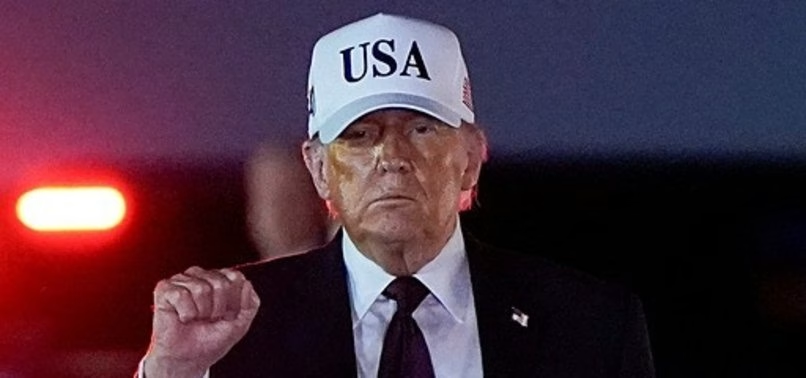
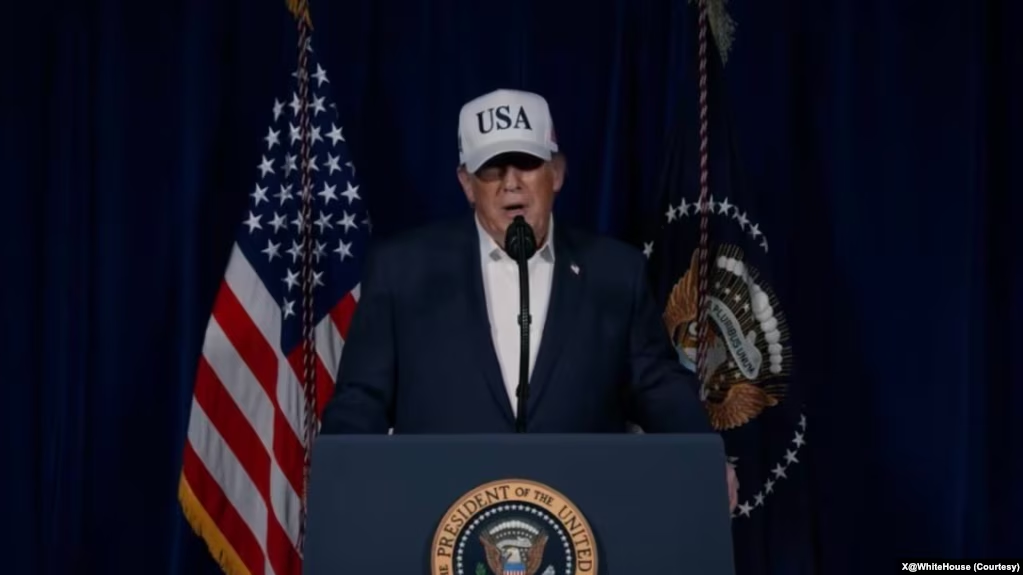
NPR (“Trump to address nation after saying U.S. may leave war within weeks“):
President Trump is set to address the nation on the Iran war at 9 p.m. Eastern time on Wednesday night, with White House press secretary Karoline Leavitt saying he would be providing “an important update,” without providing further details.
On Tuesday, Trump said he expected the conflict to be over in two to three weeks, adding, “we’ll be leaving very soon,” and promising gas prices would then “come tumbling down.”
Trump shrugged off what would happen to the blockaded Strait of Hormuz – which has cut off one fifth of the world’s oil supply – saying, “we’re not going to have anything to do with it.” He said that it wouldn’t affect the U.S. and would be something for other countries to deal with.
“They’ll be able to fend for themselves,” he said, having previously told European allies who have refused to enter the war to “go get your own oil!”
The assertion to wrap up the war quickly comes just days after Trump threatened to up the ante if there was no deal and Tehran didn’t reopen the strait. He said he could seize Iran’s oil and blow up all of their Electric Generating Plants and desalinization plants. He also said he was considering an invasion of Iran’s key oil export terminal, Kharg Island.
But on Tuesday, Secretary of State Marco Rubio echoed his boss’s latest comments on the war being over in a matter of weeks, saying the main goal of preventing Iran from being able to build a nuclear weapon had been achieved.
Rubio has expressed frustration in recent days over news reports accusing the administration of lacking clear objectives in Iran.
He said the objectives were: the destruction of Iran’s air force, the destruction of its navy, the “severe diminishing” of its capability to launch missiles, and the destruction of its factories.
Regime change, previously touted by the administration as a goal, was not mentioned. Earlier this week Trump said he considered regime change had been achieved, despite the fact that it remains a hardline theocracy led by the son of the previous ayatollah.
Reuters (“Trump says US may exit Iran war soon and threatens to quit NATO, as oil crisis escalates“) adds:
Global oil supplies are expected to be hit twice as hard this month as in March, the International Energy Agency said on Wednesday, underlining the urgent need to resolve the conflict over Iran that U.S. President Donald Trump said could end soon.
While Trump signalled he could wind down the war within weeks even without a deal, he also scaled up threats to pull the United States out of the NATO defence alliance if European states did not help stop Iran blocking the Strait of Hormuz.
“I was never swayed by NATO. I always knew they were a paper tiger, and (Russian President Vladimir) Putin knows that too, by the way,” Trump told Britain’s Daily Telegraph, saying he had moved beyond merely reconsidering U.S. membership.
The remarks on the war underscored Washington’s shifting and at times contradictory statements about a conflict that has killed thousands, spread across the region and caused unprecedented energy disruption.
“We’ll be leaving (the Iran conflict) very soon,” Trump told reporters, saying that could be “within two weeks, maybe two weeks, maybe three.”
“Iran doesn’t have to make a deal, no,” he said, when asked if successful diplomacy was a prerequisite for the U.S. to end what it calls “Operation Epic Fury”.
Cynics might say that expending tens of billions of dollars, the loss of countless lives, and doing lasting damage to the global economy without achieving any significant war aims constitutes a humiliating failure. Or that, having precipitated the closure of the body through which most of the world’s energy flows creates some responsibility to open it. But those people do not have the unique strategic mind possessed by this President, who knows more about war than any collection of generals.
And, indeed, investors seem relieved that the end of the operation may be in sight.
WaPo (“Markets rally, oil prices fall as Trump prepares to address nation on Iran war“):
Financial markets rallied, and oil and gas prices fell on hopes of an approaching end to the U.S.-Israeli war in Iran, even as strikes in the region continued and Tehran maintained a show of defiance against opening the Strait of Hormuz.
Stock markets in Asia closed higher Wednesday while European markets posted gains in early trading. The price of Brent crude, a global benchmark, dipped below $100 a barrel, down from about $118 a day earlier, and European gas prices fell.
A day earlier, U.S. markets closed higher, with the Dow Jones Industrial Average, S&P 500 and Nasdaq composite index all gaining more than 2 percent.
Oddly, many in the region want the war to continue.
AP (“Gulf allies privately make the case to Trump to keep fighting until Iran is decisively defeated“):
Gulf allies of the United States, led by Saudi Arabia and the United Arab Emirates, are urging President Donald Trump to continue prosecuting the war against Iran, arguing that Tehran hasn’t been weakened enough by the monthlong U.S.-led bombing campaign, according to U.S., Gulf and Israeli officials.
After private grumbling at the start of the war that they were not given adequate advance notice of the U.S.-Israeli attack and complaining the U.S. had ignored their warnings that the war would have devastating consequences for the entire region, some of the regional allies are making the case to the White House that the moment offers a historic opportunity to cripple Tehran’s clerical rule once and for all.
Officials from Saudi Arabia, United Arab Emirates, Kuwait and Bahrain have conveyed in private conversations that they do not want the military operation to end until there are significant changes in the Iranian leadership or there’s a dramatic shift in Iranian behavior, according to the officials, who were not authorized to comment publicly and spoke on the condition of anonymity.
The push from the Gulf nations comes as Trump vacillates between claiming that Iran’s decimated leadership is ready to settle the conflict and threatening to further escalate the war if a deal is not reached soon.
Indeed, one ally is apparently ready to put their money where their mouth is.
WSJ (“U.A.E. Wants to Force Hormuz Open and Is Willing to Join the Fight“):
The United Arab Emirates is preparing to help the U.S. and other allies open the Strait of Hormuz by force, Arab officials said, a move that would make it the first Persian Gulf country to become a combatant, after being hit by Iranian attacks.
The U.A.E. is lobbying for a United Nations Security Council resolution that would authorize such action, the officials said. Emirati diplomats have urged the U.S. and military powers in Europe and Asia to form a coalition to open the strait by force, the officials said. A U.A.E. official said the Iranian regime thinks it is fighting for its existence and is willing to bring the global economy down with it in a chokehold on the strait.
The U.A.E. official said the country had reviewed its capabilities to assist in securing the strait, including efforts to help clear it of mines and other support services.
The Gulf state has also said the U.S. should occupy islands in the strategic waterway including Abu Musa, which has been held by Iran for a half-century and is claimed by the U.A.E., other Arab officials said.
[…]
The U.A.E.’s newly assertive approach is a fundamental shift in its strategic outlook, said officials from a Persian Gulf state. Dubai, the commercial center of the U.A.E., has long financed the Iranian regime. Emirati diplomats were racing to mediate between the U.S. and Iran before the war, an effort that included a visit to Abu Dhabi by Ali Larijani, an Iranian national-security official who later died in an airstrike.
Meanwhile, The Mustache of Understanding argues “Trump Has a Way Out of the War.” But first, some insults:
It is actually embarrassing to watch the American president flip-flopping around, from telling us that the surviving Iranian leaders have pretty much agreed to his every demand, that the war is close to being over and Trump won, to admitting that he has no idea how to get the Strait of Hormuz shipping lane out of Iran’s grip. If America’s Western allies, whom Trump never consulted before the war, won’t send their armies and navies to do the job for Trump, then it’s too bad for them, he says: We have all the oil we need. That is, unless Trump decides to “obliterate” — his favorite word — Iran’s industrial base and desalination plants until Iran says uncle.
In short, we are watching what happens when you put into the Oval Office an impulsive, unstable man who ran for president largely to get revenge on his political foes. Then he surrounded himself with a cabinet chosen for its handsome looks and its willingness to put loyalty to Trump over loyalty to the Constitution. Add to that Republican majorities in the House and Senate willing to write him blank checks, and it all eventually leads to sloppy, undisciplined decision-making, including starting a huge war in the Middle East with no plan for the morning after.
Trump is a man-child playing with matches — the world’s most powerful military — in a gas-filled room.
But, finally, we get a solution so brilliant that it’s shocking no one has thought of it before:
Trump should set aside his 15-point peace plan — which would be ridiculously complicated to implement — and reduce it to two points: Iran gives up its more than 950 pounds of nearly bomb-grade highly enriched uranium, and in return the United States gives up on regime change. Both sides would then agree to end all hostilities. That is, no more American and Israeli bombing, no more Iranian and Hezbollah rockets, no more Strait of Hormuz blockade and, for darn sure, no U.S. ground troops landing in Iran.
I mean, why didn’t I think of that? Iran, which is arguably winning the war, could hand over its prime security asset in exchange for promises from (checks notes) Benjamin Netanyahu and Donald J. Trump to play nice. Why, they’d be fools not to take such a great deal.
Nancy A. Youssef, one of the aforementioned cynics, counters that there’s “No Good Way Out.”
All of [Trump’s] options come with serious liabilities, not least the fact that Iran appears to consider its own position to be relatively strong, given its de facto control over the Strait of Hormuz and, therefore, the global price of oil. Tehran may not feel that ending the war on a quick U.S. time frame is in its own interests.
“While we are inflicting enormous pain on Iran, we are also signaling to them that we are experiencing pain, and we don’t like it,” Peter Feaver, a professor of political science and public policy at Duke University, told me. “That tells them that their strategy—to just ‘survive’ and that will be a win—might be working. And if they hold on, they might get a better deal next week rather than this week. And that complicates negotiations.”
Indeed. This is especially true if we’re telling them they only need to endure another two or three weeks.









