Who’s Running Iran?
Apparently, not the president or his "leadership council."
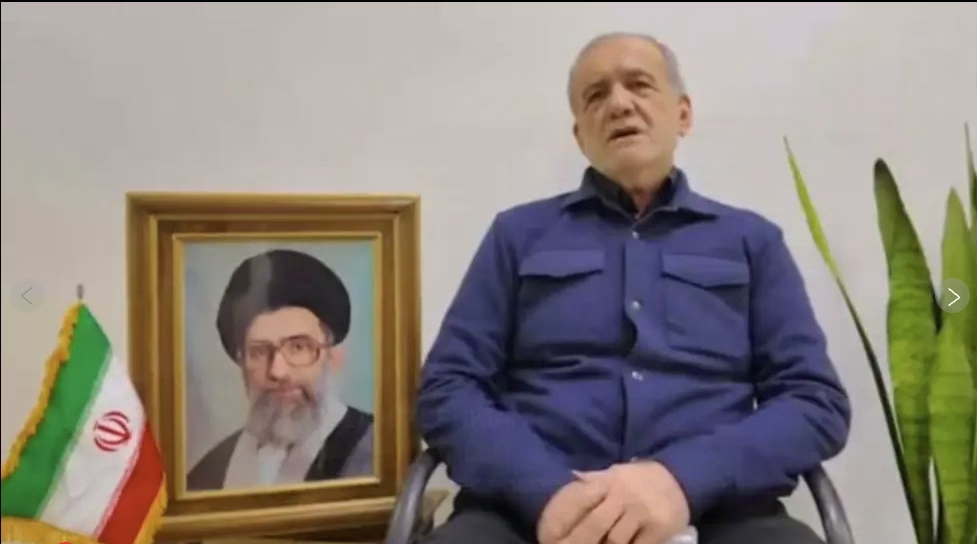
AP buries the lead in its report, “Iran’s president apologizes for strikes on neighbors as missiles and drones still pound their cities.”
Iran’s president apologized Saturday for attacks on regional countries even as its missiles and drones flew toward Gulf Arab states, indicating that Tehran’s political leadership could not exercise full command over Iran’s armed forces. He also rejected U.S. President Donald Trump’s repeated demands for surrender.
President Masoud Pezeshkian, one member of a tripartite leadership council overseeing Iran since a Feb. 28 airstrike started the war and killed Supreme Leader Ayatollah Ali Khamenei, delivered the defiant message exactly one week into a conflict that has spread across the region, rattled global markets and air travel and left Iran’s own leadership greatly weakened by hundreds of Israeli and American airstrikes.
The third paragraph shifts considerably:
The message, seemingly filmed in a hurry without professional broadcast equipment, again underlined the limited powers being exercised by the theocracy’s leaders over its paramilitary Revolutionary Guard, which controls the ballistic missiles targeting Israel and others. It answered only to Khamenei and now appears to be picking its own targets as the conflict widens.
Empahsis mine. So, the IRGC, not the president or any other regime official, is directing the war. Which means the headline news—the presidential apology (some might call it a surrender) to regional countries is meaningless, since the president is not in control of the missiles. Indeed,
Pezeshkian’s statement Saturday said Iran’s three-man leadership council had been in touch with the armed forces over the attacks.
“I should apologize to the neighboring countries that were attacked by Iran, on my own behalf,” the president said. “From now on, they should not attack neighboring countries or fire missiles at them, unless we are attacked by those countries. I think we should solve this through diplomacy.”
Gen. Abolfazl Shekarchi, Iran’s armed forces spokesman, then added more confusion by saying after Pezeshkian that Tehran has “not hit countries that did not provide space for America to invade our country.”
The American strikes haven’t been coming from the Gulf Arab states now under attack.
Likely in response to the ongoing political confusion, on Saturday, a prominent cleric in Iran, Ayatollah Nasser Makarem Shirazi, urged the country’s Assembly of Experts to act quickly to name a new supreme leader. Buildings associated with the 88-cleric panel have been hit by airstrikes in the war, likely slowing any meeting of the group.
“The timely realization of this important matter will lead to national authority and the best possible organization of affairs,” Shirazi said in a statement.
The IRGC is loyal to the regime, which is to say the Islamic Republic and its revolutionary aims, not to any particular person. As Steven Taylor rightly noted last Sunday, while Ayatollah Ali Khamenei embodied the regime for nearly four decades, the regime remains intact until it is replaced by a new system.
But decisionmaking power may well rest with the leadership of the IRGC—which will almost certainly fear for reprisals if the regime falls—rather than Pezeshkian or his leadership council. They are going to be very unlikely to surrender, unconditionally or otherwise, because of that.

I noted yesterday that we don’t have anyone who can surrender and make it stick. It’s one of the problems that comes from just killing everyone in an ayatollah hat.
@Michael Reynolds: “I noted yesterday that we don’t have anyone who can surrender and make it stick. It’s one of the problems that comes from just killing everyone in an ayatollah hat.”
But that’s the genius of Trump’s plan! He’s going to decide when Iran has surrendered, not any of those annoying Iranians.
@wr:
Maybe he can name Rubio as Viceroy of Persia and have him surrender.
@Michael Reynolds:
I think for Persia the proper term would be Satrap.
@Kathy: “It’s a Satrap!”
@Michael Reynolds:
Marco, Prince of Persia?
More seriously, it looks like no-one in Iran is in central control of the missile and drone right now.
I suspect control of wepons has devolved to dispersed command, and they have moere or less gone into spasm.
Striking mostly at the UAE, which has refused US use of bases, is a bit dubious.
Striking Turkey and Azerbaijan is quite epically idiotic.
They have the military capability to take, at minumum, the Azeri Turkic region of NW Iran.
At least they haven’t been quite insane enough to hit Pakistan.
Yet.