Trump Threatens to Obliterate Iranian POWER PLANTS
STARTING WITH THE BIGGEST ONE FIRST, naturally.
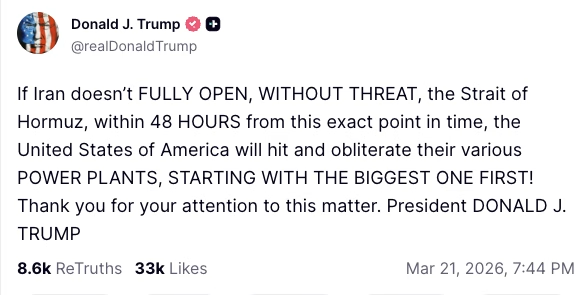
WaPo (“Trump threatens to ‘obliterate’ Iran’s power plants if Strait of Hormuz does not open“):
President Donald Trump threatened to strike Iran’s power plants if the country does not fully open the Strait of Hormuz by Monday, escalating his attempts to force Iran to reopen the waterway as energy prices surge.
“If Iran doesn’t FULLY OPEN, WITHOUT THREAT, the Strait of Hormuz, within 48 HOURS from this exact point in time, the United States of America will hit and obliterate their various POWER PLANTS, STARTING WITH THE BIGGEST ONE FIRST!” Trump said Saturday night on Truth Social.
[…]
In response to Trump’s threat, an Iranian military spokesman said Sunday that Iran would respond to any attacks on its energy and fuel infrastructure by targeting U.S.-linked energy facilities in the region. “All energy infrastructure, as well as information technology (IT) and water desalination facilities” linked to the U.S. in the region will be targeted, said Ebrahim Zolfaqari, spokesman for Iran’s primary military command, according to state-affiliated Fars News.
Reuters (“Trump and Iran step up threats over energy targets as war escalates“):
U.S. President Donald Trump and Iran threatened to escalate their war by attacking energy facilities in the Gulf, a potential widening of hostilities that could deepen a regional crisis and add to concerns in global markets.
[…]
Iran’s Parliament Speaker Mohammad Baqer Qalibaf wrote on X that critical infrastructure and energy facilities in the Middle East could be “irreversibly destroyed” should Iranian power plants be attacked.
[…]
“President Trump’s threat has now placed a 48-hour ticking time bomb of elevated uncertainty over markets,” said IG market analyst Tony Sycamore, who expects stock markets to fall on Monday as energy supplies remain strained.
[…]
The Islamic republic’s power grid is deeply intertwined with its energy sector. Striking major plants could trigger blackouts, crippling everything from pumps and refineries to export terminals and military command centres.
While some Gulf desert states such as Saudi Arabia, Oman and the UAE have access to more than one sea to draw water from for desalination, Qatar, Bahrain and Kuwait are crowded along the shoreline of the Gulf with no other coastline.
POLITICO (“Iran strikes near Israeli nuclear research center as Trump threatens attacks on Iranian power plants“):
Iranian missiles struck two communities in southern Israel late Saturday, leaving buildings shattered and dozens injured in dual attacks not far from Israel’s main nuclear research center, while President Donald Trump warned the U.S. will “obliterate” Iranian power plants if it doesn’t fully open the Strait of Hormuz within 48 hours.
The developments signaled the war was moving in a dangerous new direction at the start of its fourth week.
Trump — who is facing increasing pressure at home to secure the strait as oil prices soar — issued the ultimatum in a social media post while he spent the weekend at his Florida home.
[…]
The Iranian strikes in Israel came after Tehran’s main nuclear enrichment site at Natanz was hit earlier in the day.
Israel’s military said it was not able to intercept missiles that hit the southern cities of Dimona and Arad, the largest near the center in Israel’s sparsely populated Negev desert. It was the first time Iranian missiles penetrated Israel’s air defense systems in the area around the nuclear site.
[…]
Iran also targeted the joint U.K.-U.S. Diego Garcia military base in the Indian Ocean about 2,500 miles away, suggesting that Tehran has missiles that can go farther than previously acknowledged — or that it had used its space program for an improvised launch.
The aims of the war continue to evolve, apparently. To the extent it was ever about replacing the regime of the ayatollahs with one more favorable to US interests and the Iranian people, that goal seems to have gone by the wayside. To say the least, taking out the country’s ability to provide energy will make it incredibly difficult to govern, much less prosper economically, in the aftermath of the conflict.
UPDATE: While it’s decidedly not what “obliterate” means, a retired defense reporter offers this perspective:
USAF can easily deploy graphite bombs (BLU-114B/CBU-94) and the USN can fire TLAMs specially fitted with canisters that puff long reels of carbon fibers, which TEMPORARILY cause blackouts when they come into contact with non-insulated power lines and transformers.
Clean off the graphite and the juice returns.
This isn’t radically different from the crude tech used by the Germans (Seilbombs) and British (the highly underrated Operation Outward balloon attacks) during WWII.
We’ve used these munitions against Baathist Iraq twice and later on to immiserate the former Yugoslavia during the Kosovo War.
The reason why I bring it up is because people don’t understand Iran’s proposed response. Iran knows this is just a short-lasting soft bomb. Although the US could destroy the grid by taking out the thermal plants with gravity bombs, this would destroy Iran, with disease radiating across the country due to the loss of water treatment plants.
But that’s not really what’s at stake here, at least from the U.S. perspective.
I must admit to being unfamiliar with this technique, but trust my source’s knowledge here. This is, indeed, a decidedly different matter than actually obliterating the power plants.

Alternative headline: “POTUS threatens to commit massive war crime”
While attacking energy infrastructure can be lawful if it achieves come concrete military advantage and meets the requirement of proportionality, as a general punitive strategy, however, it is clearly illegal.
And this is aside from the fact that Iran’s regime doesn’t care much about the well-being of its population while Iranian counterattacks may cause years-long disruption to energy production and distribution on a global scale.
As Iran can dish out more pain than the US will be able to inflict in return, it’s not even going to help.
And then there is, of course, the additional threat to desalinization plants, which could lead to immediate harm to millions around the Gulf.
Let’s just hope Trump chickens out. Because if not, we’re well and truly fucked.
@drj:
Yes, Trump is not alone in being able to climb the escalation ladder, Iran has options also.
There is a real scenario here wherein the US substantially damages Iranian power capabilities and other key infrastructure, and the Iranians do damage to desalination and other key infrastructure in the Gulf states. All of this would create a number of humanitarian disasters that would have long-term economic and political consequences–none of which would lead to a safer region (indeed, quite the contrary).
This is shaping up to be a massive disaster and the best exit ramp I can see is just Trump TACOing out, and that does not seem on the table at the moment.
If you thought it was dangerous to let children play with matches, how about man children playing with armies?
@Kathy:
This week the old meme about the life we’re living is like being tied to a chair while an toddler plays with a loaded handgun has been circulated again.
@Steven L. Taylor: The Japanese and others agreeing to buy Iranian oil with the Chinese yuan puts serious questions on the future of the US/Saudi petro dollar, and thereby the US’s status as the world’ banker. While this may be a necessity of the moment, the implications of losing that status are truly massive.
If used recklessly and unpredictably, as it is now, there’s a some point at which the Euros and the Asians will seek a check on US power. The Chinese may be as ruthless but they aren’t manifesting the signs of insanity such as we are now. We are making them look like a viable, even necessary, alternative.
@Steven L. Taylor: I don’t think the US gives two shits about a humanitarian disaster in the Middle East — they should, as humanitarian disasters tend to create waves of refugees, and we really don’t like refugees, but we’re very dumb — so I don’t think hitting desalinization plants would act as a deterrence at all.
Energy production infrastructure, on the other hand. We’ve already had enraged off-Brant-tweets about the horrors of anyone striking energy-production infrastructure.
Of course, this all depends on whether Iran’s lead ship is looking to cause maximum damage or alter US behavior.
The “retired defense reporter” is blowing smoke. When Trump says “obliterate” he means it literally. It’s not a euphemism for “temporarily disable”, nor is it apparent what purpose would be served by doing the latter.
Close the straits: relatively short-term pain. Months. Blow up pipelines and pumps: long term pain. Years. ‘Our’ side is running out of interceptors and somehow Iran does not appear to have run out of missiles. There’s a YouTube intel/military guy named Ryan McBeth and his position on drone warfare was that air superiority trumped drones. No one has ever had more total air superiority than US and Israeli forces and still 16 ships have been hit, and two ballistic missiles got through to Dimona.
The Saudis and Emiratis must be just looking at handfuls of dust right now. Their tourism push? Gone. They’re about to run out of caviar and truffles for the suites. Their stable economic and banking center thing? Gone. Look where their alliance with Trump has brought them. Xi won’t even have to roll out any red carpets to have the Arabs coming to pay court. They’d be fools to rely on us.