America’s Oligarchs
The state of being too big to care.
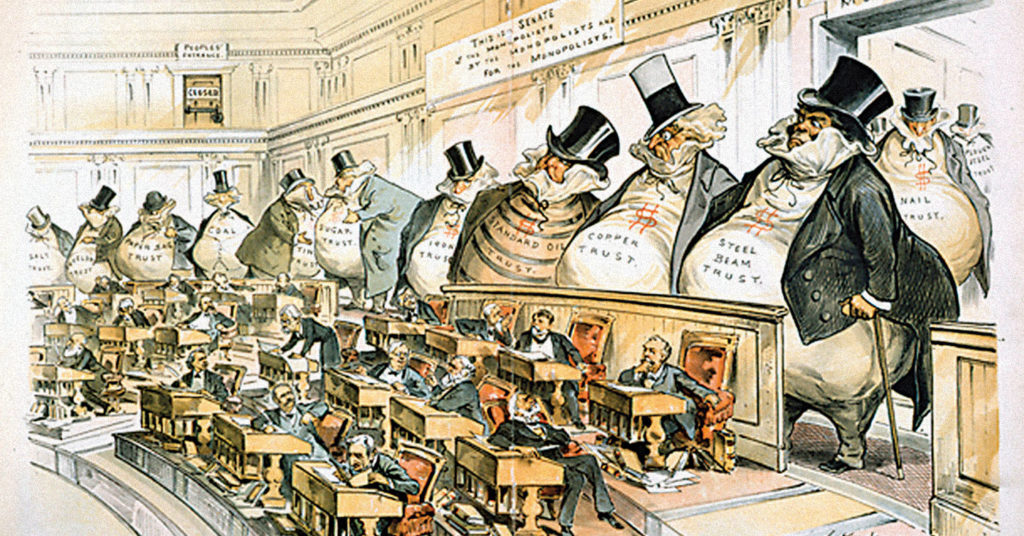
I see my colleague Steven Taylor has written a piece drawing on two of the same sources. They’re sufficiently different to leave both up.
While the rise of the Tea Party strained my relationship with the Republican Party and the MAGA ascendancy ended it, I’m still fundamentally conservative in my views of government. I still believe in the power of market economics and that those who create value ought be rewarded for it. It does not bother me in the least that the likes of Bill Gates, Jeff Bezos, Mark Zuckerberg, and Elon Musk are extremely wealthy.
At the same time, it’s become increasingly clear that the super-rich have too much power in our system. At the extreme level, as the author and filmmaker Noah Hawley describes in his Atlantic essay “What I Learned About Billionaires at Jeff Bezos’s Private Retreat,” they become essentially untouchable.
Though we didn’t know it at the time, Bezos’s first marriage would be over a few weeks later. My defining impression of his wife that weekend was sadness, even though Bezos made a big show of performing the role of family man. In hindsight, it is that performance that sticks with me. The Jeff Bezos of 2018 acted as if he still believed that people’s impression of him mattered, that his financial and social value could be affected by negative publicity. He still believed that his actions had consequences. He had not yet freed himself—the way Daniel Plainview freed himself—from the rules of men.
Eight years later, Bezos and two of the world’s other richest men—Mark Zuckerberg and Elon Musk—have clearly left the world of consequences behind. They float in a sensory-deprivation tank the size of the planet, in which their actions are only ever judged by themselves.
The closer I’ve gotten to the world of wealth, the more I understand that being truly rich doesn’t mean amassing enough money to afford superyachts, private jets, or a million acres of land. It means that everything becomes effectively free. Any asset can be acquired but nothing can ever be lost, because for soon-to-be trillionaires, no level of loss could significantly change their global standing or personal power. For them, the word failure has ceased to mean anything.
This sense of invulnerability has deep psychological ramifications. If everything is free and nothing matters, then the world and other people exist only to be acted upon, if they are acknowledged at all. This is different from classic narcissism, in which a grandiose but fragile self-image can mask deep insecurity. What I’m talking about is a self-definition in which the individual grows to the size of the universe, and the universe vanishes. Asked recently if there is any check on his power, President Trump—himself a billionaire, and by far the richest president in American history—said, “Yeah, there is one thing. My own morality. My own mind. It’s the only thing that can stop me.” Not domestic or international law, not the will of the voters, not God or the centuries-old morality of civic and religious life.
Decades of research in developmental psychology have shown that moral reasoning develops through consequences—not punishment, necessarily, but experiencing the effects of your actions on others, receiving honest feedback, having to accommodate reality as it actually is rather than as you wish it to be. It’s not that the wealthy become evil; it’s that their environment stops teaching them the things that nonwealthy people are forced to learn simply by living in a world that pushes back. When you can buy your way out of any mistake, when you can fire anyone who disagrees with you, when your social circle consists entirely of people who need something from you, the basic mechanism by which humans learn that other people are real goes dark.
When Peter Thiel said, “I no longer believe that freedom and democracy are compatible,” he wasn’t talking about your freedom. He was talking about his own. You don’t exist. When Musk took a chainsaw to the federal government as part of the inside joke he called DOGE, he did so with the air of a man who believed that nothing matters—poverty, chaos, human suffering. He was having fun. It didn’t even matter that the entire destructive exercise ultimately yielded no practical financial gains. For him, the outcome was a foregone conclusion: He could only win, because losing had lost its meaning.
At a more mundane level, the two most recent episodes of the Ezra Klein Show illustrate more fundamental concerns: the fact that the uber-wealthy pay comparatively little in taxes and the enormous political power they have.
His April 17 interview with Boston College law professor Ray Madoff, “Our Tax System Should Make You Furious,” delved into something I already knew pretty well: the degree to which the truly wealthy can avoid taxes because they make very little in the way of “income.”
Salaries are for suckers. When people take a salary, they’re subject to high income taxes and payroll taxes, and Jeff Bezos and a lot of our other multibillionaires have no interest in paying those taxes.
So instead, they take their benefits through the growing value of their stock — and their stock has grown enormously. And that massive growth of stock happens entirely tax free — with no time frame under our current system in which that stock will ever be subject to tax.
That is because we only impose a tax if the stock is sold, and Bezos never has to sell the stock because he can simply borrow against the stock and use that money to support his lifestyle and to pay any interest that’s due on the loan.
What I either didn’t know or had forgotten was how radically the thinking of even the rich on all of this has changed relatively recently. Madoff quotes Andrew Mellon’s 1924 book Taxation: The People’s Business:
The fairness of taxing more lightly incomes from wages, salaries and professional services than the incomes from business or from investments is beyond question. In the first case, the income is uncertain and limited in duration; sickness or death destroys it, and old age diminishes it. In the other, the source of income continues; the income may be disposed of during a man’s life, and it descends to his heirs.
Moreover, this was the conservative position in my young adulthood:
And you know who else agreed? Ronald Reagan, in the Tax Reform Act of 1986.
They actually succeeded in equalizing, for a very brief period, capital gains rates and ordinary income rates. They got rid of the preference for capital gains, which we should definitely do today.
But, naturally, the rich and their accountants figured out a huge loophole.
Before 1982, because companies could only share their profits through dividends, it meant to own a lot of stock was to get a lot of dividends. For much of the 20th century, dividends were taxed at the highest rates, just like salaries. What that meant was that somebody who was sitting on a lot of stocks got a lot of dividends and paid a lot of taxes.
However, in 1982, after this rule change, companies switched from issuing dividends. It used to be more than 70 percent of profits were distributed through dividends. Now it has never been as high as 20 percent since this change went into being.
The effect of this is that companies began to do lots and lots of buybacks of their stock. And this had a tremendous impact on multiple levels.
If you look at the Dow Jones, there’s a chart in my book that shows that in 1982, the Dow Jones was at about 3,000. It was also that in the ’70s, the ’60s, the ’50s, the ’40s, the ’30s and the ’20s — it was around 3,000. That’s the inflation adjusted amount.
Now, it’s something like 45,000 today.
Part of this story is stock buybacks. Stock buybacks boost the value of stock.
But another important part of the story is that it meant that for somebody who owned stock, they no longer had to get taxable income. They could enjoy their profits through the increased value of the stock.
Some shareholders would sell their stock, because that’s the nature of the stock buyback. However, a lot of these shareholders are tax exempt organizations, so they’re not worrying about paying taxes on their proceeds.
So in terms of revenue to the federal government, profitable companies used to provide a lot of revenue to the federal government in the form of taxation of dividends. Now, with the rise of stock buybacks, that is much less likely to be the case.
There’s also a longish discussion recounting what I already knew in the abstract if not in detail: the degree to which the ultra-wealthy can create generational wealth through the creation of trusts, effectively shielding their grandchildren and their grandchildren’s grandchildren from taxation.
Today’s episode, “Why Are Palantir and OpenAI Scared of Alex Bores?” is mostly anecdotal, focusing on a New York state legislator who’s running for Congress and being aggressively opposed by a SuperPAC funded by some uber-rich AI moguls. There’s no real value in excerpting the interview, which is mostly about the merits of regulating AI. But it’s just another illustration of how the very wealthy have outsized influence in our political system.
The solutions to these problems are less than obvious. Wealth taxes are very complicated to administer and are likely unconstitutional, at least at the federal level. But there are certainly ways to ensure that the very rich pay taxes if we had the will to do so. But, of course, their outsized political power combined with a considerably higher interest in the tax system means that they have essentially written the tax code in their favor.
Madoff again:
[P]eople feel like the regular people are always going to lose out. The rich are always going to have their way — it’s always going to be to their advantage.
But that is not always the case. I think it’s important to think back in history to different times.
One of the times I think is particularly interesting is the Tax Reform Act of 1986. That is the last time that we actually had any really meaningful reform in the tax system. It was under President Reagan, which was kind of surprising, but it adopted principles that had been around under both parties.
When we talk about high-income earners and the inability of high-income earners to avoid taxes, that is because of changes that occurred in 1986. Before 1986, we had a flourishing tax shelter business. Your high-paid surgeon would not have paid taxes on their income because they would have been able to invest in tax shelters and offset all of their income by losses.
[…]
The 1986 act did something very interesting, something I think that we should be doing today: It broadened the base by getting rid of those tax shelters. They so effectively got rid of those tax shelters that we don’t have them today.
Our high-income people, people with lots of salaries, are paying lots of taxes. There’s really very little reason or ways for them to avoid taxes, and they were a politically powerful group.
So it can happen if you have people who really care about making it happen. It’s not like it’s impossible to make it happen.
I think that is the only way to go. Our only way forward as a country is if we figure out how to have a fair tax system.
But the cardiac surgeon making $2 million a year or the Big Law partner making $4 million a year are just in a completely different category from people whose net worth fluctuates that much every five minutes. Obvious reforms, like closing the carried interest loophole, would have no impact on them even if they let them happen.

Great minds read alike, or something.
I am not as conservative as you, James, but I do accept Adam Smith, who I think would have been on board with identifying the problem we have. Adam Smith, after all, described monopolies and cartels and identified them as bad for the public weal.
One of the more mundane issues I see is that billionaires everywhere seek to avoid a fair and free market. They call it “commoditization”. You know when there are many buyers and sellers and prices hit equilibrium and transmit information the way Hayek described? (Some parts of Hayek I love, and others are garbage.)
So, the billionaires hate that. Because they can’t make enough money doing that. They are just in the game on an equal footing with everyone else, and the last thing they want is to give everyone else an equal footing.
This, it turns out, is core to my support for Net Neutrality among many other things. I still don’t know why an ideological conservative would oppose Net Neutrality. But it seems many did. Though I think that it was more about money talking, and talking mostly to Trump.
There is a groundswell of animosity for billionaires in the air. I hope we can find a person/movement who can mobilize that politically.
Edit: “groundswell of [something] in the air”? Way to mix metaphors, Jay!
@Steven L. Taylor: Indeed. I had all but the last couple paragraphs written before seminar but then had to run before finishing it up.
@Jay L. Gischer: I’m less libertarian than I was years ago, but I’ve never been an anarcho-capitalist; that some regulation is necessary has always struck me as a given.
I don’t even have an antipathy for billionaires, per se. Warren Buffett seems like a nice enough guy, for example. Bill Gates, Epstein involvement notwithstanding, seems to want to do good for humanity with his money. But, rather obviously, they ought to pay at least as high a share of their proceeds in taxes as I do. And, well-intentioned or not, I’m really uncomfortable with Gates and others having the power to decide what diseases get cured or what our public policies in a whole host of areas will be.
I read that article yesterday and was disgusted. Seriously, I canceled my Prime membership, deleted Alexa (which is pointless), and will never shop at Whole Foods again. The article offers three examples of how the billionogarches have entered the realm of the Greek gods, at least in their minds. This is the result of extreme privilege funded by a social contract that has become increasingly UNFAIR since the early 1970’s. It has nothing to do with providing just rewards for those contributing more to society. I believe one of the main tenants of libertarianism is not taking more than you need, but they always forget that part. I’m not against wealth. Yes, it can be a great motivator but we need a golden mean (ancient Greece concept) that provides fairness to workers. If we don’t get that soon, I can promise all of you that you will live in a society that you truly don’t want to live in.
@James Joyner:
Buffet seems nice, but I suspect he’s more than a bit hypocritical. He has pointed out many times his secretary pays a higher tax rate than he does. He makes this sound unfair and ridiculous, which it totally is.
But I can’t help but ask, “Warren, how many loopholes and shelters and tax breaks do you take advantage of?”
As to Gates, he could pay a high tax rate, have plenty of money for his charitable endeavors, and still be one of the richest men in the planet.