Supreme Court Strikes Down Majority Minority Districts
Partisan gerrymandering just got a bit easier.
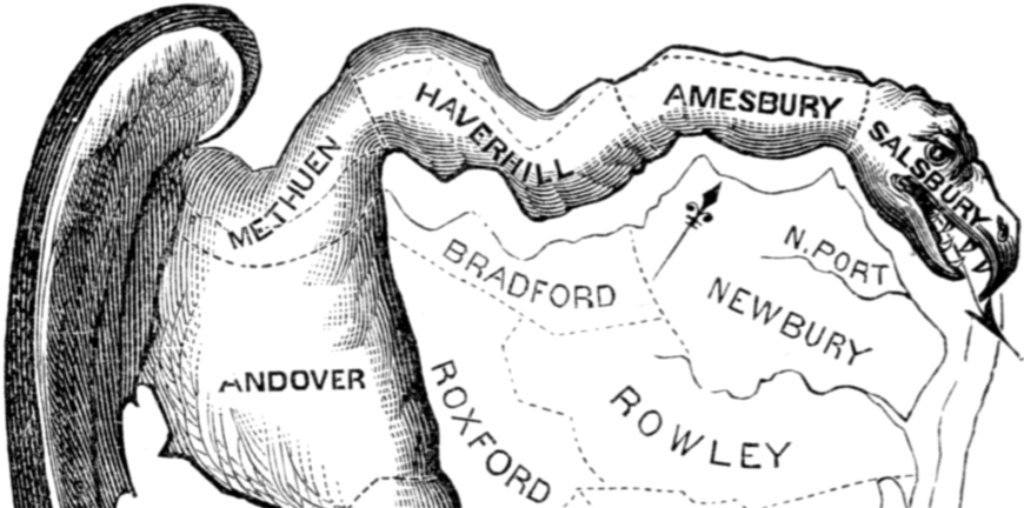
WaPo (“Supreme Court limits key provision of the landmark Voting Rights Act“):
The Supreme Court on Wednesday sharply weakened a key provision of the landmark Voting Rights Act, a ruling that limits the consideration of race in drawing voting maps and could usher in Republican gains in the House.
The decision is expected to touch off a scramble by Republicans to redraw majority-minority districts, especially in the South. New districts could shift the balance of power in Congress by imperiling the reelection prospects of some Black Democrats, possibly as soon as November’s midterms in some instances. Minority representatives in state legislatures and local offices could also be redistricted out.
The court’s conservative majority found Louisiana unlawfully discriminated by race when it created a second majority-Black congressional district to comply with the VRA. But the court did not strike down the provision, known as Section 2, as unconstitutional as many voting rights advocates had feared. Still, the court’s liberal justices and voting rights experts said it was effectively gutted.
The ruling carries significant symbolic weight, scaling back the last major pillar of a 60-year-old law long considered one of the marquee achievements of the civil rights era. The Voting Rights Act bans discriminatory voting practices such as literacy tests and poll taxes, and has helped greatly increase minority representation in state and federal offices.
In an ideologically divided 6-3 ruling, the conservative justices created a higher bar for the law’s powerful provision that allows states to use race to draw maps that help minority communities elect candidates of their choice. Section 2 is aimed at combating discriminatory gerrymandering that weakens the power of Black, Latino, Native American and Asian voters.
SCOTUSblog’s Amy Howe (“In major Voting Rights Act case, Supreme Court strikes down redistricting map challenged as racially discriminatory“):
The Supreme Court on Wednesday, in the case of Louisiana v. Callais, struck down a Louisiana congressional map that a group of voters who describe themselves as “non-African American” had challenged as the product of unconstitutional racial gerrymandering. By a vote of 6-3, the justices left in place a ruling by a federal court that barred the state from using the map, which had created a second majority-Black district, in future elections. Although Wednesday’s ruling did not strike down a key provision of the federal Voting Rights Act, as Louisiana and the challengers had asked the court to do, Justice Elena Kagan suggested in her dissent (which was joined by Justices Sonia Sotomayor and Ketanji Brown Jackson) that the majority opinion by Justice Samuel Alito had rendered the provision “all but a dead letter.”
The decision was the latest, and presumably final, chapter in a long-running dispute arising from Louisiana’s efforts to adopt a new congressional map in the wake of the 2020 census. The first map that the state adopted, in 2022, had one majority-Black district out of the six allotted to the state. A group of Black voters – who comprise roughly one-third of the state’s population – went to federal court, where they alleged that the map violated Section 2 of the VRA, which prohibits discrimination in voting.
A federal judge agreed that the 2022 map likely violated Section 2, and the U.S. Court of Appeals for the 5th Circuit upheld that ruling. It instructed Louisiana to draw a new map by January 2024 or risk having the court adopt one for it.
The map that Louisiana drew in 2024 created a second majority-Black district, leading to the election in November of that year of Cleo Fields, a former member of Congress who had represented another majority-Black district during the 1990s.
The map also prompted the lawsuit leading to Wednesday’s opinion. It was filed by a group of “non-African American” voters who contended that the 2024 map violated the Constitution’s equal protection clause by sorting voters based on race. A three-judge federal district court agreed with them and barred the state from using the 2024 map in future elections, but a divided Supreme Court temporarily paused that ruling in May 2024.
[…]
In a 36-page opinion, Alito explained that “the Constitution almost never permits the Federal Government or a State to discriminate on the basis of race.” The question before the court, he said, is “whether compliance with the Voting Rights Act should be added to our very short list of compelling interests that can justify racial discrimination.”
As a general rule, Alito wrote, Section 2 of the VRA guarantees voters, including minority voters, an opportunity to cast a vote for their preferred candidate, but that candidate’s chances of success may be affected by the choices that the state is allowed to make when drawing a redistricting map – such as the desire to protect incumbents or increase the number of seats held by a particular political party. And under the Constitution, Alito continued, a violation of Section 2 only occurs when “the circumstances give rise to a strong inference that intentional discrimination occurred” – for example, when there are several possible maps that contain majority-minority districts, but the state “cannot provide a legitimate reason for rejecting all those maps.”
Slate‘s Richard L. Hasen proclaims, “The Supreme Court’s Conservatives Just Issued the Worst Ruling in a Century.”
Wednesday’s 6–3 party-line decision in Louisiana v. Callais will go down in history as one of the most pernicious and damaging Supreme Court decisions of the last century. All six Republican-appointed justices on the court signed onto Justice Samuel Alito’s opinion gutting what remained of the Voting Rights Act protections for minority voters, while pretending they were merely making technical tweaks to the act.
This decision will bleach the halls of Congress, state legislatures, and local bodies like city councils, by ending the protections of Section 2 of the act, which had provided a pathway to assure that voters of color would have some rudimentary fair representation. It’s the culmination of the life’s work of Chief Justice John Roberts and Samuel Alito, who have shown persistent resistance to the idea of the United States as a multiracial democracy, and a brazen willingness to reject Congress’ judgment that fair representation for minority voters sometimes requires race-conscious legislation. It gives the green light to further partisan gerrymandering. It protects Alito’s core constituency: aggrieved white Republican voters. It’s a disaster for American democracy.
The Atlantic‘s Adam Serwer contends “Voters Can Be Disenfranchised Now.”
The decision purports to uphold Section 2 of the Voting Rights Act, which prohibits racial discrimination in voting, but effectively nullifies it, ruling that a Louisiana redistricting map that created two majority-Black districts out of six, in a state whose population is one-third Black, was an “unconstitutional racial gerrymander.” The majority opinion uses procedural language to obscure what its rewriting of the VRA will allow lawmakers to do: engage in racial discrimination in drawing political districts as long as they say they are doing so for a partisan purpose rather than a racist one—as if the results would not be identical.
In states with large Black populations that remain under Republican control—half of the Black American population resides in the South—lawmakers will now be able to draw districts that dilute Black residents’ voting power. In his opinion for the right-wing majority, Justice Samuel Alito wrote that “in considering the constitutionality of a districting scheme, courts must treat partisan advantage like any other race-neutral aim: a constitutionally permissible criterion that States may rely on as desired.”
[…]
[W]hat the Roberts Court is making possible, is a country where white people can maintain their political dominance at the expense of Americans who are not white. The anticaste provisions of the Reconstruction amendments, intended by their authors to reverse the “horrid blasphemy” that America was a white man’s country, are being inverted to defend that dominance. This is not the color-blindness of Martin Luther King Jr., but what the scholar Ian Haney López has called “reactionary colorblindness,” the purpose of which is to maintain racial hierarchy through superficially neutral means. It takes the view that the Constitution’s “color-blindness” renders any attempt to remedy anti-Black racism unconstitutional, because by definition that would involve making racial distinctions. Similarly, the ruling in this case does not explicitly overturn the VRA’s ban on racial discrimination in voting so much as rewrite it to allow such discrimination.
I shared my thoughts on this seemingly inevitable ruling in my October post, “End of the Voting Rights Act?“
Given that we’ve been essentially a 50-50 nation the last decade-plus, stacking the deck to make it nearly impossible for Democrats to win is obviously wildly undemocratic. But Section 2 has been living on borrowed time for decades, with conservative and even moderate Justices being skeptical of race-conscious remedies going back at least as far as the Bakke decision in 1978. Case after case since then, at least as recently as 2023’s Students v Harvard, have held that the Equal Protection Clause prohibits race-based discrimination, even if intended to remedy the ongoing effects of past discrimination.
The creation of “majority minority” districts, first done during the 1990 redistricting cycle, always struck me as problematic. I so happened to move to Alabama’s newly created 7th Congressional District to start graduate school in 1992. It was created by connecting the Blackest parts of Tuscaloosa with the Blackest parts of Birmingham, which was just bizarre. But it had the desired impact of essentially guaranteeing Alabama would have a Black Congressman for the first time since the Reconstruction era. It also had the probably unintended consequence of “bleaching” the other six districts, virtually guaranteeing they would be represented not only by White Congressmen but by White Republicans.
Regardless, assuming the ruling goes as predicted and Section 2 is either ruled unconstitutional or significantly neutered, it will remove the last remaining barrier to hyper-gerrymandering.
Unlike the commenters quoted above, I actually see the specific ruling here as incredibly modest. The damage was done years ago when the Supreme Court ruled, probably correctly from a textualist standpoint, that the Constitution does not prohibit partisan gerrymandering. This simply officially removes a barrier that no longer existed in practice. So long as the gerrymandering is done to advantage Republicans rather than to disadvantage Black and Hispanic voters, it’s constitutionally fine.
On this morning’s episode of The Daily, “A Landmark Ruling on Civil Rights,” guests Adam Liptak and Nick Corasaniti predicted that this would supercharge the already ongoing race to gerrymander Congressional districts. But that process is already feeding itself, with states like California and Virginia abandoning nonpartisan districting commissions to gain partisan advantage (granted, in response to efforts by Republican-dominated states to do the same). But, given the overwhelming advantage Democrats have with Black voters, they’ll have a harder time using this ruling to their advantage.

I am still digesting this, but I am going to push back on the notion that this is going to have a modest effect. While I agree the ruling about partisan gerrymandering was huge, what this ruling does is take away the only current bulwark against noting but partisan gerrymandering as the core of our maps, to include state legislatures and other bodies.
The effects on Black representation are also significant.
Nothing stops GOP states in the South in particular from using technology to maximize their advantage at all levels of government and effectively silence most of the opposition.
Put simply: there are now zero guardrails on the most egregious partisan gerrymanders a computer can dream of.
More later from me, I expect.
The long-term effect is already in place; this verdict is just an outcome of it. Serwer calls it ‘reactionary colorblindness’ but it’s also just total small-time incuriosity as an operating ideology.
For example, I know someone whose boyfriend is in the military. He’s black, and the order to be clean-shaven is being understood as an attack because shaving every day can suck for black people. In a normal world, the reasons for this are well-stated and no one should be forced to be clean-shaven. In the GOP’s world, this is crazy; this doesn’t make sense to a white person who has never listened to a black person.
No one has ever really attempted to govern themselves into total mental regression. But white people in the GOP really want that. Not only do they find it strange that there’s need to create a majority black district in the south, but they’re dim about everything that isn’t exactly congruent to their experience in life.
The ruling is apace with Roberts’ previous neutering of the VRA in that it assumes (1) the days of racial discrimination are over, and (2) that redistricting by state legislatures will be done in good faith. I don’t know how Roberts, Alito and Uncle Clarence can keep a straight face.
Oh was textualism the excuse du jour that time? Makes sense, as their made-up “originalism” and activist “history and traditions” tests wouldn’t work to fit their partisan goals that day: it’s obvious that politicians picking their voters not vice versa is an affront to democracy, to precedent, and not what the Constitution intended.
Must be nice being a rightwing jurist, lying to yourself and the public that you’re an objective interlocutor, innocently and dispassionately calling balls and strikes. All while reaching into a grab-bag of fake, phony, invented rationales to serve Republican goals as needed: textualist one day, originalist intent the next, “history and traditions” the third, “major questions doctrine” by Friday, shredding precedent by the weekend, then back to being a warrior for “super-precedent” on Monday.
Roberts, Gorsuch, Barrett, Alito, and Kavanaugh, and especially Thomas are full of shit. If like liberal judges, conservatives believe in a “living Constitution” and outcome-oriented judicial activism — and they absolutely do — then the right should just cut the phony objectiver-than-thou crap and admit it.
@Charley in Cleveland: They can keep a straight face because they’re doing what they were installed to do: help Republicans. Roberts is a known fraud. His bad faith arguments you mention are a fig leaf for his MAGA partisanship. If blacks were still largely Republican voters, he and the other Federalist Society shills would’ve upheld the VRA as is.
There will be a decline in black representation in the South. But the national effect is likely a wash, as in response more blue states will a) pull back from independent redistricting and fair maps, and b) start moving some black/Latino/urban neighborhoods into historically Republican districts.
So I’m not worried about the effect on overall partisan balance. But drawing districts to maximize factionalism hinders good governance, as our current legislative impotence shows. Despite total control, House Republicans are in legislative shambles — partially because there extreme partisan districts have put too make instransigent extremists in their conference. Such people would be unelectable in sanely drawn districts.
This gerrymandering race is much more of a dog-that-caught-the-car self-own for Republicans than for Democrats, because Democratic proposals are actually popular. What is the use of a majority that can’t pass anything because their agenda is too unpopular and their electeds too psychotic?
It’s kin to why Senate Republicans are hellbent on keeping the filibuster. They’d rather hide behind the filibuster than explain to their dumb, gullible base why passage of rightwing wishlist would destroy the country and the Republican Party.
The Supreme Court picks its cases for the Fall Term (beginning in October) in late June/July. No one can convince me that they don’t already know how they are going to vote on those cases. They are not sitting around saying, “Gee, that is an interesting question, let’s pick this and cogitate on it for a while”.
This has been the kabuki dance for awhile but I think that belief has ended.
@Charley in Cleveland:
Practice. Constant practice.
American Revolution: No taxation without representation.
Tacoland Revolution: No taxation for those with effective representation.
French Revolution: let them eat cake.
Tacoland Revolution: Let them watch the oligarchs eat their cake.
I don’t think this is about partisanship per se — they’re just not interested in a multiracial democracy.
The sickness in American society is evident in the fact political parties have been given the green light to gerrymander districts to their hearts’ content, and most Americans have reacted with passive acceptance. Representative democracy has become a farce but there’s no popular grass roots move to restore it. On the contrary, the minority of politically engaged Americans are fixated on getting into power so they can focus on ways to keep it.
@Ken_L:
That’s one part of the problem.
The other is the enormity of what’s needed to reform the US constitution, so it becomes a more democratic, more representative document.
Just to undo the latest fixer court fix, would require a constitutional amendment. I don’t think one can be passed, even coupled with an end to partisan gerrymandering (or especially if coupled with it). The same goes for other things which would need the iron-clad protection only and amendment can give, like abortion, equal rights for all, etc.
And unless the midterms produce a veto-proof Democratic majority, little at all can be done in the next two years.
But, you miss all the shots you don’t take. And it’s better to try and lose than to give up in advance.