Iran War Ceasefire Over in All But Name
Now what?
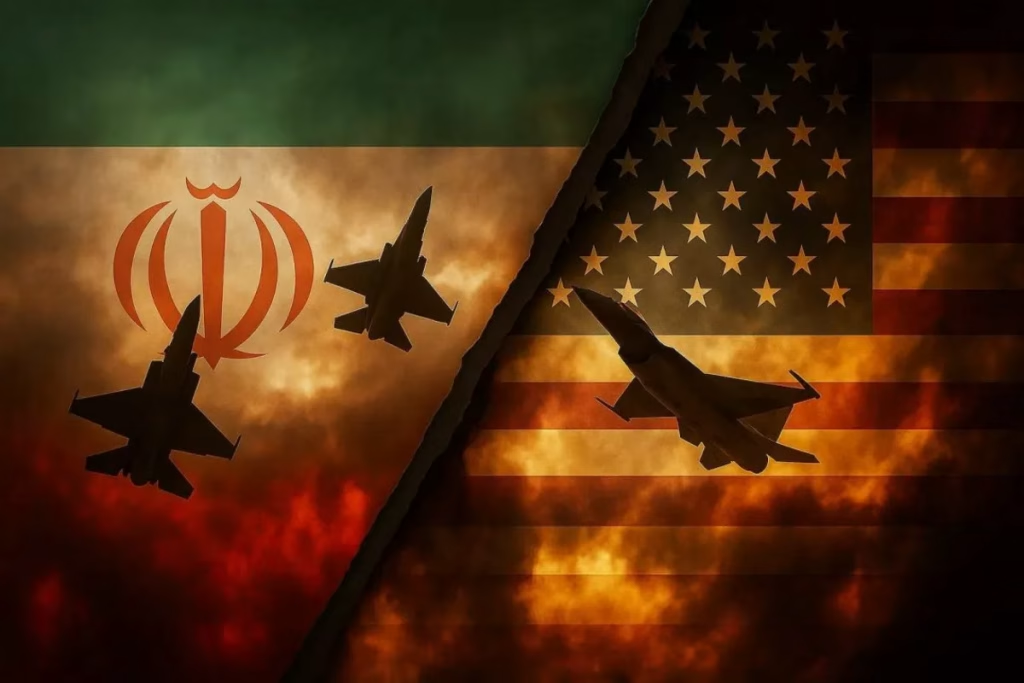
WaPo (“Attacks in Strait of Hormuz, Gulf region imperil fragile U.S.-Iran ceasefire“):
A sharp escalation in attacks in the Strait of Hormuz and the Persian Gulf is threatening the shaky ceasefire between Iran and the United States as the two sides struggle to make progress in talks on a lasting end to the war.
Iran accused the U.S. of ceasefire violations and issued new warnings Tuesday after two U.S. destroyers, closely followed by two merchant vessels, came under attack Monday morning during successful transits of the strait, in an expansion of U.S. operations in the waterway.The United Arab Emirates reported an Iranian assault on an energy hub that caused a fire. And Oman’s state media reported an attack in the country but did not identify a perpetrator.
Iran fired cruise missiles and drones at the U.S. naval and commercial vessels but did not land any hits, said Adm. Brad Cooper, head of U.S. Central Command. Iran also sent six fast boats after the commercial ships, he said, but U.S. forces fired on and destroyed the vessels. He would not say whether the exchange of strikes meant the ceasefire was over.
In a separate incident, President Donald Trump said Iran hit a South Korean tanker in the strait. “Perhaps it’s time for South Korea to come and join the mission!” Trump wrote in a Truth Social post Monday. South Korean officials met Tuesday to discuss their response to the incident, according to Yonhap, South Korea’s state news agency.
Iranian officials issued new warnings following the flare-up in hostilities. Parliamentary Speaker Mohammad Bagher Ghalibaf accused the U.S. of ceasefire violations, saying “we know full well that the continuation of the status quo is intolerable for America; while we have not even begun yet,” in a post on X.
Foreign Minister Abbas Araghchi said events in the strait “make clear that there’s no military solution to a political crisis” in a separate statement. “The U.S. should be wary of being dragged back into quagmire by ill-wishers,” he said, adding: “Project Freedom is Project Deadlock.”
Earlier, the head of the Islamic Revolutionary Guard Corps, the predominant branch of the Iranian armed forces, warned any U.S. vessels in the strait would be considered “a legitimate target.”
“The Strait of Hormuz will not be opened by the tweet of the President of the United States; the management and control of this waterway is in the hands of Iran,” Ahmad Vahidi said in a post on X.
Iranian officials said over the weekend that U.S. attempts to “interfere” with Tehran’s “management” of the strait would qualify as a ceasefire violation.
The ceasefire is over in all but name. Iran is firing at our ships and we’re sinking theirs.
BBC security correspondent Frank Gardner states the obvious: “It would not take much for the situation to escalate further.”
As the US-Iran ceasefire teeters on the brink of collapse, residents in the Gulf are now wondering if a full-scale resumption of hostilities is inevitable and if so, what form it will take.
With the US attempting to break the blockade that Iran has imposed on the Strait of Hormuz and with Iran lashing out at both shipping and onshore targets in the UAE it would not take much for the situation to escalate further.
Iran retains a large number of its missiles and drones, including some reportedly dug up from where they were buried to evade airstrikes in March.
The IRGC Navy is also thought to possess powerful anti-ship missiles which pose a serious threat to any US Navy warship escorting merchant vessels past Iran’s coastline.
President Trump has threatened dire retaliation if a US warship is hit.
This all reinforces the fact that it will be extremely difficult, if not impossible, to prise open the Strait of Hormuz by force.
While a ceasefire with a guarantee that the Strait returns to its prewar state would seem to be the best deal in the offing for either party, neither side seems willing to take that deal. A prolonged ceasefire with American sailors and Marines seems rather clearly to Iran’s advantage, as it degrades US combat power and gives them time to regroup and reconstitute.
I haven’t the foggiest what comes next. We seem to be about out of useful military targets to hit from the relative safety of the air and sea. And we clearly have no desire to launch a ground invasion.

This must be fake news. Both Trump and Hegseth said we have destroyed their military capabilities saying they were “totally defeated” and “we own the skies (except maybe the part that missiles fly through).
Steve
I see this project as more of an evacuation of large U.S. flagged commercial ships than the breaking of a blockade. Two have been successfully evacuated, and a few more may follow using a route shown to be relatively mine free along the coast of Oman.
There are about 900 other large ships stuck in the Gulf, as well as the issue of when ships will be able to enter the Gulf without payment to and/or permission from Iran.
The question no one seems to be asking:
With all the wealth and military assets the UAE, Saudi Arabia, Kuwait, Oman have, why does the US believe that it has to expend its treasure and risk its people in this region?
US military accompanies commercial carrier through Strait of Hormuz
U.S. deploying ‘umbrella’ of defense and tech assets to shield ships in the Strait of Hormuz
Cost:Benefit. I wonder that may be.
@Scott:
I wonder how they talked Maersk into risking a ship.
@Scott: At 2 or 3 ships per day the cost per ship will be huge. Traffic is normally over 120 per day IIRC.
Steve
The zombie Iranian military – “obliterated,” “totally defeated,” “they want a deal so bad,” sure is a thorn in the side of our Imbecile In Chief who would rather focus on the ballroom, the arch, and continuing the grift. I didn’t think it would be possible for a president to make a bigger foreign policy blunder than Bush had with his idiotic invasion of Iraq, but Trump has done it. He started his assault on the world economy with his (illegal) tariffs, and iced the cake with his (illegal) war on Iran. Hell of job, Trumpie!
ETA – As was the case with the pandemic, Trump simply cannot resist going in front of the cameras every day and offering his ignorant and preposterous thoughts.
900 ships currently trapped. About 66 days of Iranian, then Iranian+US blockades, which have reduced the usual Hormuz 100-150 ship a day traffic by north of 7,000 ships so far. Minus the two ships the Navy busted out.
Now, I’m no math whiz. . .