A Summit About Nothing
Winging it is seldom a sound diplomatic strategy.
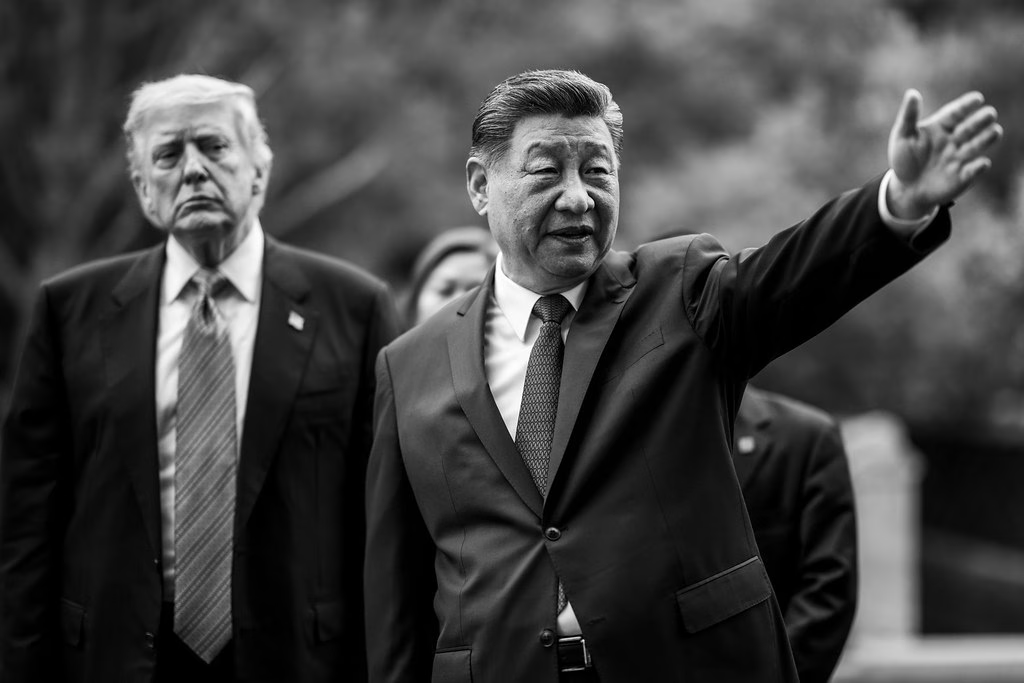
NYT (“Trump Calls Xi a ‘Friend.’ But He Left China Without Any Breakthroughs.”):
There was a vague agreement that China would purchase Boeing jets and more American soybeans. There was discussion about Iran and opening the Strait of Hormuz, and a nod to other issues, like cracking down on chemicals used to make fentanyl.
But President Trump departed Beijing on Friday with almost nothing concrete to show for his two-day summit with President Xi Jinping of China. After months of buildup and a delay necessitated by Mr. Trump’s difficulty in extricating the United States from the war with Iran, the summit ended with no major public progress on the Middle East, trade, Taiwan, nuclear proliferation, artificial intelligence or any of the other myriad issues that are sources of friction between the world’s two superpowers.
Instead, Mr. Trump seemed intent on a different kind of diplomacy, forging a personal bond with a Chinese leader who appeared far more focused on advancing his own nation’s strategic agenda.
Mr. Trump toasted Mr. Xi as “my friend” at their banquet in Beijing on Thursday and said he had “become really a friend” when they sat down before the cameras on Friday.
A Chinese Foreign Ministry spokesman, asked at a briefing during the summit whether Mr. Xi considered Mr. Trump a friend, responded with boilerplate: “the two sides exchanged views on major issues.”
Mr. Trump has hailed the summit in Beijing as a major success, highlighting the personal bond he says he has built with China’s longtime leader. But the feeling is not necessarily mutual, as evidenced by Mr. Xi’s more measured tone and the lack of clarity about any major agreements.
Orville Schell, vice president of the Center on U.S.-China Relations at the Asia Society in New York, called the summit “quite insubstantial and aspirational.”
“We have Trump dreaming out loud,” he said.
The mismatch shows the risks in Mr. Trump’s personality-driven foreign policy, his bet that he can solve the world’s problems and defend American interests by his charm and force of will. In Mr. Xi, the U.S. president faced a counterpart this week well versed in Mr. Trump’s desire for praise and pomp, and with an apparent strategy for how to exploit it.
The result, analysts said, was a summit that illustrated the growing confidence of China on the world stage alongside a strategically muddled U.S. foreign policy under Mr. Trump.
WaPo (“Trump’s China summit shows toll of a difficult year for the president“):
President Donald Trump was riding the early high of his return to power last year when he took his first major foreign trip and declared that he would make a sharp break from years of U.S. nation-building around the world.
Exactly one year after that visit to Saudi Arabia, Qatar and the United Arab Emirates, he came to China at a very different moment in his presidency, with inflation spiraling and no easy way out of a conflict with Iran. The fight has ensnared the U.S. military, driving energy prices up and Trump’s approval rating down.
This time, there were no sweeping declarations about how Trump’s America would manage the world, nor backslapping bonhomie shared with Gulf royals who offered golden swords and honor guards riding Arabian steeds.
Instead, there was Chinese President Xi Jinping, respectful but businesslike, welcoming but appearing to bend little on the U.S. leader’s priorities.
Trump came to Beijing hoping to do trade deals. Xi made it known that Taiwan’s fate, not investment, was China’s top priority — yanking the spotlight from Trump’s preferred focus to warn of “clashes and even conflicts” with the United States should disagreements over the disputed island be mismanaged.
Trump left on Friday with a promise of a Xi trip to the White House in September and trade deals that were mostly a disappointment, at least as measured by the 8 percent drop in Boeing’s stock price between Trump’s arrival in Beijing and his departure. The president declared delight that the trip made it possible for top U.S. business executives to meet the Chinese leader, but offered little evidence of transactions that resulted.
WaPo (“Xi, in summit victory, projected stability and conceded nothing to Trump“):
For Chinese leader Xi Jinping, the 43 hours that President Donald Trump was in Beijing was plenty of time to score diplomatic points while conceding nothing to his U.S. rival.
There were no major breakthroughs and few agreements, but there weren’t any blunders, and the frictionless summit brought China closer to a more stable footing in its most important — and often volatile — bilateral relationship.
That, it seems, was precisely Xi’s objective.
“China’s primary goal,” said Yun Sun, director of the China Program at the Washington-based Stimson Center, “is to aim for stability of the relationship: ‘Please don’t bother us. Please don’t harass us. … And let’s find some rules of engagement that will allow us to proceed in relative peace and relative stability.’”
[…]
The absence of tangible outcomes also has risk, leaving plenty of issues unresolved, particularly on trade. Without concrete agreements, experts said, it’s unclear what exactly is stabilizing the relationship.
But Xi also succeeded in presenting himself as a leader at the height of his power, one who did not need to boast of being part of what Trump called the “G2″ because he still has friends and allies that he has no interest in offending, unlike Trump who makes no secret of the view that his America needs no one.
While Trump returned to Washington to grapple with his stalled war against Iran, falling poll numbers and rising inflation, Xi will now turn his focus to another big meeting, with Russia’s Vladimir Putin visiting Beijing this week.
China and Russia, longtime partners in the U.N. Security Council against Western hegemony, have emphasized in recent years their cooperation in constructing a multipolar alternative to the U.S.-led global order.
The United States, while still able to flex military muscle abroad, has lost sway as Trump has alienated traditional allies in Europe and cut off foreign aid and other assistance long relied on by many nations in Asia, Africa and Latin America.
Trump brought an entourage of CEOs to Beijing, but they left without announcing any major deals, creating an impression — reinforced by the president who boasted of introducing them to Xi — that the titans of American industry traveled around the world just for the privilege of shaking his hand.
TMR editor Michael Tomasky is unsparing: “How Do We Know the China Summit Was a Failure? Because Trump Did It.”
Donald Trump says China agreed to buy 200 jets from Boeing. He crowed about it on Fox News Thursday night. But funny thing: A spokesman for China’s Ministry of Foreign Affairs was asked specifically about the jet deal after Trump spoke, and he said nothing about any such agreement. Wanna take bets on whether it actually happened?
Three points here. First of all, we should stop quickly to note that it’s sad that it’s come to pass that we just automatically believe a foreign government—and China’s no less—over the president of the United States (sad about him, that is, not us). Second, let’s remember that Boeing is an American company in a deep and sustained crisis that was brought on by basic greed: As David Goldstein explained in Democracy journal in 2024, after its acquisition of McDonnell-Douglas in 1997, the historically proud engineering culture at Boeing was destroyed as the company became more anti-union and outsourced more of its production.
And third, assuming that Trump is lying or at least exaggerating, well, we’ve just learned again for the jillionth time that Mr. Art of the Deal is a total fraud.
[…]
Trump can fool himself, if he wants to, that Xi Jinping was talking about the Biden years when he referred to America’s decline and the suddenly famous “Thucydides Trap.” But everyone knows the truth. He was talking about the United States in general, under both parties—a country that is by now pretty much owned lock, stock, and barrel by a handful of greedy Robber Barons whom the GOP worships and the Democrats haven’t had the stones to stop.
And he was talking about the United States under Trump specifically. Xi may be a ruthlessly immoral tyrant. But one thing he isn’t is dumb. He sees very clearly what the United States is doing to itself, having reelected a low-I.Q. kleptocrat, adjudicated sex offender, and psychologically damaged sociopath who spends the wee hours firing off batshit tweets and obsessing about a ballroom the way the Sun King did over Versailles. That man, not Joe Biden, is why China now tops the United States in global approval ratings.
The United States always led China in those kinds of polls because at the end of the day we could say well, at least we’re a democracy. The way things are going, we’re not even going to be able to say that soon. But hey, he’s a great dealmaker, right?
The Atlantic‘s Franklin Foer is only somewhat kinder (“Xi Jinping Was Only Humoring Trump“):
Spare a moment, please, for the lame-duck superpower. It calls itself the leader of the free world, but the free world no longer believes it. When it extends its hand, nobody rushes to accept. When it threatens, nobody trembles.
After President Trump arrived in Beijing this week, Xi Jinping showered him with pomp befitting a summit of great powers. Yet the Chinese leader permitted potshots at his guest to go viral on his country’s internet rather than suppressing them, as some observers expected he would during a state visit. Xi answered Trump’s lavish praise by sternly lecturing him about meddling with Taiwan. In the end, Xi offered nothing of great substance—no solutions to the war in Iran, no sweeping trade deals, no promises of access to rare earth minerals. Xi used the visit to humor the lame-duck president, waiting for his time to pass.
During the first Trump administration, foreign leaders flattered and accommodated the president out of deference to American power. They feared it; they relied on it. During the second administration, and especially since the beginning of the Iran war, their calculus has quietly shifted—not because the strategy of obsequiousness has failed, but because it’s no longer worth the trouble. Like many of his counterparts around the world, Xi has begun to assume that it’s not just Trump who is term-limited; it’s also his nation.
Trump’s war in Iran was meant to showcase American power. It did the opposite. In the course of failing to remove a much weaker regime or eliminate its nuclear threat, the United States blew through its arsenal—so much so that allies in the Pacific reasonably wonder whether enough munitions remain to protect them. According to The Wall Street Journal, the Pentagon is now worried that it lacks the firepower to execute contingency plans for defending Taiwan.
Supporters of the war argued that it would deal China a severe blow by eliminating one of its most potent allies. But the Gulf nations most threatened by Iran have actually turned to China. As first reported by The Washington Post, an intelligence assessment prepared for the chair of the Joint Chiefs of Staff warned that those countries have begun acquiring from Beijing the systems needed to protect their oil infrastructure and bases. Trump didn’t just fail to weaken China’s position in the Middle East. He strengthened it.
Without exerting itself much, Beijing has profited from America’s self-immolation. China’s petroleum reserves and its investments in renewable energy have allowed it to offer Thailand, the Philippines, and Australia relief from the energy crisis that the United States instigated. Instead of applying diplomatic pressure on Iran to cut a deal, China has let the conflict linger, so that the United States continues to bear the blame for the disruptions to shipping. Meanwhile, China poses as the faithful steward of the rules-based order—the cooler head, the power on which even the U.S. must now rely.
By patiently waiting out this moment, by letting the United States exhaust itself, China has bought time to pursue what Xi calls “national self-reliance”—time to catch up with the West technologically and to fortify itself for the point when competition takes a harsher turn.
Then-Senator Barack Obama rightly came under fire during the 2008 campaign for his repeated declaration that he would negotiate with the Iranian regime “without preconditions” in order to revive diplomatic relations and reach a deal on nuclear proliferation. While dialogue among world leaders is useful in and of itself, there is a longstanding understanding that U.S. Presidents do not travel to summit meetings, lending their prestige to foreign dictators, without significant concessions having been negotiated ahead of time by professional diplomats.
While Obama never backed off his position rhetorically—lest he be accused of flip-flopping—he in fact adhered to that tradition. While he had his flaws as President, an unwillingness to learn from those with more experience was not among them.
It’s possible that more was accomplished at this summit than meets the eye. But it certainly looks at this juncture that Xi came out positioned as the stronger leader. The President of the United States came to court him, along with an entourage of senior U.S. officials and businessmen, with very little to show for it.
Beyond that, the notion that the two men could be “friends” while the two countries are engaged in a level of adversarial competition not seen since the Cold War is rather strange. The Trump 45 administration rightly declared winning the strategic competition with China the top national security priority of the United States. It saw an adversary seeking to “shape a world antithetical to U.S. values and interests. China seeks to displace the United States in the Indo-Pacific region, expand the reaches of its state-driven economic model, and reorder the region in its favor.” If anything, that has become more plain in the decade since. That is the opposite of friendly.

Far too kind, really. This summit was an unmitigated disaster.
One other headline: Trump noncommittal to continued Taiwan arms sales after meeting with Xi
So what did we learn?
a) The US might not stand by Taiwan – in itself a major win for Xi
b) More generally speaking, the US is (at best) a very unreliable ally, which brings us closer to a multipolar world – another major win for Xi (and Putin)
And in exchange for demonstrating this for the whole world to see, the US got absolutely nothing (except humiliation, of course).
Art of the deal, baby.
James Joyner is nothing if not a master of measured understatement.
Newsweek:
A paedo president, on break from bootlicking Putin and losing an economy-killing Iran war prosecuted for his Saudi and Israeli masters, surrendered his base to China — without a shot fired. Xi came out like the cat that’s been licking the cream.
Most Republican primary voters are a lost cause, happily skinning their faces to feed leopards. But maybe right-leaning indies have yet had enough of betrayal, incompetence, and failure. Stay tuned.
The Dept of Commerce gave permission for ten Chinese companies to buy Nvidia’s H200 chip, the next to top of the line product and a generation more advanced than what they were allowed to purchase before. The H200 is intended for data centers doing AI and other high-performance GPU work; they cost ~$32,000 each. All H200s are manufactured by TSMC in their Taiwan fabs. One possible interpretation of this is it gives China an incentive to make sure nothing “accidentally” happens to those fabs. Another possibility is that Trump is getting a kickback somehow.