Tulsi Gabbard Out as Director of National Intelligence
Another one bites the dust.
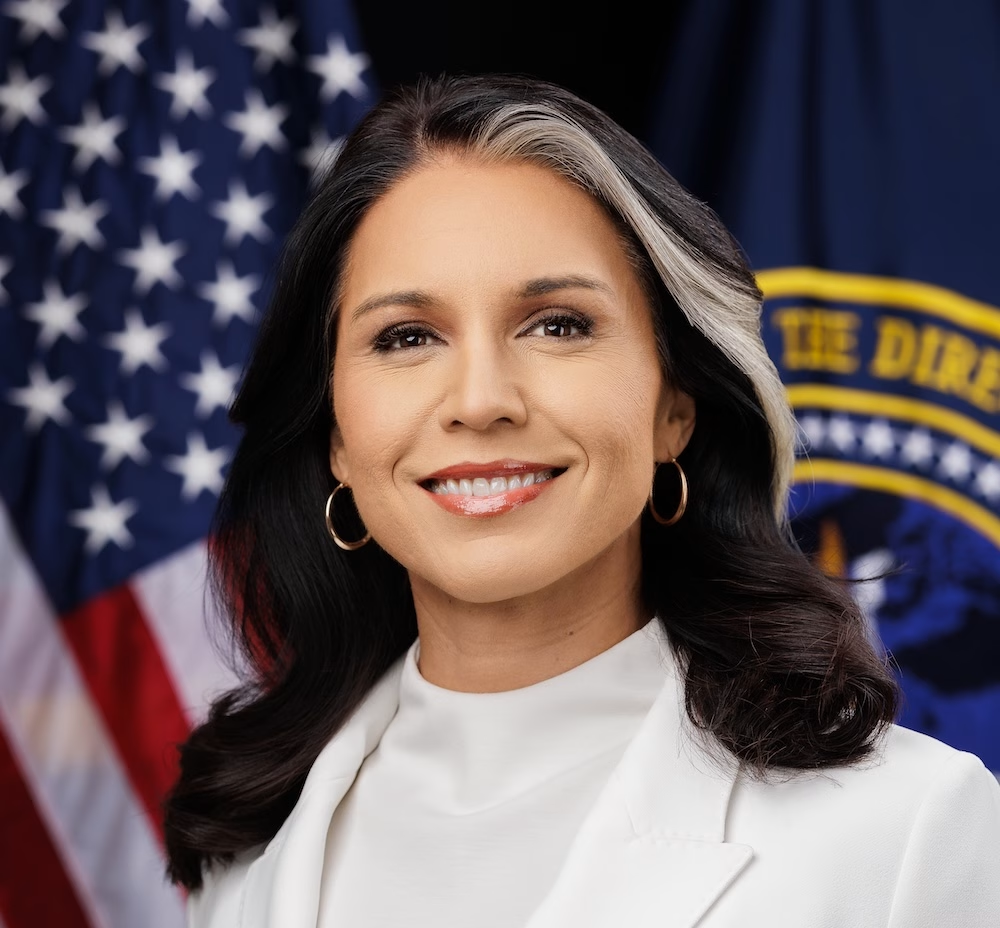
NYT (“Tulsi Gabbard Resigns as Director of National Intelligence“):
Tulsi Gabbard, the director of national intelligence and an advocate of a more restrained foreign policy, submitted a letter of resignation to President Trump on Friday, saying that she was stepping away to support her husband after he recently was diagnosed with a rare form of bone cancer.
The departure will bring an end to Ms. Gabbard’s rocky tenure overseeing the 18 U.S. intelligence agencies, during which she had been largely sidelined by the White House on significant national-security issues, including military operations in Iran and Venezuela.
Mr. Trump assembled a second administration last year with an unusual mix of foreign-policy hawks in one corner and critics of American entanglements overseas like Ms. Gabbard in the other. But Ms. Gabbard and her wing found themselves increasingly marginalized in recent months, and her departure marks the most significant exit yet from the coalition of restrainers.
In her letter Friday, Ms. Gabbard, 45, said she would remain in her post as the nation’s intelligence chief until June 30.
“My husband, Abraham, has recently been diagnosed with an extremely rare form of bone cancer,” Ms. Gabbard said in her resignation letter, a copy of which was released by her office. “He faces major challenges in the coming weeks and months. At this time, I must step away from public service to be by his side and fully support him through this battle.” Ms. Gabbard has been married to Abraham Williams, a cinematographer, since 2015.
[…]
Mr. Trump did not force Ms. Gabbard to resign on Friday, according to people familiar with the matter, but her standing and influence within the White House had continued to erode in recent months.
In a post on Truth Social, Mr. Trump thanked her for her service in the administration. “Tulsi has done an incredible job, and we will miss her,” he wrote.
[…]
Ms. Gabbard had been a controversial figure in the Trump administration. She was seldom seen in the room when Mr. Trump made major national-security decisions and was widely viewed within the administration and by lawmakers in Congress as not a key member of the president’s team.
Her problems began soon after she was narrowly confirmed to the job last year following an especially contentious confirmation hearing. Several Republican senators joined Democrats in aggressively questioning her about some of her past views, including her defenses of the former intelligence contractor Edward Snowden and Bashar al-Assad, the former Syrian dictator.
As a fierce critic of the war in Iraq, Ms. Gabbard was closely aligned at times with Vice President JD Vance. But that put her out of step with Mr. Trump and many of his most influential advisers, including Secretary of State Marco Rubio and Stephen Miller, the White House deputy chief of staff, who pressed for an increasingly aggressive foreign policy in Latin America and Iran.
Reuters (“Gabbard resigns as Trump’s top US intelligence official“) contradicts the NYT report:
A source familiar with the matter said that Gabbard had been forced out by the White House. The White House did not respond to a request for comment, but Davis Ingle, a White House spokesperson, said on X that Gabbard was departing in light of her husband’s diagnosis.
Trump has hinted in the past at differences with Gabbard on their approach to Iran, saying in March that she was “softer” than him on curbing Tehran’s nuclear ambitions.
In April, several sources told Reuters that Gabbard could lose her role in a broader cabinet shakeup.
A senior White House official said then that Trump had expressed displeasure with Gabbard in recent months. Another source with direct knowledge of the matter said the president had asked allies for their thoughts on potential replacements for his intelligence chief.
[…]
Signs of tension with the White House appeared when Trump in June suggested she was wrong in assessing there was no evidence that Iran was building a nuclear weapon.
She has been absent from deliberations between Trump and his top national security advisers on major foreign policy issues, including the U.S. military operation that deposed former Venezuelan President Nicolas Maduro, the Iran war and Cuba.
She was pushed out by the White House,” the source familiar with Gabbard’s departure told Reuters. “The White House has been unhappy with her for quite some time.”
The person said among other reasons for the displeasure with Gabbard were the activities of her taskforce known as the Director’s Initiatives Group. The group has worked to declassify documents related to the death of former President John F. Kennedy, investigate the security of election machines and probe the origins of COVID-19.
Another source of friction, the person said, was Gabbard’s revocation last August of the security clearances of 37 current and former U.S. officials that exposed the name of an intelligence officer serving undercover overseas.
WaPo (“Tulsi Gabbard resigns as director of national intelligence“) is also reporting she was pushed:
A person familiar with the situation said that Williams’s diagnosis notwithstanding, Gabbard had been pressured to depart by White House officials increasingly unhappy with her actions, which had brought unwelcome publicity or diverted attention from Trump’s messages. The person, like some others interviewed, spoke on the condition of anonymity to discuss internal administration dynamics.
[…]
Gabbard, an Iraq War veteran who has long voiced opposition to U.S. intervention abroad, never seemed to click with the president or his top security advisers. She was not included among key decision-makers for critical meetings with Trump on military action against Iran or the raid that seized former Venezuelan President Nicolás Maduro.
An oft-repeated administration joke was that DNI, the abbreviation of her title, stood for “Do Not Invite.”
On other matters, she took actions highly unusual for the U.S. intelligence czar, a position that generally focuses on foreign threats. In at least two domestic instances — in Georgia and Puerto Rico — she and her office were involved in the seizure of voting material related to the 2020 presidential election, which Trump falsely claims he won.
For months, senior administration officials speculated about when Gabbard would depart, because of widespread frustration within the White House about how ODNI has been run under her leadership. Among the early frustrations was a messy declassification process surrounding files related to the assassination of President John F. Kennedy, which resulted in the dissemination of people’s private information including Social Security numbers, said a senior U.S. official.
Obviously, one wishes her husband all the best in his recovery from cancer. He’s only 37 years old.
Gabbard was rather in over her head as DNI. Most of her predecessors had been career diplomats or intelligence officers. Her main experience consisted of eight years as a House backbencher. She had no intelligence experience, but did sit on the Foreign Affairs and Armed Services Committees.
Most were skeptical of her appointment, with some going so far as to call it “clownish.” Her tenure didn’t disappoint. My favorite moment was her declaration before the Senate Intelligence Committee that, “It is not the Intelligence Community’s responsibility to determine what is and is not an imminent threat.”
It’s noteworthy as well that, a mere 16 months into the second Trump administration, an inordinate number of high-level officials have been fired, reassigned, or resigned. Gabbard joins Attorney General Pam Bondi, DHS Secretary Krist Noem, National Security Advisor Mike Walz, and Labor Secretary Lori Chavez-DeRemer at the cabinet level. And there have been many, many more in senior posts, including FDA Commissioner Marty Makary and Navy Secretary John Phelan.
