Airlines Managing Flight Delays. For Now.
Things will get radically worse if the shutdown doesn't end soon.
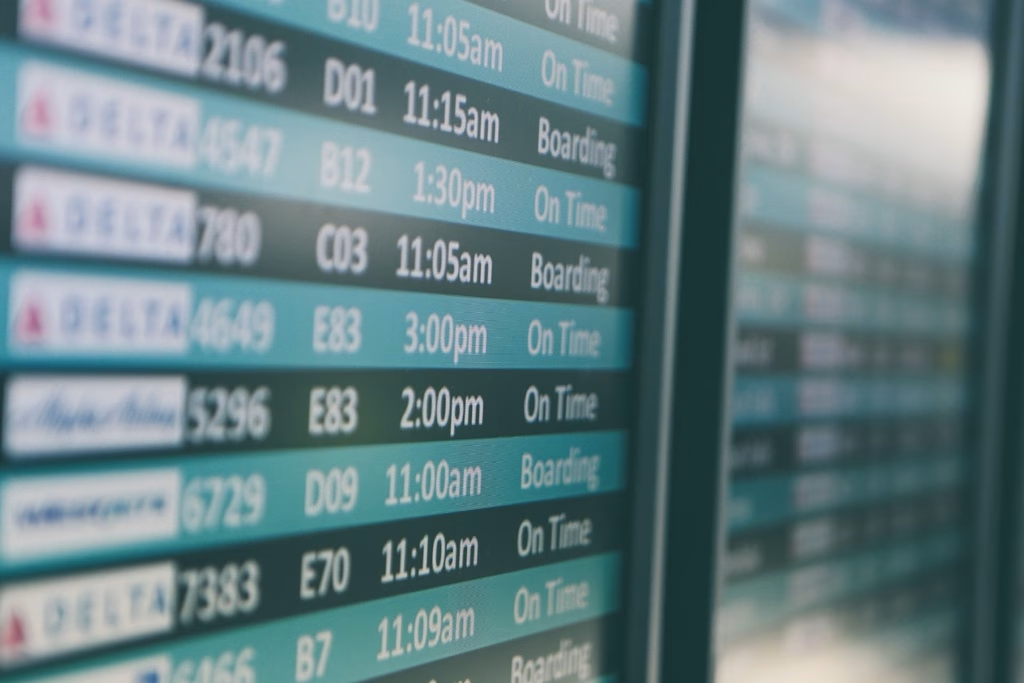
POLITICO (“US airlines cancel more than 1,000 flights for a second straight day largely due to shutdown“):
U.S. airlines again canceled more than 1,000 flights Saturday, the second day of the Federal Aviation Administration’s mandate to reduce air traffic because of the government shutdown.
So far, the slowdown at many of the nation’s busiest airports hasn’t caused widespread disruptions. But it has deepened the impact felt by the nation’s longest federal shutdown.
[…]
Analysts warn that the upheaval will intensify and spread far beyond air travel if cancellations keep growing and reach into Thanksgiving week.
[…]
Flight disruptions ticked up a bit on Saturday — typically a slow travel day — as each of the first two days creeped above 1,000 cancellations, according to FlightAware, a website that tracks flights.
The airport serving Charlotte, North Carolina, saw 130 arriving and departing flights canceled by mid-afternoon Saturday.
Airports in Atlanta, Chicago, Denver, and Newark, New Jersey, also saw numerous disruptions throughout the day. Ongoing staffing shortages in radar centers and control towers added to the cancellations and delays on Saturday at several East Coast airports, including those around New York City.
[…]
Air traffic controllers have gone without paychecks for nearly a month as the shutdown continues, leading many to call in sick and add to already existing staffing shortages.
Most controllers are working mandatory overtime six days a week during the shutdown without pay, and some are taking second jobs to pay their bills, the National Air Traffic Controllers Association has said.
NYT (“Airport Disruptions May Get Worse This Week“):
The disruptions from federal restrictions on flying at the nation’s busiest airports were challenging, but relatively contained this weekend. But the cuts are expected to grow in the coming days, threatening to wreak havoc for airlines and travelers as Thanksgiving approaches.
[…]
Airlines weathered those restrictions by making surgical cuts, but managing the disruption will become harder as the restrictions rise throughout the coming week to 10 percent by this Friday and possibly even higher.
“The degree of complexity increases for every flight that we are not going to operate,” said Steve Olson, the head of system operations and airports at JetBlue Airways. “That means that we have a crew that may not be in the right position to be able to operate their next flight or an aircraft that may not be in the right place.”
Airlines canceled hundreds of flights each day from Friday through Sunday at airports serving major cities like Atlanta, Dallas, Denver, Chicago, Los Angeles and New York. The cuts were concentrated among trips offered by three of the largest carriers, American Airlines, Delta Air Lines and United Airlines, which dominate many of those busy airports.
[…]
Planes are generally less full in early November because many people reserve travel for later in the month, around Thanksgiving. That gave the airlines the flexibility to trim on busy routes, moving passengers from canceled flights to others still operating between the same destinations. United said that about half of its customers affected by the cuts over the weekend were rebooked to flights that took off within four hours of their original departure time.
Airlines also focused cuts on less popular regional routes, dropping flights linking tiny airports with larger cities. Flights to small, regional airports can typically accommodate about 50 to 75 passengers, while flights between big cities can often carry twice as many people, if not more. While American cut more than 5 percent of its schedule on Friday, for example, only about 2 percent of its passengers that day were on affected flights.
[…]
Still, most routes, even regional ones, retained at least some service through the weekend, though there were a few examples of carriers dropping routes with one or two flights. (Delta, for instance, cut its only trip between Asheville, N.C., and New York.)
Airlines generally avoided cutting flights between hub airports or to destinations abroad. Most cuts were carried out by U.S. airlines, though a handful of flights were canceled by international carriers. Many airlines allowed customers to change flights or request refunds, even if they had restrictive, nonrefundable tickets.
Despite the limited disruptions, some travelers were reconsidering flying, exploring other options, including renting cars, taking buses or trains or just staying home.
Airlines are well practiced at managing flight cancellations caused by myriad factors, like bad weather, staffing shortages and technological outages. In deciding which flights to cancel, crisis teams use software to help identify candidates and consider a range of factors, including how cuts will affect the placement of customers, pilots and planes. But there are limits to how much disruption the industry can handle.
The economic and stress toll of this is significant. Thousands are having their lives disrupted and millions have added uncertainly piled on the usual stresses of airport travel.
But the real concern is that we’re putting people’s lives in danger. How long can air traffic controllers work overtime hours, let alone while worried about putting food on the table, before there’s a catastrophe? I’m hoping we don’t find out the hard way.

The wife is flying back tomorrow. Connection through Reagan National. Flights are still listed as on time. She should be checking in about now. Both flights are the regional arms for American. Not sure if that matters.
Congratulations to the Trump Administration, for finding a way to make the upper class bear some of the pain of the shutdown.
@Moosebreath:
I was supposed to be in Providence Rhode Island today. Instead I’m home in Florida, playing Strat-O-Matic baseball, listening to the soundtrack for Goldfinger, and will be watching the Miami Dolphins-Buffalo Bills game at 1 pm.
I’m bearing up all right.
@Scott:
Good luck to both of you.
While I was stationed at Bethesda Naval Hospital from 1982 to 1984 and living in Chevy Chase MD, I never flew in or out of DCA even once. Back then if I ever went to visit my sister in NYC or my parents in Boca Raton, I’d drive. I’d do the 1000 mile trip to FL in one day. Those were the days, I was in my early twenties and had a bladder that could go six hours without need of emptying where as it is two hours these days.
As I said those were the days.
@Bill Jempty: Last year we drove from NC back to Houston. Planned to have a stop in Tuscaloosa. But Hurricane Beryl was on its way so we decided to make the 21 hour drive in a straight shot. We did it but I had to admit that at 70+years it was a stretch to do that. Overtired, over caffeinated is no way to go through life at that age.
I’m one of those people who rages at the march of time and believes I will be 30 forever.
OK, I’ll fess up, sometimes in my advanced age, I struggle with the logic.
The first (of many things) I fail to see is the logic of withholding the pay of air traffic controllers while simultaneously literally throwing money at ICE agents. The Trump administration continues to pay ICE agents because they are providing a vital public safety function, but for some bizarre, air traffic controllers are not providing a vital public safety function.
Is this able to be explained? Are any of the national news anchors asking this to their Trump administration guests?
Another thing that seems sideways is the FAA’s actions in accelerating the air space restrictions as a function of time. If today a 4% reduction in traffic is maintaining a satisfactory cushion (covering a controllers shortage), but a 10% reduction may be ordered 5 days from now (again to insure air safety), that certainly suggests that the 4% today is not really safe. My cynical self feels that this correlation between days in shutdown and air traffic restrictions is purposeful; if the Dems don’t capitulate the FAA (via the DOT) will inflict more pain on the public.
Since I’m raging I’d like to see the Dems offer a six month extension of the ACA subsidies. Why six months, because that would avoid the Nov 2026 re-enrollment period and simultaneously place the deadline sufficiently ahead of the mid-term elections, allowing candidates plenty of time to create an issue for the mid-terms.
Given that the airlines stand to lose hundreds of millions of dollars, perhaps it would be in their best interest to arrange zero interest loans for air traffic controllers, so they can stay on the job.
We have a number of large banks who could help. These would be pretty safe loans, so the airlines would really only be on the hook for the interest that the banks would want to charge.
Seems cheaper than cancelling all those flights.
Just a thought.
Alternately, There are only 15,000 air traffic controllers… Some douchebag billionaire donated $150M to keep the military paid for part of a day, so send out one of the Trump boys to rustle up a donation to keep air traffic controllers paid. Maybe pillage the ballroom fund.
@Bobert:
Prices are determined for the year — unless you want to create some system where people get/have to switch plans again in 6 months, this is a terrible idea. It’s actually worse than 50% funding for a year, since at least then there would be certainty.
@Gustopher:
I understand your point, however policy holders who rely on the subsidy need to know IN ADVANCE what their pocketbook cost will be to enroll for the following year. Asking a person to make a decision right now with the subsidy in the air will cause many to decide to forgo insurance coverage completely- which I believe is the Republican “plan”.
From Politico…
and…
I’m just not buying that the government shutdown is the main reason for cutting flights. Air traffic controllers are professionals who are well paid by the time they become certified. During the shutdown, they are in a pay status, whether working or on vacation, sick leave, parental leave, etc., and will get their back pay when the shutdown ends. What they need now is competent leadership.
What didn’t help is the administration’s woodchipper approach to cost cutting and the demonization of federal employees earlier this year, along with incentives for them to retire early or quit their jobs. Add to that the Transportation Secretary threatening ATCs on October 9th when he said, “If you don’t come to work, you don’t get paid. … If we have some on our staff that aren’t dedicated, we’re going to let them go,” which he did soften in early November with, “They need support, they need money, they need a paycheck. They don’t need to be fired.”
Asserting that ATCs are calling in sick to skip work because their pay will be delayed speaks to a conduct issue that points to poor management, if it is really happening much more than normal. Sick leave can only be used for certain reasons, and working a side job outside the home while on sick leave would be a strange risk to take for an analytically minded professional like an ATC. Something that has contributed to employee absences since 2020 is paid parental leave, which is not a bad thing, but does result in long absences (for mothers and fathers) that need to be covered.
ATCs at the certified level are better equipped than most to deal with a delay in pay–they are well paid and have good benefits such as health insurance that continues during the shutdown. They are also able to take out a low-interest loan, if needed, from their TSP retirement account, and the loan can be paid off upon receiving their back pay, likely with negligible loss of investment growth for the loan amount and period.
There were bound to be controller related cancellations during the holiday travel season with or without a government shutdown, given the state of the ATC workforce–the Sunday after Thanksgiving was the busiest TSA screening day of year in 2024. ATC numbers have been low in recent years, especially since the pandemic, but numbers did increase in 2024. Hopefully this year’s administrative drama hasn’t set things back too much.
@Eusebio: the other thing that Duffy was complaining about this morning was that the retirement rate of controllers was 2.5 times the historical rate.
Now I may be misremembering but controllers were encouraged to take early retirement, but the could delay that early retirement so that they could work through their next anniversary date to get an additional years service (sweetening their retirement pay) and or obtaining their pension vesting date. But, I seem to recall that the delay to obtain an early retirement bonus could not extend beyond the end of 2025.
If my recollection is accurate, Sean Duffy should be pointing to DOGE/trump efforts to trim the federal labor force for the increase of controllers retirements.
Speaking of unintended consequences!
@Bobert:
I think the FAA had to backtrack on the doge buyout offers, but that doesn’t change the fact that the administration did some serious shitting on federal employees.
I caught some of what Duffy said this morning but couldn’t make much sense of it… He says controllers (reportedly working six days a week) are working second jobs, and seems to want us to believe they’re working those other jobs while on sick leave; he says the missed (delayed) paychecks are especially difficult for newer employees who don’t make as much, but I’m not seeing how that affects air traffic; and says that many more controllers are retiring per day during the shutdown, but retirements naturally fall on certain months and certain days of the month, so that little nugget doesn’t mean anything.
I get the feeling he’s setting up the narrative for a post-shutdown air traffic control slowdown.
@Bobert:
@Eusebio:
I’ve read somewhere that after Reagan fired all the ATCs in 1981, a great many new ones were eventually trained and hired en masse. And that now they’re all hitting retirement at around the same time.
I don’t vouch for the accuracy of this statement. It would mean a lot of ATCs have hung on to the job for over 43-44 years.
@Eusebio:
Theoretically, all federal employees, whether furloughed or excepted, will get full back pay once funding passes. But many if not most of them are not in a position to go without pay for weeks on end waiting for Congress to get its shit together.