
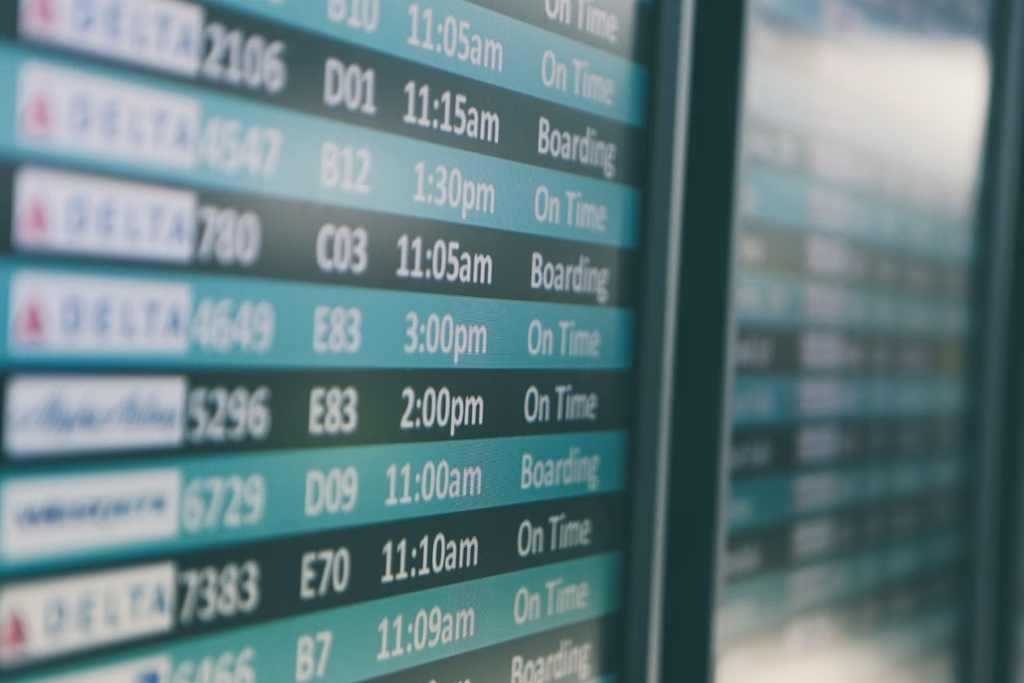
POLITICO (“US airlines cancel more than 1,000 flights for a second straight day largely due to shutdown“):
U.S. airlines again canceled more than 1,000 flights Saturday, the second day of the Federal Aviation Administration’s mandate to reduce air traffic because of the government shutdown.
So far, the slowdown at many of the nation’s busiest airports hasn’t caused widespread disruptions. But it has deepened the impact felt by the nation’s longest federal shutdown.
[…]
Analysts warn that the upheaval will intensify and spread far beyond air travel if cancellations keep growing and reach into Thanksgiving week.
[…]
Flight disruptions ticked up a bit on Saturday — typically a slow travel day — as each of the first two days creeped above 1,000 cancellations, according to FlightAware, a website that tracks flights.
The airport serving Charlotte, North Carolina, saw 130 arriving and departing flights canceled by mid-afternoon Saturday.
Airports in Atlanta, Chicago, Denver, and Newark, New Jersey, also saw numerous disruptions throughout the day. Ongoing staffing shortages in radar centers and control towers added to the cancellations and delays on Saturday at several East Coast airports, including those around New York City.
[…]
Air traffic controllers have gone without paychecks for nearly a month as the shutdown continues, leading many to call in sick and add to already existing staffing shortages.
Most controllers are working mandatory overtime six days a week during the shutdown without pay, and some are taking second jobs to pay their bills, the National Air Traffic Controllers Association has said.
NYT (“Airport Disruptions May Get Worse This Week“):
The disruptions from federal restrictions on flying at the nation’s busiest airports were challenging, but relatively contained this weekend. But the cuts are expected to grow in the coming days, threatening to wreak havoc for airlines and travelers as Thanksgiving approaches.
[…]
Airlines weathered those restrictions by making surgical cuts, but managing the disruption will become harder as the restrictions rise throughout the coming week to 10 percent by this Friday and possibly even higher.
“The degree of complexity increases for every flight that we are not going to operate,” said Steve Olson, the head of system operations and airports at JetBlue Airways. “That means that we have a crew that may not be in the right position to be able to operate their next flight or an aircraft that may not be in the right place.”
Airlines canceled hundreds of flights each day from Friday through Sunday at airports serving major cities like Atlanta, Dallas, Denver, Chicago, Los Angeles and New York. The cuts were concentrated among trips offered by three of the largest carriers, American Airlines, Delta Air Lines and United Airlines, which dominate many of those busy airports.
[…]
Planes are generally less full in early November because many people reserve travel for later in the month, around Thanksgiving. That gave the airlines the flexibility to trim on busy routes, moving passengers from canceled flights to others still operating between the same destinations. United said that about half of its customers affected by the cuts over the weekend were rebooked to flights that took off within four hours of their original departure time.
Airlines also focused cuts on less popular regional routes, dropping flights linking tiny airports with larger cities. Flights to small, regional airports can typically accommodate about 50 to 75 passengers, while flights between big cities can often carry twice as many people, if not more. While American cut more than 5 percent of its schedule on Friday, for example, only about 2 percent of its passengers that day were on affected flights.
[…]
Still, most routes, even regional ones, retained at least some service through the weekend, though there were a few examples of carriers dropping routes with one or two flights. (Delta, for instance, cut its only trip between Asheville, N.C., and New York.)
Airlines generally avoided cutting flights between hub airports or to destinations abroad. Most cuts were carried out by U.S. airlines, though a handful of flights were canceled by international carriers. Many airlines allowed customers to change flights or request refunds, even if they had restrictive, nonrefundable tickets.
Despite the limited disruptions, some travelers were reconsidering flying, exploring other options, including renting cars, taking buses or trains or just staying home.
Airlines are well practiced at managing flight cancellations caused by myriad factors, like bad weather, staffing shortages and technological outages. In deciding which flights to cancel, crisis teams use software to help identify candidates and consider a range of factors, including how cuts will affect the placement of customers, pilots and planes. But there are limits to how much disruption the industry can handle.
The economic and stress toll of this is significant. Thousands are having their lives disrupted and millions have added uncertainly piled on the usual stresses of airport travel.
But the real concern is that we’re putting people’s lives in danger. How long can air traffic controllers work overtime hours, let alone while worried about putting food on the table, before there’s a catastrophe? I’m hoping we don’t find out the hard way.








