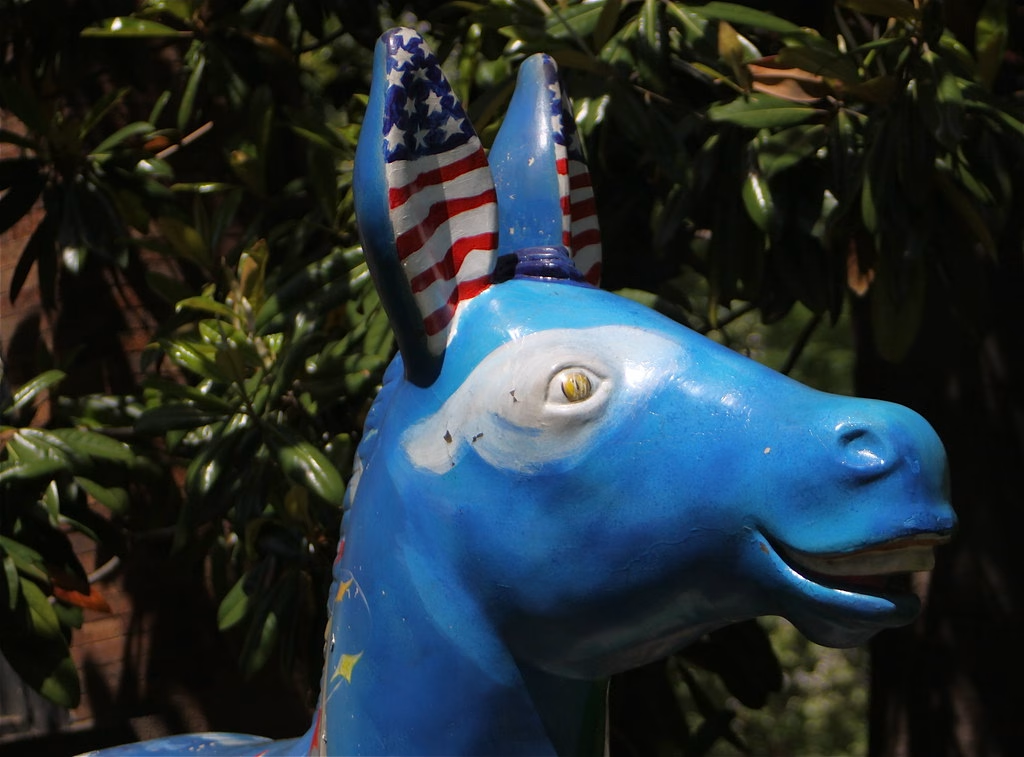
Blue Democratic Donkey, Dupont Circle, Washington DC
“Blue Democratic Donkey” by ChrisGoldNY is licensed under CC BY-NC 4.0

Democrats Lose By Winning?!

36

Comments

WaPo has published a truly bizarre op-ed by Ruy Teixeira under the headline “How a ‘blue wave’ ultimately could cripple the Democratic Party.” After a brief setup about what appears to be good news for the party in Tuesday’s midterms, he explains,

The bad news for the party is that this very success may cripple it just as it faces the all-important 2028 election and beyond, when unfavorable population trends will start to bite. The Democrats’ job as a national party will soon become much more difficult.

How so?

The populations of red states are growing faster than those of blue states, which will give Republicans an electoral college advantage after the 2030 Census. By the 2032 presidential election, many of the swing-state combinations that currently deliver Democrats an electoral college victory will go the other way. Now, winning Minnesota, New Hampshire, Wisconsin, Michigan and Pennsylvania (while losing Georgia, Nevada, North Carolina and Arizona) would put Democrats ahead by one electoral vote. But in six years, it would put Republicans up by eight.

Okay . . . .

But what if—hear me out—states aren’t inherently red or blue? What if the reason some states’ populations grow while others decline has to with internal migration patterns that ultimately change the demographic makeup of the states? What if, when people move from, say, Minnesota to, say, Georgia they remain fundamentally the same?

For example, when I moved to the DC suburbs of Northern Virginia in 2002, my politics were the same as when I lived in Alabama. I made an already “red” state ever so slightly redder. Unfortunately for the Commonwealth’s GOP, lots of others were also moving to NoVa during the DotCom boom, and they were disproportionately Democrats. The population grew from 6.2 million in 1990 to 7.1 million in 2000, 8 million in 2010, and 8.6 million in 2020. A state that voted for the Republican presidential nominee in every election (save the 1964 fiasco) between 1952 and 2004 swung blue in 2008 and has now voted for five straight Democrats.

Democrats don’t have an easy road ahead. But, paradoxically, the better they do in 2026, the more likely they are to ignore their party’s weaknesses with working-class and rural voters. Those weaknesses led to Trump winning the 2024 election, but they are likely to fade from the party’s memory as Democrats, buoyed by the fool’s gold of midterms success, attempt to placate an energized left.

Celebration is easy; confronting underlying problems is hard. Thus, when Republicans get shellacked on Nov. 3, expect Democrats to see the result as an enthusiastic endorsement of the party rather than a repudiation of the GOP — a far more plausible explanation.

I don’t even know what this means. Which Democrats are going to do this? The voters? The newly-elected Democratic Members of Congress? The 2028 primary electorate?

Voters have intensely negative feelings about Trump, his administration and his stewardship of the economy, sentiments that have (finally) pushed Americans to prefer Democrats’ handling of the economy. According to a recent Washington Post-ABC News-Ipsos poll, this is the first time Democrats have held an advantage on the economy in 12 years. Otherwise, the Democrats would not be nearly as successful as they are likely to be.

Well . . . yes? As long as I’ve been paying attention to these things—and that’s a long time—midterms have been referenda on the President’s policies rather than an embrace of the opposition party’s agenda.

The Democratic “brand” also continues to be stubbornly negative. A New York Times–Siena poll in September surveyed five red-state Senate battlegrounds — Alaska, Ohio, Texas, Kansas and Iowa — where Democratic campaigns are doing well. In each state, despite the strength of these candidates, the party’s image continues to be very poor. Voters were more likely to say the Democratic Party is too far left than to say the Republican Party is too far right, which is remarkable after two years of the second Trump administration. Moreover, the contrast between the two parties is especially strong among working-class (non-college-educated) voters. In Ohio, 54 percent of these voters said Democrats are too extreme compared with 39 percent who said the same about Republicans.

Let me get this straight: Republican-leaning states are more likely to align ideologically with the Republican Party than the Democratic Party? That is an important insight if true.

More broadly, national polls continue to show that Democrats are just not well liked as a party. In an NBC News poll from September, voters’ view of the Democratic Party was actually worse than that of the Republican Party (and even U.S. Immigration and Customs Enforcement). The Democrats’ rating is roughly on par with that of the MAGA movement and significantly better than only those of socialism and the Democratic Socialists of America — both of which are becoming more closely associated with Democrats.

But isn’t that mostly a function of Democrats frustrated with the inability of their party’s leadership to stop President Trump from enacting policies they despise?

None of this prevents Democrats from making big gains this November, including shifts in their favor among working-class and Hispanic voters. But the data indicate that most of these voters will be “just visiting” rather than locking in their support.

So, the voters who have shifted between Trump and his Democratic opponents in recent elections are unlikely to suddenly become committed Democrats? Again, big if true.

Democrats need to turn their good fortune into a lasting political advantage, but the party’s midterms strategy indicates this could be a challenge. Democratic candidates have adopted the “affordability” slogan, seasoned with a generous helping of economic populism. This has been a successful formula for this cycle. Post-election, it could have diminishing returns.

Because each election cycle is different? And parties and candidates usually try to appeal to the current concerns of voters?

Democratic candidates have put forward a confusing smorgasbord of measures on affordability. Besides undoing Trump’s tariff regime and reversing his health care cuts, there is a grab bag of price controls, subsidies and new regulations that may or may not be successful. Democrats have also suggested an array of ideas for new social welfare programs (from universal child care to Medicare-for-all) and expansions of old ones — expensive and extremely difficult, if not impossible, to implement in today’s fiscal climate. And there are traditional favorites such as taxing the rich and raising the minimum wage.

So individual Democrats running in different states and congressional districts with distinct political cultures aren’t all running on the same playbook? That is truly shocking.

There is nothing particularly new about this program. Indeed, it seems suspiciously similar to the laundry list of progressive economic priorities that defined the Biden administration. Those didn’t work, and proposing a do-over is unlikely to win back many working-class voters.

Presuming a blue wave—the premise of the column—won’t those policy proposals almost by definition have won back many working-class voters? Regardless, 2028 will be a presidential year, no? In which case, won’t there be two presidential nominees who will be the de facto leaders of the two parties? So, until we know who the Democratic nominee is, we have only the vaguest idea of what the predominant Democratic message will be.

Besides, with Trump as president, these ideas have no chance of becoming law. They will, however, provide material for the inevitable tsunami of aggressive messaging bills from progressives charged up by the 2026 results. That certainly won’t do anything to convince voters that Democrats are not still “too far left.”

Democrats should keep a lesson from the second Trump administration firmly in mind: If you promise to fix the economy, make life affordable and get things back to normal, you’d better do it.

Which voters, exactly, are going to hold Congressional Democrats responsible for the economy under a Republican presidency? When in the history of American politics has that ever happened?

Of course, Democrats will argue that voters understand that the party isn’t really in control, given the Republican White House, and will give them a mulligan leading into the 2028 presidential campaign.

It’s not a mulligan. The party really isn’t in control. Voters always—always!—blame presidents for a bad economy.

Then, the thinking will go, their economic ideas will get a fair hearing. But that presupposes the party can unite behind a plausible centrist economic program. The lead-up to the 2020 presidential election, when the primary process was similarly open, does not inspire confidence.

Now, 2020 was a while back and my memory isn’t what it used to be. But didn’t a Democrat win that one? I could have sworn that happened.

It also presupposes that voters won’t mind a post-2026 Congress defined by Democratic grandstanding. There’s reason to doubt this, too.

Why do we expect the Congress to be defined by Democratic grandstanding?

New findings from a Blue Rose Research survey from this month indicate that voters’ patience is wearing thin. By an overwhelming 65 percent to 23 percent margin, voters said it was more important to them that “things in America change” after the election than that their party controls Congress.

Presumably, that’s why some significant number of Republican voters are projected to switch teams this cycle? But it’s simply the case that there’s very little a Democratic majority can do to effect major change with Trump in the White House.

This desire for politics beyond simple partisanship is palpable. Voters agreed (70 percent to 18 percent) that almost all members of Congress vote the party line regardless of what benefits their district. Even more tellingly, by almost 2 to 1 (53 percent to 28 percent), voters said they hope the 2026 elections produce more leaders who are willing to break with their party to make bipartisan progress rather than have their party control Congress and pass a partisan agenda.

Could Democrats speak to this mood? They could. There is a golden opportunity in the current bipartisan permitting bill. This is an excellent piece of legislation, which has the twin virtues of plausibly improving both affordability and the Democrats’ image.

So, what if the things voters tell pollsters they want and the things that actually motivate their voting behavior diverge? What if their vote is mostly influenced by their party identity and their sense of the state of the country, particularly its economy? And what if I were to tell you that, if the economy indeed improves as a result of legislation passed by a Democratic Congress (which is highly doubtful for many reasons) the credit will redound mostly to Trump and the Republican Party because voters always give credit to the party in the White House?

Look, like Teixeira, my preference would be for Democrats to push a relatively moderate agenda over the next two years and nominate a pragmatist rather than a Democratic Socialist in 2028. Not only do I think that’s more likely to lead to electoral success, but it happens to align with my own policy preferences. But there’s no world in which a blue wave in 2026 bodes ill for the party’s 2028 chances.

36 responses to “Democrats Lose By Winning?!”

  1. Sounds clear to me. After the election and a Blue Wave, the Democrats need to clean house and fire the consultants responsible for all that victory. Then they need to hire Ruy Teixeira, a 70-something guy with a Substack and an op-ed in a trillionaire’s broken newspaper.

    5
  2. Michael Reynolds Avatar
    Michael Reynolds

    My natural preference is for moderates. But ‘moderate’ is not a direction. North, South, left, right, up down, those are directions. Moderate is just what it’s not. Not disruptive, not alarming, not moving too fast, or at all. Inert. See: Senator Chuck Inert Schumer.

    I like the DSA’s economic direction, if not every detail of their wish list. They really need to STFU about open borders and abolishing ICE and stay focused on the Rich/Poor split rather than Left/Right, or Black/White, or Male/Female. Their economic agenda easily meshes with anti-corruption, which is the flag Democrats should be waving.

    AOC says, ‘Woke 1 was crazy.’ Yes, it was. I think she knows, and is signaling that the Left’s Stalinist tendency toward policing not just speech but thought, was a damaging mistake. (A position I took 10 years ago and for which I was multiply canceled. But hey, bygones. . .)

    Go after the corrupt and the super rich. Elon Musk and Jared Kushner are to 2026 what John D. Rockefeller and JP Morgan were to the Golden Age. A corrupt and mentally unstable billionaire, and a corrupt and greedy little shit-stain, should be the face of the GOP, even more than Trump – no one ever voted for Musk or Kushner, no one ever wore a little red hat for either.

    3
    1. I think “Reboot ICE” is a much better slogan than “Abolish ICE”. I would be happy to wipe the whole thing out and start over.

      AND, i do not think we can go without some sort of border enforcement agency.

      However, all empirical evidence suggests that wild over-the-top hyperbole is what works in the current political environment. I would love that not to be true.

      2
      1. See Europe: there are currently no sane centre-left parties who think it remotely sensible to campaign on “open the borders!” or “nationalise everything and pray to the magic money tree!”
        Some further left parties still try such lines, and tend to lose. Badly.

        That does not mean you can’t institute a reasonable and generally popular (not populist) program on sound left-of-centre bases of equitable taxation, sensible welfare, appropriate regulation, de-carbonisation, equality of opportunity, sound finance, industrial policy, worker protection, infrastructure renewal, etc.

        It just means you need to tell the Guardianista culture warrior “secular Presbyterians” in pursuit of righteousness to GO AWAY.

        Though given the “open” nature of US parties, probably tricky for Dems to do via party discipline.
        (otoh, even the DSA are hardly far-left by European standards.)

    2. And let’s not forget Witkoff and Lutnick when considering the hearings.

      Incidentally, I have a small mental side-bet that Jared is going to end up getting iced by one of his “business partners” when he fails to deliver for them.
      That there is a man swimming in shark-infested waters if ever there was one.

    3. As someone who lives in Minnesota/Minneapolis in my view ICE and the DHS clearly need to be abolished and reimagined.

      Yes we need border security and immigration reform, but I don’t see how that is possible while still having ICE. When masked ICE agents are killing protesters (Good and Pretti), running people down in cars (see Houston where the ICE agent was charged with assault) and slashing people’s tires who are filming them from a distance and legally, https://bsky.app/profile/aclu.org/post/3myzh3bqffs2c, then that agency needs to be abolished and replaced.

  3. Charley in Cleveland Avatar
    Charley in Cleveland

    It wasn’t that long ago that Ruy Teixeira predicted a demographic shift that would crush the Republican party. I guess the wind direction shifted on him. That said, here in Ohio the political ads are all culture war (when they aren’t offering a wink and a nod to child sexual abuse). The more lightly educated would think Sherrod Brown was personally performing transgender operations at day care centers when he wasn’t raising everyone’s taxes and giving illegal immigrants free healthcare and food stamps; and that Amy Acton is a drug addled, barely qualified doctor who “shut down Ohio” during COVID* for the perverse pleasure of crashing the economy. Of course it is all bullshit, but the R’s have nothing positive to say about themselves, and so every Democrat is a TOO LIBERAL TAX RAISING COMMUNIST SOCIALIST WHO WILL TURN YOUR LITTLE BOY INTO A LITTLE GIRL. That’s the national message of the GOP (adding in a dose of Islamophobia in Michigan, and, for god know why, homophobia in Texas), and the volume of that message is what prompts a lot of the “I can’t stand Trump, but I can’t vote for a Democrat” conundrum.

    *Acton was the health director. Republican Governor Mike DeWine made the call to close businesses and schools, and had strong praise for Acton at that time and afterward. DeWine is an old school, country club Republican who politely declined to kiss the MAGA ring.

    3
  4. This is EXACTLY the sort of nonsense I was complaining about on Tuesday.

    MULTIPLE semi-prominent Democrats are spewing this stupidity.

    It is exhausting, this “if we win, we won’t examine what needs to be adjusted” garbage. So, what is to be done? Lose?

    Honestly, this is just so stupid. If Democrats cannot win AND analyze what else has to happen, then they are worse at leadership than Republicans are. J.F.C.

    7
    1. It’s even worse than the trump pandemic era “you need to catch COVID so you won’t catch COVID.”

  5. It continues to amaze me how little people who get a lot of money and eyeballs to talk about politics understand the basics of how the system works.

    James hit the highlights, so I won’t reiterate, but I will add that the last time the Dems held a trifecta, they passed a lot of legislation aimed at the kinds of things Teixeira thinks are magic, and what ended up mattering was inflation in 2024.

    4
  6. I have been aware of Ruy Texeira’s shtick for a long time.

    Didn’t read the post, but my view is the smartest things the Democrat’s can do is the opposite of whatever Ruy Texeira is recommending.

    3
  7. Which voters, exactly, are going to hold Congressional Democrats responsible for the economy under a Republican presidency? When in the history of American politics has that ever happened?

    The exact reverse of that happened back in 1948 when Harry S Truman ran against the “Do nothing 80th Congress.” (I am old enough to remember that.)

    That was, IMO, a total outlier – I totally do not see Little Marco or Couchfuck McGee doing anything comparable.

    ETA: A bit ironic – run against a “do nothing” Congress when you have used the veto 75 times.

  8. Up next, James Carville, no doubt.

    4
  9. We’re deep into the “I’ve been writing about the election for 6 months and have nothing left to say” part of the campaign. Often it’s best to read the headline and save time and not read the article.

    3
  10. If the Democrats do win, there’s going to be a lot of weird analysis like this…as if after 2006, the Democrats were in charge of the economy and that’s why they were punished when the market broke in 2008.

    It will be due to huge amounts of pressure from Bezos-types. They’re desperately trying to make populism about fighting regulation and intervention, and not about tech companies and their power and wealth. They need to make the 2027 economy the Democrat’s rather than Trump and all of the tech execs who show up to seen with him.

    0
    1. If they end up being able to legislate, I would like to see their two main focuses be on the people’s economy/struggles/wealth disparity/revenue as well as reasonable but stern immigration law. These areas of economy and immigration have windows of opportunity for moderate progress, but I feel like they will F it up.

      1
      1. Any reasonable immigration law will have to give amnesty and a path to citizenship to the people who have built their lives here doing honest work. The Republicans will never support that, and the Democrats shouldn’t bother with reforming immigration law without dealing decently with the people who are already here.

        1
        1. The crazy thing to me, at least, is the last two times amnesty was on the table was under Reagan (it passed) and W. Bush (it failed). And it was the chamber of commerce and farmers who were pushing for it…and both groups are now feeling the negative impacts of an arbitrary crackdown.

          So foolish.

          I think any efforts at completely revamping immigration won’t happen until this horrifying nationalist movement goes away.

          1
  11. Agree with Michael. Everything in moderation. Don’t go all in just because you feel the winds of change blowing in your direction. Kind of like entering the pool in the shallow end. And now all pools are pretty much 5 ft. Max. Over time moderate change evolved to what benefits everyone the most as it is the most reasonable solution, at that time. Feel Northern VA is a good barometer of the nation as a whole. We have Urban, suburban and rural all within two hours of the nation’s capital. Very diverse, multicultural, multi religious, many highly educated, many not. Plenty of immigrants and plenty of civilian, dod and military folks. And out of all that we seem to produce (with some exceptions) fairly reasonable moderate candidates out of both parties. You have to appeal to all and listen to all, and don’t over do it too fast to make up for long term injustices.. you may just end up setting things back or making things worse.

    1
    1. This take is so odd to me. It seems to me Americans are now convinced the entire system is corrupt and rigged against the little guys. And are looking for disruptors willing to break glass and smash heads to unrig the system, punish corruptocrats, and make their lives tangibly better — quickly — particularly around housing, healthcare, and cost of living, including transportation and energy costs.

      I don’t know how anyone could look at the past decade of American (and really, global) voting behavior and still think that Democratic Party can meet the moment by staying wedded to slow, ossified, sclerotic half-measures.

      It’s go big or go home time for Democrats. #1: Overhaul the tax code to create hundreds of new brackets, tax billionaires, and close their loopholes. Cancel most or all existing student debt by fiat, and cap borrowing to force colleges to either lower costs or subsidize enrollment themselves. Come up with a plan to gradually increase the number of Supreme Court justices from 9 to 13, and pick a fight on it. Make Election Day a federal holiday. Pass a plan to hire thousands more immigration intake personnel, to process claims and cases by a preset deadline.

      Then pass big sweeping bills to supercharge and fast track housing construction, high speed rail, and the cheap clean energy projects Trump gutted. DOGE the hell out of ICE and move it’s mandate to either another agency or a new one — it’s been corrupted beyond saving. Do a moonshot level investment on mRNA trials on curing cancer and HIV. Reschedule marijuana. Stop dillying around and caving to nuclear threats, and get Ukraine everything they need to push Putin’s army out of Europe.

      Almost three decades into the 21st century, we no longer have time to wait or waste. If Democrats don’t get it by now, we will lose in 2028 or 2030, and we will deserve it.

      2
      1. Come up with a plan to gradually increase the number of Supreme Court justices from 9 to 13, and pick a fight on it.

        Lifetime appointments with strategically timed retirements mean that a party can finagle any hard limit on the number of justices to get their way long term.

        Appoint one justice every 2 or 4 years and let the numbers shift.

      2. How does any of that pass before 2028? The only way anything avoids a veto is somehow has to be agreeable to Trump. So have to hold accountable all the wrongs over the next two years while also still remaining as best choice for 28′ to hold the trifecta…..meanwhile AI bubble is boiling up and inflation and interest rates are quite frothy…it is going to be so difficult. If claim both houses and can somehow re-establish the rule of law and hold bad actors accountable over next two years, will count that as a win. Any real legislation will be difficult to say the least…..unless economic apocalypse occurs. Its sad that I feel something really bad has to happen to unite us towards progress, but nowadays it seems something really bad has to happen to get us going in either direction. And electing Trump was the bad thing speeding us in the wrong direction

      3. The Democrats need an FDR moment.

        1
        1. dazedandconfused Avatar
          dazedandconfused

          Indeed. Ruy Teixeira is very frightened of the winning…and it hasn’t even happened yet.

          1
  12. Putting aside the (previously mentioned) fact that this is the same Ruy Texeira who once predicted a long period of Democratic dominance, what he’s saying here is just such surface-level hackery, where you state something mind-numbingly obvious while acting like you’re hitting upon a profound truth other people are missing: in this case, the idea that winning one election doesn’t guarantee a party will prevail in the next one. Well, duh!

    1
    1. “…acting like you’re hitting upon a profound truth other people are missing: in this case, the idea that winning one election doesn’t guarantee a party will prevail in the next one.”

      It’s slightly worse than that. They’re saying that if Democrats win, all thinking and analysis stops, everyone will be too busy celebrating the win that they’ll think they can just coast to victory for ever and ever.

      It’s like saying getting an A on a test in college means that you don’t have to study for the next test.

      1
      1. “It’s like saying getting an A on a test in college means that you don’t have to study for the next test.”

        More pertinently, it’s like a parent telling you just before taking the test that even if you get an A it’s nothing to celebrate because it means you’re on your way to flunking the next one.

        2
    2. The man is a perfect pundit. He wrote one book, which was wrong, and has been coasting on that failure ever since.

      2
  13. Ruy Texeira is a vain nonentity who likes to see his name in print.

    The WaPo – exactly like every mainstream outlet – loves “Dems in disarray” stories.

    And so, even if the Dems win, they’re still in disarray!

    And thus everyone involved got precisely what they wanted.

    Bunch of stupid wankers, the lot of them.

    4
  14. It’s a load of cobblers.

    Why would the consequences of a Congressional election victory now necessarily lead the left of the Dems to become dominant in shaping the 2028 campaign?

    Or even that all the left are daft enough to not calculate differences between local campaigns and a presidential contest?
    Doubtless some would be so inclined, but it’s then up to other Dems to sit on their heads.

    In my experience and observation, few parties of the centre-left suffer greatly when they request the left-wing to curb their enthusiasm, sit down, and shut up.
    However, using that to argue an electoral win is a disadvantage is just silly.

    As for bipartisan policy: nice idea, good luck getting that to fly far off the runway with a still MAGA-fied Republican Party in Congress.
    Sure, it’s worth trying for some bills that some rebel Republicans might be recruited for, and that just maybe Trump would not veto.
    Go ahead.

    But I doubt such exceptions will make much of legislative programme.

    Some of the arguments about voter alignment etc on both sides speak more to US-specific things about which I plead ignorance.

    But if by “grandstanding” Texeira means “avoid inquisitorial hearings” and/or “don’t put up bills that MAGA is bound to reject”, what the heck is the point in working a Congress separate from the executive at all?
    (Personally I’d say its another argument in favour of a parliamentary system, but seeing as that’s not in the offing, best to work with what you’ve got. 🙂 )

  15. A return to pragmatic, moderate governance as the key to holding power over time didn’t work out so well for Biden, did it? CHIPS Act, the Infrastructure bill, the post-COVID economic recovery – not a one of these is radical or particularly partisan.

    This particular midterm referendum on the ruling party’s policies would suggest a call for a reining in of the lawlessness, warmongering, and corruption. The Dems want to hold hearings to highlight the malignant governance, then associate the malignancy to not just Trump, but the whole Republican Party. That’s the best path to a trifecta in 2028. Then they can be pragmatic.

    1
  16. It’s the flip side of every empty pundit’s favorite lecture of the moment — “just because the Democrats are ahead in the polls, they shouldn’t just rest of their laurels and assume they’ll win — they have to work!”

    As if there is one Democrat anywhere saying anything like that…

    1
  17. My wife and I went to the new Lucas Museum of Narrative Art in Los Angeles a few weeks ago. In it there is a section of historial political ads and cartoons. Do you know what they were arguing about in 1916?

    Immigration.
    Entering a war.
    Foreign Policy.
    Taxes.
    Mexican incursions (into New Mexico).
    Tariffs.

    100 fucking years, and we’re still arguing about the same shit.

    1
    1. Wasn’t that when Doroteo Arango (aka Pancho Villa) got Pershing to chase him south of the border?

  18. otoh, WW1 was more or less a rational decision
    Give Wilson his due in that regard. 😉

  19. Teixeira has spent the last 20 years trying to explain that he didn’t get it wrong in The Emerging Democratic Majority. Not at all. It was the Democratic Party’s own fault it didn’t build an impenetrable blue wall that would condemn Republicans to permanent minority status. They missed the footnote somewhere in the book that noted how the whole thesis hinged on the ability of the Democrats to retain the support of the working class (whatever that means in the 21st century).

    It sucks when you try to help people and they don’t take the time to read your advice thoroughly. No wonder he got pissed off and took a job at the American Enterprise Institute.

    1

Leave a Reply

This site uses Akismet to reduce spam. Learn how your comment data is processed.