Approaching a Major Red Line on Elections
A potential Executive Order on elections.
ABC News reports: Pro-Trump attorneys push executive order that would give Trump sweeping power over elections: Sources.
A group of pro-Trump attorneys and supporters is circulating a draft of a presidential executive order that uses alleged Chinese interference in the 2020 election — of which there is no evidence — to justify a national emergency declaration that they claim would give President Donald Trump sweeping power over voting, multiple sources told ABC News.
The 17-page draft order, which sources say Trump has reviewed, would mandate the use of voter ID and hand-counted ballots, and ban mail-in ballots ahead of the upcoming midterm elections.
The attorneys pushing the draft order said they anticipate it would be incorporated into a planned executive order, which they expect to be issued soon.
All of this, of course, is illegal and unconstitutional. But if this EO is issued and is legally challenged or just ignored, it will be a blatant attempt at election interference and will cause disruptions in the middle of an already started 2026 cycle.
And this is just absurd:
Ticktin, who also represents former Colorado county clerk Tina Peters, who was imprisoned for breaking into voting equipment, said the emergency declaration would empower Trump to ban electronic voting machines and mail-in ballots because they could be tools used for foreign interference.
“The most important provision, if you ask me, is the hand counting,” Ticktin said. “Get rid of the machines. That’s what we need to do right away.”
Let me note, as someone who has studied elections professionally for decades, that hand-counting is less accurate than machine counting. This should be obvious, but I figured I would note it anyway. This is just conspiracy land, not to mention that these people also don’t like waiting for the results (which they then use as yet another reason to doubt outcomes). Do I have to note that hand-counting takes longer?
And yes, hand-counting increases the opportunities for chicanery.
More from Democracy Docket: Anti-voting activists co-ordinating with White House on blatantly illegal draft emergency order to take control of elections.
in an email to Democracy Docket, Ticktin said that Trump “may invoke emergency powers in response to an election emergency involving foreign interference, provided certain statutory and procedural requirements are met.”
Ticktin said those requirements derive from the National Emergencies Act (NEA) and the International Emergency Economic Powers Act (IEEA).
“These powers are subject to procedural safeguards and judicial review to ensure compliance with constitutional and statutory limits,” Ticktin added.
For what it is worth, I don’t see how such an EO would pass judicial scrutiny, or even have any kind of enforcement mechanism. Nonetheless, even an attempt would be an attack on the election process.
I would prefer no attempts to take place, but I partially agree with the following, insofar as a blatant and obvious attempt to corrupt the process up front would help clarify, for some, the anti-democratic nature of this administration and might make post-election attempts at interference harder to launch because of how transparently corrupt they would be.
“What a gift such a clearly unconstitutional executive order would be!,” David Becker, the executive director of Center for Election Innovation & Research and a former DOJ Civil Rights Division attorney, noted on social media. “Though divorced from legal and factual reality, it would enable the courts to invalidate this power grab well in advance of the election, and confirm the clear limits to [federal] interference in elections.”
I also agree that such an EO would not take judicial action to ignore.
Justin Levitt, a constitutional law professor at Loyola Marymount University and a former DOJ voting official, told Democracy Docket the draft order is not just illegal, but “there is literally no authority here that any local official would have to listen to.”
“It doesn’t require anybody to file anything in court to stop the impact,” Levitt added. “It just requires… not listening. Which is both easier and quicker.”
Still, should it be issued, it does need to be challenged in every way possible.
Let me conclude with a few thoughts on “red lines.” I noted this notion in a post about Greenland.
I am not talking here about a red line that, when crossed, would lead to a public response. I am talking about an analytical red line wherein the depths of authoritarianism (and long-term damage) would be at a new level. It would represent a new low for a regime that I already assess as being proto-fascist.
Maybe “red line” is the wrong metaphor, but I am thinking here about markers along the path to deeper authoritarianism.
I think we have already crossed two such red lines and averted two others.
The first was January 6th itself. This was the first time we did not have a peaceful transition of power in the United States. And while it is true that the attempt to thwart the constitutional process of certifying the election failed, we had a president who clearly was in support of the actions of the insurrectionists. We know this because of how he acted before, during, and after the event. Remember: he called it a “day of love” and pardoned/commuted the sentences of all the participants, even those who committed violence directly against law enforcement.
The second red line that was crossed was the immunity decision from SCOTUS. That ruling removed almost all capacity for there to be any accountability for what a president does in office.
We averted a red line with Greenland, and then again with the tariff ruling by SCOTUS.
But we are on the brink of a truly serious problem with the growing evidence that Trump is going to try, in some way, to disrupt the coming elections.
I remain guardedly optimistic that he will ultimately fail in the attempt, owing to the clear constitutional parameters on this subject and the decentralized nature of the electoral process. Still, I find any suggestions of executive action on this topic concerning. And, moreover, even if he fails to fully cross the line, the damage (like with Greenland and NATO) will be real, as he has successfully convinced far too many Americans that the electoral process can’t be trusted.
Trump continues to be a cancer on the body politic.

“Hubbell”
“Democracy Docket“
Not particularly relevant, but this Ticktin dude was a classmate of Trump’s at New York Military Academy.
blockquote>it would enable the courts to invalidate this power grab well in advance of the electionEnable, not require. Unlike the tariff case, this would not have pit Federalist billionaires against MAGA billionaires. I would expect Roberts and his accomplices to do their usual trick, stay all the lower court orders against Trump until SCOTUS decides, sometime in 2027.
@gVOR10:
With the tariffs, they were collected by Federal employees under Trump’s control. Trump is not in the chain of command for the state employees and officers who administer elections, he can not just tell them what to do.
This EO is DOA, seriously…even MAGA knows this.
This reeks of just such utter desperation by Trump and his cronies to hold on to power. The polls show that even folks who voted for Trump multiple times are starting to be willing to say out loud that they are beyond fed-up with his antics.
I actually want Trump to go through with this right now, just do it, because it is such a panic move on his part that it will backfire as his hardcore supporters do not want to see the flop sweat flying of off President Trump as he tries to hold onto power. It is not a good look to see your leader sweat.
Also, I suspect that even if the Supremes dragged their feet on immediately overturning this ludicrous idea of an EO, that tons of states would just act like business as usual when it comes to the Mid-Terms and send out mail in ballots and count them as they should once Election Day has rolled around.
Let the Supremes tell Americans that they are going to invalidate what could be 60-80 million votes from Democratic leaning voters just because Trump told them to. We need to lean into forcing President Trump to go through with this, it will backfire on him something fierce.
You know what, I am animated about this but not really angry about this…it is laughable that anyone would take anything the GOP has to say, or anything the Supremes have to say on any subject seriously if they did not immediately shut down his EO within minutes of his signing the order.
You can smell the desperation wafting off of President Trump and his buddies in D.C. all the way out here in California.
Look, I get it…Trump and the GOP see their leadership over the free world slipping away because the world has moved past them, you have leaders of Nations making deals with other Nations without consulting President Trump or anyone of importance in the White House, (such as Canada talking directly with China about Trade) and Europe is doing their own thing when it comes to hitting back at Putin’s thuggish behaviour.
This will lead to more desperate proclamations from Trump and friends.
@charontwo:
But it’s conceivable SoS in some states would treat the EO as lawful and binding.
@inhumans99: I like this take. I wish I could endorse it whole-heartedly.
I think we need to not just wave this off as stupid, but plan for it. What are we gonna do if he does it?
I like the part above where election officials can just ignore it and go about business as usual. How do we convey to them as citizens that we have their backs, and this is the course of action we support?
Obviously, there’s the upcoming No Kings day. What else? I’m not too worried about my state, California. They are happy to give a middle finger to Trump, and they aren’t really up for grabs, either.
It could be that some of the folks engineering this simply want to de-legitimize the results of the upcoming election. For political use, or maybe for something else, if they see an opportunity. These are smart people with bad intentions. The worst part is that they think they are saving America. Nobody does more evil than the person who has a cause they think is righteous, and that this justifies whatever means necessary.
Tell me…who is going to stop him?
@inhumans99:
The thing is, it doesn’t have to be universally followed. It only needs to work in a few states with competitive districts won by Dems. The goal is not eliminating all Dem Reps, but maintaining a majority in the House.
As I recall, the response to the 2020 claims about the Constitutionality of the Electoral Count Act, and the role of the VP, were greeted much the same way as this report.
Has Turley done his both-sides-are-wrong dance yet?
These people don’t need a consensus answer—they only need the question to seem worth asking.
@Kurtz:
But they would be safely R states.
Remember, November is not simply about electing folks to Congress, any state acquiescing to the felon, would be screwing up their on election system and any elected official that is on November’s ballot would be forced from office on Jan. 1, or thereabouts, the the state constitutions. Even Alito and Thomas would have trouble stomaching the chaos from letting such an EO proceed.
@Daryl: From issuing the EO? Nobody.
But what is the enforcement mechanism? That’s the real issue.
And even red state Secs of State know that counting ballots by hand is essentially impossible.
@Kurtz:
This is a fair concern. I suppose the question is, where might it be followed? I suppose the most concerning possibility off the top of my head is Texas.
Although as @Sleeping Dog notes, how much general chaos are they will to take on, as following these rules would disrupt a lot of local elections as well.
@Kurtz:
Even the reddest of state legislatures are unlikely to sit idly by while the SoS makes up new procedures for verifying voters, distributing ballots, and counting them, on their own, in clear violation of the state laws. Outside of counties with tiny populations, it is unlikely the county clerks will accept new procedures late in the game w/o a bunch of funding, which the SoS can’t produce out of thin air.
My understanding for my county in a vote by mail state is that a great deal of the election money for November has been committed. The county has contracted for ballot printing and envelope stuffing. They’ve negotiated how and when hundreds of thousands of presorted envelopes will be delivered to the USPS. The training procedures for election judges have been set up.
@Steven L. Taylor:
Well…from monkeying in the elections? I imagine that he has enough sycophants running things in enough states to keep control of the House. There’s really only one way Trump can be stopped. And I ain’t gonna type it out here.
I expect splintering. Some states, perhaps Texas, will quickly pass a law saying, “Do what Trump says!” Others will make a very flattering appeal to Trump to change his mind. Others will ignore him.
The focus politically should be on keeping blue and near-blue states united in their “we can safely ignore Trump”. Frankly, if he wants to call out troops over an election, that’s such a bad look. SUCH a bad look. It will get attention from lots of people who don’t pay much attention and just think of Trump as a big talker.
@Kurtz:
“But it’s conceivable SoS in some states would treat the EO as lawful and binding.”
It’s also conceivable that Trump appointed judges at the Court of Appeals level will treat the EO as legal. And there are definitely Courts of Appeals where the red states outnumber the blue ones, including the 8th Circuit (a number of red states, plus Minnesota), or the 6th Circuit (Tennessee, Kentucky, Ohio and Michigan).
@Michael Cain and Jay L. Gischer: Even (especially) in a very red state like Texas, I assume most of the county clerks who will have to administer this election are Republicans. They would see the last-minute implementation of this EO as a logistical train wreck. I can’t believe they would sit idly by and let their legislature impose this train wreck.
I have said before the industry that relies most heavily on accurately counting paper is banking and, despite having trained staffs of tellers, they use automatic counters.
@Jay L. Gischer: Fortunately, the Texas Legislature is a part time one and doesn’t meet again until Jan 12, 2027.
That doesn’t preclude mischief from the Governor, the Attorney General, or the Secretary of State.
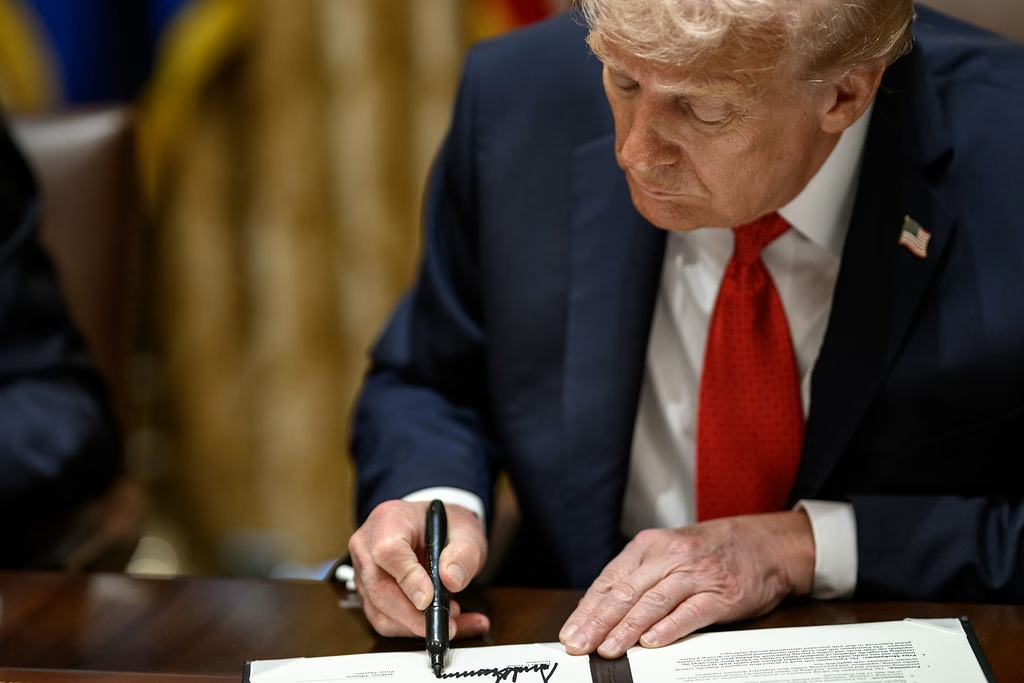
His signature looks like the EKG of an unmedicated a-fib patient.
@Joe:
QFE.
A standard conservative complaint is the slow vote counting process in some blue and swing states compared to states like Florida, fueling conspiracies that DemoncRats are changing votes to MAGA disgavor. The conspiracy is bunk; the complaint is fair. Of course, Florida’s relative electoral competence grew out of their incomptent Bush v Gore debacle, but other states (California and Nevada anyone?) do need vote-processing efficiency reforms.
Yes, Texas may desire to placate neofascists via compliance with an 11th-hour executive order requiring hand processing and Election Day only balloting. But given Texas’s size, the ensuing delays would only worsen Trumpanzee rage and undermine their partisan case.
Would Rafael Cruz and the deplorables then accuse Ken Paxton and Greg Abbott of stealing the election for Talarico/Crockett and other Marxist libtards? Can the Supremes stomach Stephen Miller’s and Steve Bannon’s unilateral declarations of who won which elections where?
Rancid, corrupt d-bags like Alito, Thomas, Kavanaugh, and the ghosts of Rehnquists and Scalia could. But Bush v. Gore was about one contest in one state. The plausibe deniaibility “just calling balls and strikes” fig leaf clung to by phony-ass frauds like Robert, Barrett, and Gorsuch crumples with dozens and dozens of matchups across the country.
@Steven L. Taylor:
I’m aware of all of the reasons why my point seems outlandish. I note that, for better or worse, I have not been a chicken little wrt to Trump. I have expressed consistent concern without jumping to the worst case. But . . .
What if the exact legal argument and exact mechanism is beside the point?
Is it beyond the realm of possibility that the goal is for local and state election officials to cry foul? Trump has long mused about the need to nationalize the electoral process.
I’m just saying maybe we should be cautious about taking these things at face value.
What I keep wondering is, how will the non-black normies react to being denied an opportunity to vote. Either because of some bogus EO or because Trump unleashes ICE on random-ish polling stations.
There’s no way Trump or the GOP could do this without it being the most ham fisted, stupid way possible.
My, totally outta my ass, guess is that if a bunch of white people, even in red states, get blocked from voting they will flip out in a way we haven’t seen before.
We can be sure El Taco and his fascist hordes will try any number of things, from legal chicanery to violence, to steal the midterm elections. The only question is what can be done about it, and what will be done.
Unfortunately, people tend to resort to most necessary measures in reaction to an attack than in prevention of one. By then it’s usually too late. By then, you will either lose, or pay a huge price. I don’t think I exaggerate when I say the attempt to steal the midterm elections may end up in a civil war, or open rebellion by state governments.