
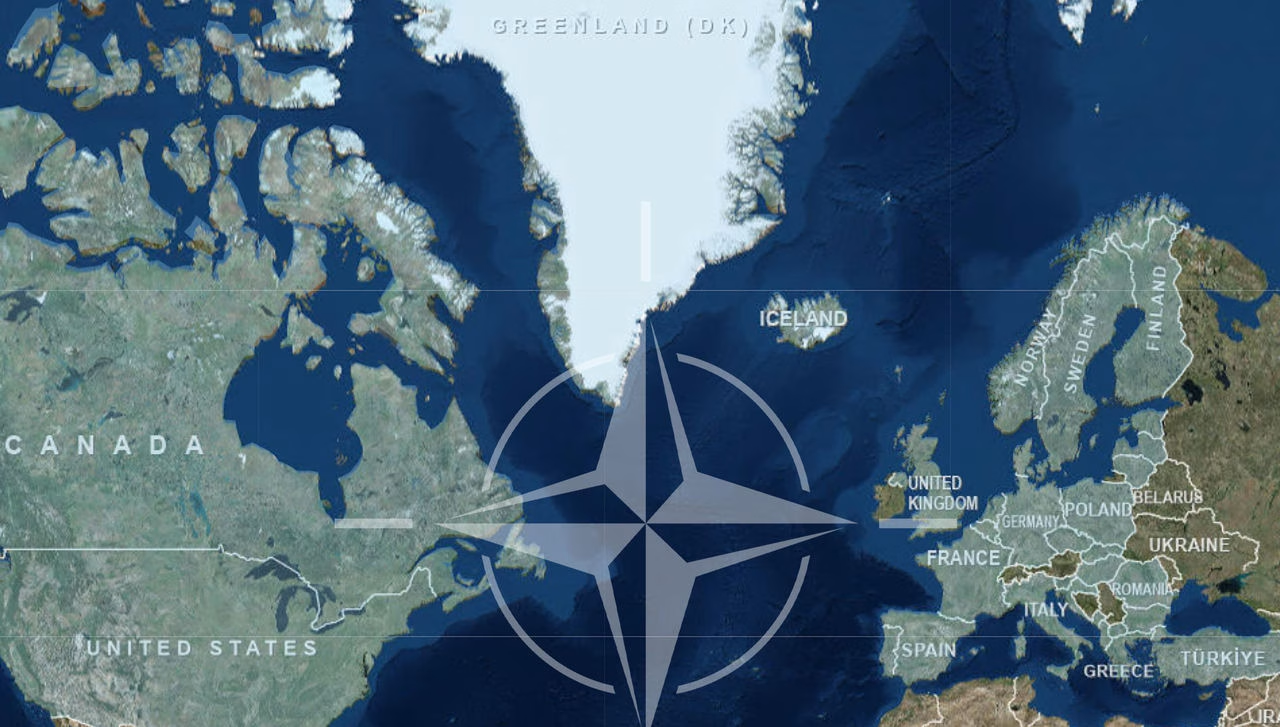
In the wake of the successful extraction of Nicolas Maduro and his wife from Venezuela, alongside still difficult to discern assertions that the US is running that country, the Trump administration appears to be feeling its imperialistic oats. Specifically, rhetoric about acquiring Greenland has been in the news.
I find all of this talk very concerning, and I would argue that any attempt to use violence or even economic coercion aimed at Denmark to acquire the island would be orders of magnitude worse than the dubious and problematic extraction of Maduro. I am of the position that such an acquisition would be severely anti-democratic, both in terms of domestic politics, signalling an ever deeper authoritarian turn by Trump, but also in terms of treating the residents of Greenland like property instead of human beings. Further, any kind of coercive takeover would likely irrevocably rupture NATO in a way that is deep, profound, and generational in its consequences.
Herein, I try to lay out my thoughts on this.
Update: note that I am not talking here about a red line that, when crossed, would lead to a public response. I am talking about an analytical red line wherein the depths of authoritarianism (and long-term damage) would be at a new level. It would represent a new low for a regime that I already assess as being proto-fascist.
For me, one of the major questions for the Trump administration is how bad can it get? As well as, what will the long-term damage be? An attempt to acquire Greenland by force would be a major action that would, in my view, take the Trump regime into a wholly new quantum of awful. It would also create substantial and potentially catastrophic long-term consequences for US national security and global affairs.
(All of this makes me realize I need to better flesh out what I mean by such red lines. In my mind, there are a number of such lines that would signal something truly horrific, such as actually trying to stay for a third term–but all of that is another conversation.)
What About Greenland Independence?
There is, I will allow, a pathway that would not have the dire implications of what I note above, which would be if the Greenlanders themselves voted for independence and then used that independence to join the US. I think such a move would still have damaging consequences for our NATO relationship, but would not be the rupture that a coercive pathway would create.
A 2009 Danish law does provide for the pathway for independence via referendum (see Chapter 8). And, indeed, a recent poll shows real interest, at least in the abstract, in independence.
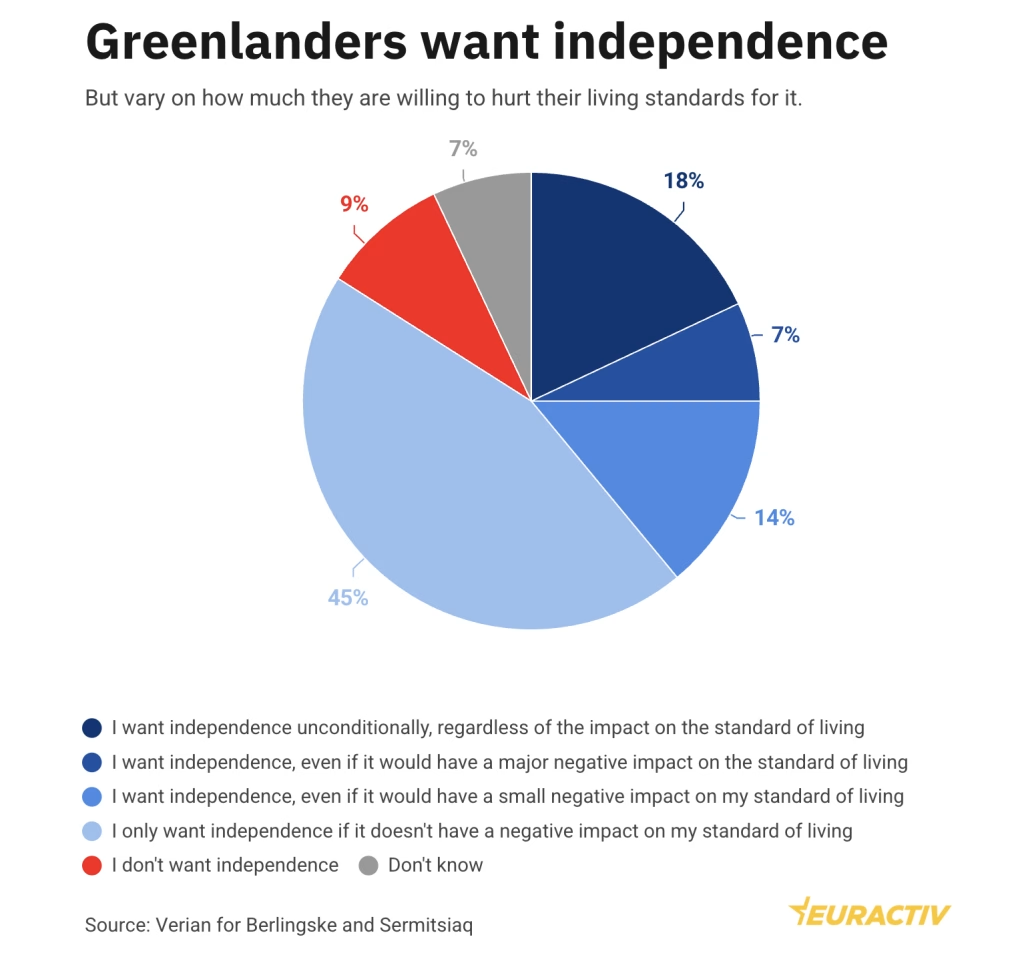
I would note that the question of standard of living is kind of important, given that Greenland residents are currently Danish citizens with access to an extensive social welfare system. Let’s just say that a population of roughly ~58k residents is unlikely to be able to generate the economic output necessary to maintain their current benefits.
Setting aside general feelings about independence, the same poll noted the following:
The poll also shows that 85% of Greenlanders reject leaving the Danish realm to join the US and 9% do not know.
So the math tells me that only 6% of Greenlanders are down with becoming part of the US.
I guess that means, as the saying goes, we’re saying there’s a chance.
Now, is it in theory possible that the US government might strike a deal with the residents of Greenland to induce a major change in attitude? The administration seems to be contemplating that possibility as per Reuters: Exclusive: Trump administration mulls payments to sway Greenlanders to join US.
U.S. officials have discussed sending lump sum payments to Greenlanders as part of a bid to convince them to secede from Denmark and potentially join the United States, according to four sources familiar with the matter.
While the exact dollar figure and logistics of any payment are unclear, U.S. officials, including White House aides, have discussed figures ranging from $10,000 to $100,000 per person, said two of the sources, who requested anonymity to discuss internal deliberations.
So, at the top end, that would mean an expenditure of almost $6 billion.
While a $100,000 is nothing to sneeze at, and for a family would be some multiple thereof, it is likely not life-changing money that would hardly offset the long-term loss of Danish social services, especially when one considers that US citizens in US territories do not get even all the services that residents of states receive. Given the profound change in legal and identity status, as well as the loss of social services (as well as the prospect of being ruled by the Trump administration, which is not exactly showing great compassion for its subjects when they are perceived as getting out of line), I am highly dubious of the proposition that a mere $100,000 would persuade enoguh people to change their attitudes (keeping in mind that, back to the poll, “45%, thinks Trump’s interest threatens the country.”
In the simplest of terms, we cannot forget that the residents of Greenland are citizens of a democracy, and any coercive takeover of their territory would also be a coerced change in their legal status.
But, Greenland Has a Lot to Offer, Right?
I understand the perspective, in a broad sense, of people like Senator Fetterman, Fetterman on Greenland, as per The Hill: ‘Ideally, we purchase it’.
“America is not a bully. Ideally, we purchase it—similar to our purchases of Alaska or the Louisiana Purchase,” Fetterman wrote in a statement on the social platform X.
[…]
“I believe Greenland has massive strategic benefits for the United States. I do not support taking it by force,” Fetterman continued.
[…]
“If anyone thinks that’s bonkers, it’s like, well, remember the Louisiana Purchase?” Fetterman said and then referred to the 1867 purchase of Alaska from the Russian Empire.
Let’s note the implications of buying territory, including its residents, from Empires. Let’s recall, too, that 19th-century imperial politics is a far cry from 21st-century notions of state sovereignty, let alone respect for human rights. Also, maybe in the back of our heads, we could contemplate why it is that so many of us recoil at Russian actions in Ukraine and oppose the notion of Beijing launching a hypothetical attack on Taiwan, just to name some, you know, random things.
So, yes, I understand the geo-strategic significance of the island, as well as its potential mineral wealth. But I would caution that any talk of purchase has to keep in mind the right of self-determination of the residents of Greenland.
As I wrote in 2019 when Trump was making noises about buying the place,
And, sure, from a wholly abstract point of view, the island has strategic significance and has natural resources to exploit. There is the pesky problem of, you know, human beings, the selling of which is kind of a no-no
[…]
There are roughly 57,000 persons living in Greenland. They have the right of self-determination, and the idea of selling legal control of them is really not acceptable in the current era. That sort of transaction is the stuff of 19th Century imperialism.
The fact that we all seem to be talking about the island like it is nothing more than a geostrategic mineral deposit that is bereft of human beings is to fall into Trump’s authoritarian outlook and to treat all of this as merely a real estate transaction, but it isn’t.
To make it as clear as possible: if Greenland really was just a vacant lot that Denmark owned and that it was willing to sell, then sure, make an offer. But we simply cannot ignore the residents who live on the lot. Allowing this to be discussed as a mere transaction over land and minerals is simply the wrong way to look at it, unless you think that when Trump buys an apartment building, he is also purchasing the right to alter the legal status of the building’s residents.
The Red Line of it All
There are at least four reasons I think any move to acquire Greenland that is in the least bit coercive is a major red line.
The first two are massively important for differing reasons.
- Any attempt to militarily seize Greenland or use other coercive tools, likely economic force, would be an utter affront to the human dignity of the residents of that island. It would deny their rights to self-determination and would come close to seeing them as mere chattel. It would be a return to the colonialism and imperialism of the past (something that Fetterman’s analogizing to the Louisiana Purchase/purchase of Alaska glides over).
- Any coercive move would rupture NATO. How do you have a mutual self-defense pact if one member is willing to use force against another? A military attack in particular would certainly turn Article 5 on its head, now wouldn’t it? Beyond that (and see more on this below), trading whatever alleged national security benefits from owning Greenland would certainly be undercut by losing NATO. (Spoiler: We have a lot of military bases in Europe.)
- One additional item I haven’t noted yet, save in passing above: American public opinion is highly opposed to a military takeover.
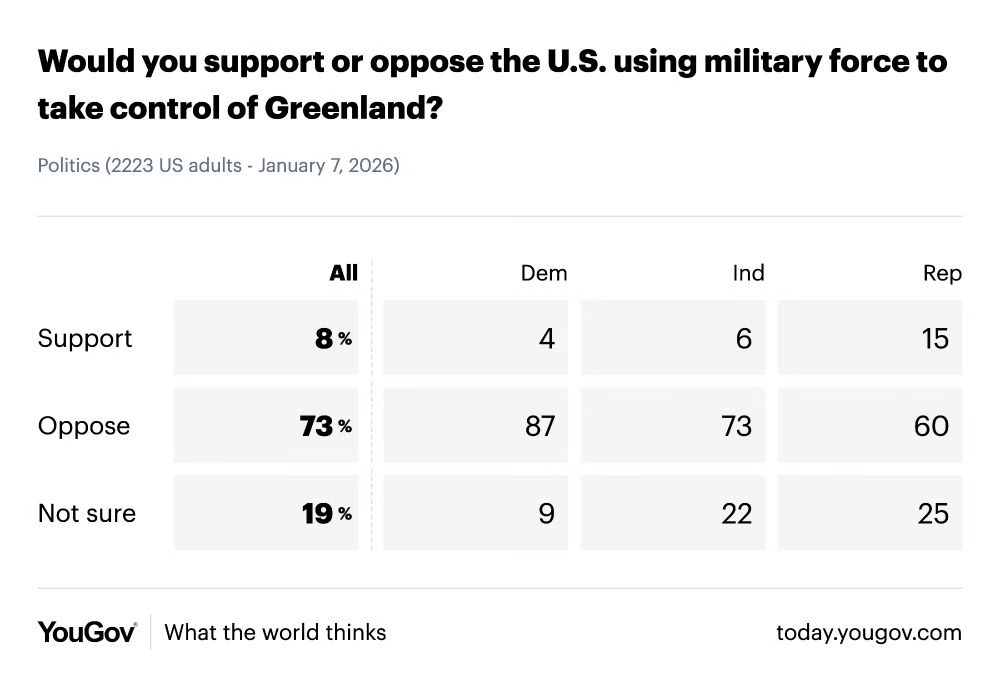
Granted, opinion can be shaped, and this question is specifically about a military takeover. But I will note two things.
First, based on the Danish government’s position on purchase and the unlikely scenario I outlined above about an independence pathway, the military option is likely the best option if Trump really, really, really wants Greenland.
Second, it is unlikely that Trump can move public opinion enough to get anything approaching enough support to move forward. Democrats are not going to budge, and a lot of Republicans are opposed to military adventurism. Further, this is an area in which the vestiges of domestic political democracy could still matter. Republicans are already facing an uphill battle for the midterms, and a military adventure in Greenland that many of their constituents oppose is potentially one of those areas in which even the ever-compliant GOP might see some movement away from Trump.
Don’t Forget: The US Can Get What it Wants Without Taking Over
Of the things I find frustrating about any talk about the need to formally acquire Greenland, whether by force or by (likely coerced) purchase, is that the US can already get whatever it might want from Greenland, right now.
Not only does the US already have a military base on the island (the Pituffik Space Base), but a pre-existing agreement allows the US access to further build as desired. The NYT reported on said agreement here: Buy Greenland? Take It? Why? An Old Pact Already Gives Trump a Free Hand.
But the question is: Does the United States even need to buy Greenland — or do something more drastic — to accomplish all of Mr. Trump’s goals?
Under a little-known Cold War agreement, the United States already enjoys sweeping military access in Greenland. Right now, the United States has one base in a very remote corner of the island. But the agreement allows it to “construct, install, maintain, and operate” military bases across Greenland, “house personnel” and “control landings, takeoffs, anchorages, moorings, movements, and operation of ships, aircraft, and waterborne craft.”
It was signed in 1951 by the United States and Denmark, which colonized Greenland more than 300 years ago and still controls some of its affairs.
“The U.S. has such a free hand in Greenland that it can pretty much do what it wants,” said Mikkel Runge Olesen, a researcher at the Danish Institute for International Studies in Copenhagen.
“I have a very hard time seeing that the U.S. couldn’t get pretty much everything it wanted,” he said, adding, “if it just asked nicely.”
This is in addition to the simple fact that Greenland is part of NATO, owing to the fact that it is governed by Denmark, and it is hardly unusual for the US to have basing rights in NATO territory.
Beyond basing rights, there are the mineral deposits of rare earths that Trump would like to exploit. Maybe I am missing something, but I see no barriers to US companies doing business in Greenland.
By the way, one of the great ironies of all of this is that the strategic importance of Greenland has been recently enhanced by climate change, such as the increased navigability of the Arctic region, as well as making mining potentially easier. This is an irony because Trump has called climate change a “con job.”
Note: Basing Rights Don’t Require Ownership of Territory
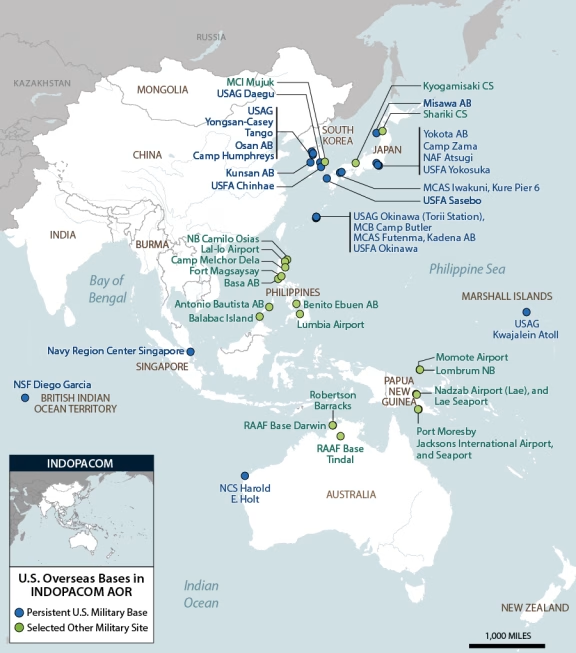
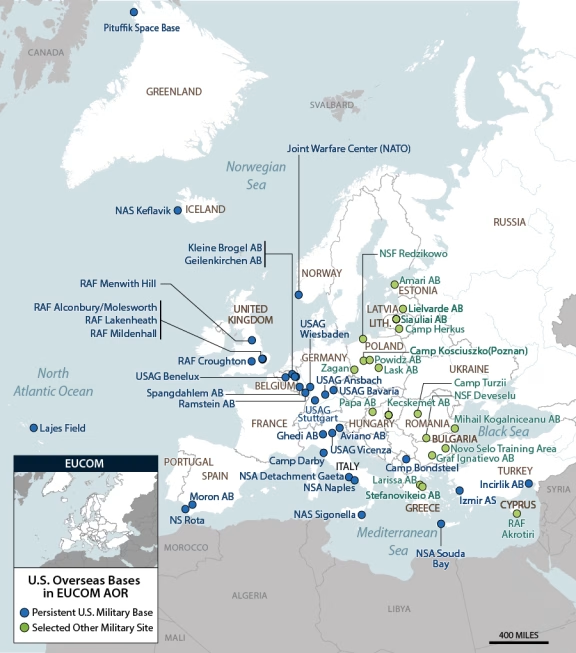
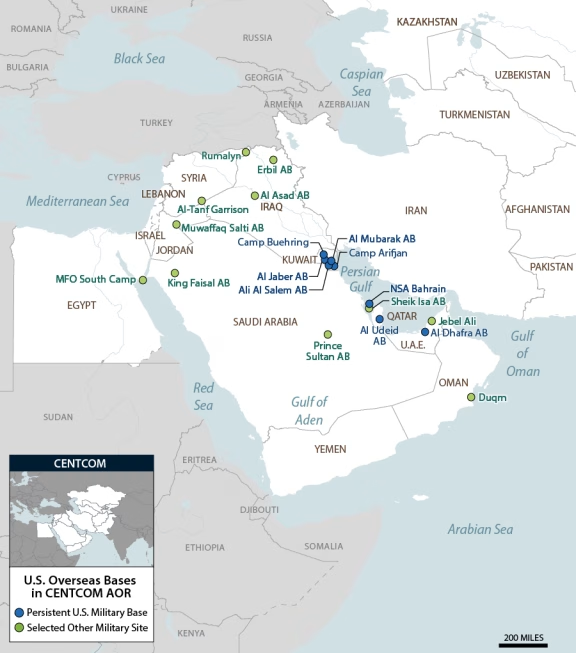
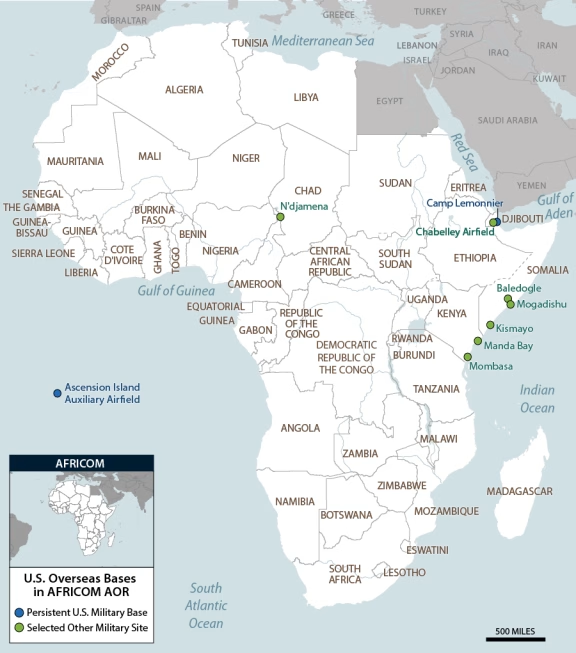
It seems worth underscoring that the notion that US ownership of a territory is requisite for a military base is undercut by, you know, reality. I can personally attest to US military bases in Japan and Korea, which the US does not own, in case anyone is keeping score at home. I have visited at least three such bases in Japan and at least two more in Korea. I saw planes and troops and everything!
Via a Congressional publication, here are the bases in Asia.
And here’s Europe.
But wait, there’s more!
The Middle East
And hey, look! Even Africa and Latin America.
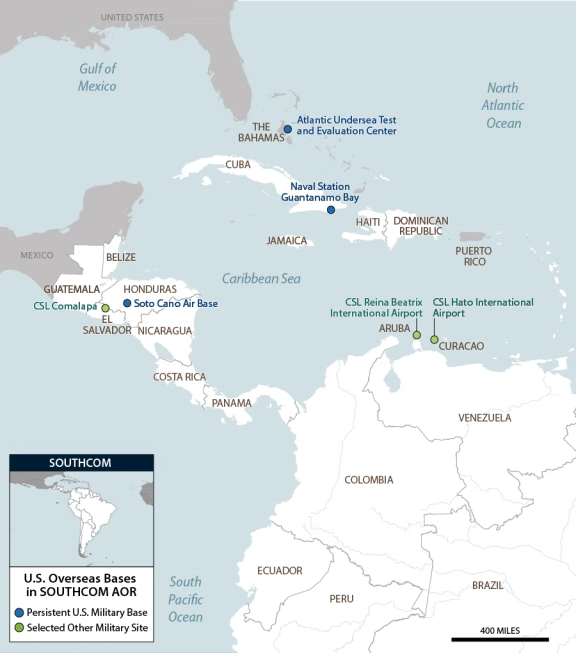
The “national security” arguments don’t hold water. And, worse, imperialistic actions by this administration would severely damage our global reputation and undercut our actual security.
The folly of actually pursuing this course of action is immense.
In Conclusion
To try and sum up a very long post: my assessment of the situation is that anything that is perceived as being a coercive take-over Greenland crosses a major line in terms of basic democratic values, if not the basic human rights of the residents of the island in way that I think is morally represensible and would signal a profound deepening of the authoritarian nature of the Trump presidency. Moreover, any coercion to acquire the territory would utterly rupture NATO in a way that would have incredibly negative, long-term, and indeed irreparable damage to our national security. And the cherry on the sundae would be that such moves would be undertaken with substantial domestic opposition.
All of this would be made all the worse when we remember that anything that might be seen as being in US interests vis-à-vis Greenland can already be acquired.









