
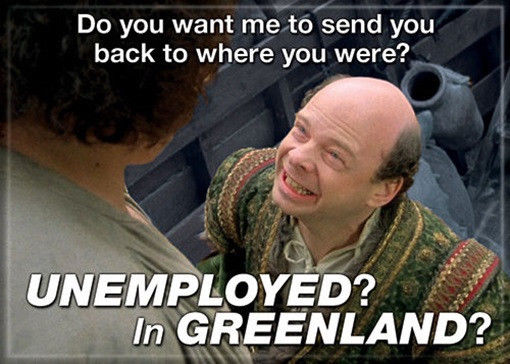

As Doug Mataconis noted earlier this week, one of the more bizarre bits of news to come out of the White House this week was a WSJ report that Trump has expressed interest in acquiring Greenland from the Danes.
On the one hand, this has put Vizinni yelling at Fezzik in my head. On the other, it is just a truly bizarre thing for a 21st Century president to be contemplating, even casually.
Paul Musgrave has a great post on this subject at Foreign Policy: American Imperialists Have Always Dreamed of Greenland which discusses the history of American interest in the island (which was all new to me), as well as making some normative points that comport with my initial thoughts from when I first saw the report.
buying Greenland has been tried seriously twice. But the changes in international relations since then make it a far worse idea than it was at the time.
The first time came during the administration of President Andrew Johnson. William Seward, a Lincoln holdover, used Johnson’s distraction over Reconstruction to pursue his longstanding goals of territorial expansion.
[…]
The second attempt came in the aftermath of the Second World War. Denmark, which still administered Greenland as a colony, was conquered in a six-hour operation in March 1940. A year later, the Danish ambassador, who retained his credentials even though he refused to take orders from the occupied government in Copenhagen, signed an agreement with the US government allowing it to occupy and fortify the island to prevent Germany from using it as a base against the US and Canada.
The wartime occupation of Greenland let the United States develop several military installations there, including an airbase.
Indeed, the US still has an Air Force base on the island.
So, in the “learn something new every day” file I can file away Seward’s and Truman’s attempts at purchase.
And, sure, from a wholly abstract point of view, the island has strategic significance and has natural resources to exploit. There is the pesky problem of, you know, human beings, the selling of which is kind of a no-no:
Greenland is no longer a colony to be disposed of as the government in Copenhagen wishesGreenland is no longer a colony to be disposed of as the government in Copenhagen wishes. Today the Danish doctrine of the “Unity of the Realm” holds that Greenland forms an integral part of the three-country Kingdom of Denmark. To put it bluntly, selling off Greenland would be as unthinkable as the US selling off Hawaii or Delaware.
There are roughly 57,000 persons living in Greenland. They have the right of self-determination, and the idea of selling legal control of them is really not acceptable in the current era. That sort of transaction is the stuff of 19th Century imperialism.
As Musgrave notes:
As a democratic country, the United States bears a special responsibility to refuse to perpetuate territorial practices. Yes, the island has only 57,000 people-about the size of Terre Haute, Indiana-but they form a distinct political community and already enjoy self rule in everything but defense and foreign affairs. Right now, there’s reason to think that Greenland may well be on a path to full independence, not simply switching one protectorate for another.
Could the United States offer Greenland’s people a better deal? Probably not. The Trump administration’s neglect of Puerto Rico and the US Virgin Islands after Hurricane Maria forms only the most recent in a long chronicle of US mistreatment of its colonies. The US still holds more than four million people as colonial subjects in islands from Guam to the Northern Marianas – and they get a worse deal than mainland Americans on every score. And who would trade the Danish healthcare system for the American one anyway?
Indeed.
The notion of buying Greenland, then, isn’t a silly idea, no matter how lightly the president may have proposed it. It’s a dangerous and a telling one that suggests that the president’s impulse to treat everything as a real estate deal means that he’s constantly tempted to bring back some of the worst habits of international relations.
Agreed.









