The Enshittification of Everything
The rapid descent into AI-generated slop.

TechCrunch’s Sarah Perez proclaims, “Google Search as you know it is over.”
The era of the “ten blue links” is officially over.
At its Google I/O conference on Tuesday, Google unveiled an AI-powered overhaul of Search centered around a reimagined “intelligent search box” — what the company describes as the biggest change to this entry point to the web since the search box debuted more than 25 years ago.
Instead of returning a simple list of links, Google Search will drop users into AI-powered interactive experiences at times. Google is also introducing tools that can dispatch “information agents” to gather information on a user’s behalf, along with tools that let users build personalized mini apps tailored to their needs.
The resulting experience will no longer look much like how people envision Google Search, which has long been defined by ranked links to websites that have the information you need.
With the revamped Search experience, the new search box simply expands to accommodate longer, more conversational queries, rather than making you decide what type of search experience or mode you want to choose at the start of your query. It will also have a new AI-powered query suggestion system that goes beyond autocomplete to help people craft more complex and nuanced queries, Google says.
Google’s AI Overviews will also allow users to ask follow-up questions in AI Mode, beginning Tuesday, the company noted.
She goes into considerably greater detail, but you get the gist. I have mixed feelings about the move, as I prefer curating my own experience using trusted sources. But Google has already been moving in this direction in recent months. For example:
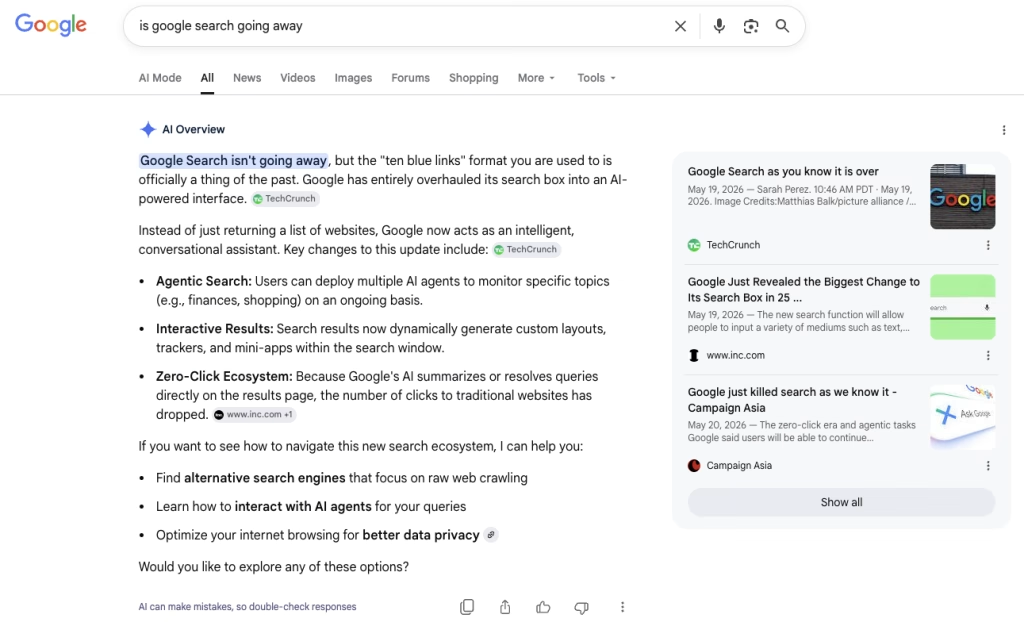
I suspect many, if not most, casual searchers would prefer this bulletized summary to actually having to comb through search results, click links, and read articles.
But it also highlights another concern that immediately came to mind. Perez addresses it late in her piece:
Combined, these changes will likely further decimate Google referrals to publishers, which have already been suffering from declining referrals due to AI Overviews. This has put some ad-dependent media operations out of business, and now things will likely get worse.
There’s little time left for publishers to adapt. The new search box is arriving this week, and generative UI is arriving this summer. Both are free. The mini-app-building feature and information agents will roll out first to Google AI Pro and Ultra subscribers this summer.
You’ll note that my search for “is google search going away” is already an AI summary of Perez’s report. While the report goes into greater detail than the summary, few searchers will bother to go through the trouble of finding and reading it.
On the one hand, Google is providing a transformative service here. Millions of people will get the information they need, quickly. On the other, it costs money to produce that information. TechCrunch, presumably, is paying Perez and others to do reporting and analysis. But Google and other AI-driven businesses are taking that information, without paying for it, and profiting from it. That, rather obviously, is not a sustainable model.
We’re already seeing reputable publishers relying on young, poorly paid staffers and removing editorial supervision in order to cut costs. Given the pressure to crank out large amounts of context, the quality is often quite low. And they’re already turning to AI to help them do it.
Soon, the Internet will be AI-generated summaries of AI-generated content.
Information should be free, dontcha know?
It’s predictable that search results will become less reliable over time. As some reliable sources disappear due to revenue declines and others, mostly the large media companies, begin to fence off their publications from the AI bots, the floodgates to low accuracy junk will begin to dominate.
Will have to see how this works. I very much like being able to find and read original literature. For stuff about which I have only casual interest this works fine. For example yesterday I had a cooking question and the pop-up AI answer was fine. I also had a question about a specific medical therapy. For that I wanted to read original stuff rather than the Ai interpretation.
As an aside, I have people here working on my house so I was trapped in one room reading and I got irritated with the current series I am reading so I turned on the TV and caught some interviews about AI. The people being interviewed are projecting changes much faster than I thought ie major changes in one year.
Steve
I have simply stopped using Google Search. I find Qwant.com superior now. (There are more options, though.)
The only downside is that Qwant lacks reviews and integration with Maps. But, of course, that is how Google deliberately tried to make their product irreplaceable. Still, Search and its associated AI slop are so unusable that I don’t care anymore.
I prefer a product that does at least one thing well.
Maybe the bigger point is that we, as consumers, don’t need to go along with the shit that the tech bros are pushing on us.
While they like to pretend otherwise, we don’t live in a company town.
As one Reddit user observed, the AI search removes the serendipitous discoveries of traditional search. That’s a net negative.
Yesterday on my office laptop, I stopped getting the AI summary when I searched Google (I do this a lot when programming, to find documentation and discussion of errors). Here at home though, I’m still getting it.
A bit of research suggested that Google had moved AI to an “opt-in” model. Where you go to google.com/ai to do your “ask the AI” thing.
This morning, though, I’m just getting AI responses. It’s a different computer. It’s very odd.
@Kingdaddy: I am more Google-positive and AI-positive than the median commenter here. I do agree with this take, though. Some noise in the results has a value. I mean, I would interpret how much noise there was as a measure of how much confidence to place in an answer, or how popular a particular answer was, in addition to the serendipity thing you have mentioned.
I can see a couple of paths.
One, Google and other tech companies acquire all news orgs and websites for pennies on the dollar, and pay the staff almost subsistence wages.
Two, they let AI hallucinate the content, like thus: Prometheus, a Brief Biography and Short Account of the Unparalleled Developments of Sergey Brin, BS., MA., Ph.D., LL.D., L.H.D., and of the Benevolent System He Founded.
Hat tip Robert Heinlein.
On the gripping hand, how many tools and websites and projects has Google developed, deployed, and then killed?
Slim sliver of hope.
I still fairly frequently use the “-noAI” at the end of my search query if I just want the results. Hopefully that won’t go away.
@Jen:
I found another way in Google’s settings. It even says “search in AI-free web for…” in the right-click pop-up menu when I highlight something in a website. It still does he AI summary etc, but doesn’t show it as a default.
The problem is I don’t recall what I did. Hey, I did it once, months ago. I posted about it here, but it would take a while to find it… I’ve been searching the web, but most results I get are for Android and iOS.
If I find it, I’ll let you all know.
Rant warning.
Let me preface by saying I’m a technophile and have been one all my life. I got into computers in 1981, when they could do little that was really useful. mostly it was a hobby of sorts, or playing the primitive games that somehow managed to produce relatively good gameplay.
I do try almost any new development, but won’t adopt all unless they do something for me. Take Windows. I recall trying Windows 2 on a portable Toshiba PC (80286 processor, maybe 1 MB RAM, 40 MB HD), and it struck me as completely pointless. I could run WordPerfect, games, the modem dialer, etc. perfectly well on DOS (4.01). It wasn’t until I tried Windows 3.1 that I found it useful, and then only because Netscape was a far, far, far superior way to navigate the World Wide Web than LINKS. Even then I kept running a lot of stuff in DOS. It wasn’t until Win95 that I saw it as an OS (which it still wasn’t*)
Point is, when something new comes out, I’m intrigued and will look it up. Sometimes I don’t even get the point. It took me months to find a use for Fakebook, which is now mostly useless. When the Segway came out, I struggled to see what was so great about it, given all the hype in the press.
So when “Generative AI” came out, I was curious to try it. You may recall I posted extensively about it here over several years, and over changes to the Copilot interface.
It was very intriguing, but riddled with fatal flaws. You know all about hallucinations, I assume. And about the sycophancy (useful if you want to stroke your ego, but little else). There are many more. For something labeled “intelligence” it lacks any. It doesn’t think, there’s no judgment, there are inexplicable obvious errors (Q: which days of the week contain the letter d? A: Tuesday, Wednesday, Thursday). Most of the output will be the data it was trained on. This can be useful, but one should keep in mind it doesn’t really produce much that is original. Hallucinations are convincing imitations of real exemplars, like how it makes up court cases by coming up with “Calledit v Dibs.”
Image generation is relatively good, and impressive if, like me, you have trouble visualizing things and couldn’t draw anything more complicated than a stick figure. It does better modifying images, which I’ve used to waste time paying virtual dress up (might be useful if it didn’t copy the body shape of the model wearing the outfit you want to see on yourself).
I’ve found some limited uses, not many. For many things, it can do like a portion of what one needs, say 50% to 90%, but, depending on the task, it might take longer than doing the work yourself, it might contain erros (including fatal ones and hallucinations), it requires to be checked, and there’s still the rest of the work to be done.
The bottom line (finally!!) is that I don’t see LLMs as being worth the tonnage of money and resources being invested in them, or the way they are being pushed and integrated into everything. and there’s still Google’s latest brainstorm, which oges far beyond what Jame sposted here.
*It was an “operating environment”.
As a libray-wallah I find both AI “summaries” and Google’s general search decline frquently infuriating.
The “AI” output is to a large extent a pirated derivative of copyrighted material in a LLM precis.
And not uncommonly, wrong or at best misleading, on certain subjects.
Google (and other LLM mongers) might do a lot better to address the basic problems of their current LLM’s (beside their “eagerness to please”): they don’t pay and credit the intellectual property owners appropriately.
For this reason they reamin shut off from huge amounts of actual human knowledge, such as the total print corpus, and the academic journals.
Being therefore reduced to “scraping the internet” it’s a minor miracle the replies to everything are not “CATS!”. And porn.
The knowledge base of LLM’s is in fact rather shallow; but presented in a way that camouflages that.
The real problem may come with a “slop feedback cycle” where the “open internet” is increasingly AI generated, and LLM’s end up getting trained on what is effectively their own output.
Per Perez
Putting ad-dependent media operations out of business seems like a problem for a company that makes a lot of its money from running the ad networks that that are used by those ad-dependent media operations.
And given the computational costs of AI, Google is spending a lot of money to hurt one of their major sources of revenue.
Search ads being basically buried are also a problem, but might not be as big of a problem, as Google directly decides how much AI crap to add (searching for “crow funeral rituals”* is likely less likely to generate ad clicks than “malpractice attorney”, and the latter may surface ads better), and could put ads in the AI crap.
*: you might not want to actually look up crow funerals, just quietly accept that crows are complicated, intelligent creatures that say goodbye to their loved ones in their own, unique way.
@Kathy:
…
It’s not “little else,” it’s big to me!
The latest brainstorm form Google is called Google Spark.
The good news, it will be available at first only to Google AI Ultra subscribers (whatever that means).
The bad news, this is “at first.” They will likely release watered down version for lower subscription tiers, and barely usable ones for everyone else.
I’d need a lot more useful use for AI before I spend as much as half a penny on it.
Anyway, I had a thought. I’ve reas a great deal about homework and papers taking anywhere from dozens to hundreds of prompts, plus several hours with the LLM, and I presume some more time to check it didn’t place WWII in the 1500s, or waxed poetic about the Battle of Patagonia between Japan and the Russian Empire*.
I’ve no idea what prompts are used. Typically one begins with a maximalist request, maybe very detailed, and then spends hours correcting the output to something usable. So, what if instead I tell it a story in stages describing scenes and dialogue, correct its impressions (or incorporate those I might like**), and once I’m all done I ask it for a draft.
It’s worth a shot.
I’d still find no use for that, but it would satisfy my curiosity.
*I can imagine something like that if asked how WWII played out in Latin America.
**With care. Relying on” ideas” from an LLM strikes me as a sure route to plagiarism.
I used ChatGPT enough to be willing to purchase the entry level plan for $20/mo. When I reviewed my credit card statement, I was being billed for $200/mo. So, I immediately sought to contact OpenAI to resolve the matter. Surprisingly (tongue-in-cheek) I could only contact them via a AI controlled chat.
The responses were consistently AI-generated, even though they were signed by human names. The referred to their Terms and refused to refund me for the extra $180/mo.
So I told them that they had lost a loyal customer. Another AI-generated response with a human name attached.
I asked them to quit the AI crap and let me communicate with a human. More AI crap.
I’m sad. I really enjoyed using ChatGPT, but I can’t in good conscience support a company that is so AI focused that is refuses to allow human connection.
Other companies to which I’m loyal would have worked with me to make sure I was happy. No so Open AI.
Part of me is afraid that society will become numb to the shock of AI blocking communication with a person who has agency to deal with individual customers and just accept what the machine spits out.
@Kingdaddy:
I was concerned by this back when dinosaurs walked the earth – 1973-4 – when I first encountered a computer replacing the card catalog. One of my jobs at Wilmer Cutler was doing odd bits of non-legal research. I used GWU, Georgetown, American U, the DC Public and on rare occasions the LC. I couldn’t begin to count the number of times I’d be thumbing through the card catalog and coming accidentally upon the thing I did not know I needed, but did. Or just stumbled into something that wasn’t what I needed, but was interesting.
No one I talked to agreed that it was a problem. And strangely the march of progress was not stopped by the whining of a 20 year-old library grunt.
I quit using Google products to the extent that I could last year. However, once in a while, I’m unhappy with the results I’m getting with other search engines and resort to using Google.
Somewhere I learned how to stop Google from presenting their AI Overview and “featured” links first. The key is to enter “%s” (no quotes) in the search field to get the non-edited search window. Then replace the “%s” with your search query.
I just tried this and the sub-menu offer AI mode, but otherwise the results are like the earlier Google search results.
Don’t know how long this will work, but it’s still working as of today.
@Skookum: I hope you got the credit card involved — chargebacks are how they learn.
I’d been trying to remember something John Maynard Keynes said that seemed apt to AI, techbros, and late-stage capitalism, although Keynes got it wrong. Yesterday, Paul Campos at LGM quoted it, a prediction for 2030.
Seems he was right to call it possibility. Doesn’t seem probable.
@gVOR10:
The timing’s a little off.
Here:
This will absolutely happen, after the last human dies. Which probably won’t be by 2030.






