
Investigators Conclude Flight MH-17 Shot Down By Missile Brought Into Ukraine From Russia
A new report concludes that Malaysia Air Flight 17 was brought down by a missile brought into Ukraine from Russia.
A new report concludes that Malaysia Air Flight 17 was brought down by a missile brought into Ukraine from Russia.
A high-level French Court has struck down the ban on the so-called ‘burkini’ adopted by many towns along the French Riviera.
For largely irrational reasons, French police are arresting women on the beach for wearing swimsuits that are compatible with their faith.
A night of terror mars Bastille Day celebrations in France.
A quick succession of events this morning means that Theresa May will become Britain’s Prime Minister far sooner than anticipated.


Regardless of the outcome of the Conservative Party’s leadership race, the next Prime Minister of the United Kingdom will be a woman.


Early panic over the Brexit referendum was an overreaction. It’s time for statesmanship.
Given the consequences of a Brexit, one wonders why the referendum didn’t require more than just a simple majority to pass.
A British political scientist lays out some of the political and institutional factors that will be relevant going forward.

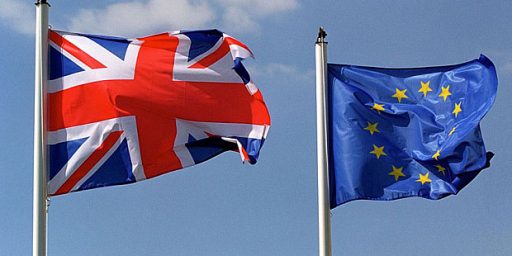
Voters in the United Kingdom are headed to the polls in a vote that will have widespread consequences.
With just over a week to go, the latest polling shows voters in the United Kingdom leaning toward leaving the European Union.
Europe’s anti-immigrant, xenophobic far right scored major victories in France yesterday.
NATO is extending full membership to the tiny nation of Montenegro, and there doesn’t seem to be a good reason why they’re doing it.
The German Parliament has approved expansion of the nation’s involvement in the campaign against ISIS, but that doesn’t make the current campaign any less incoherent.
The British Parliament has approved expansion of that countries airstrikes into Syria, but it’s unclear just how much of an impact that will have on the ground.
A vote is still as much as two years away, and support for staying in the E.U. still has the most support, but support for the idea of a British exit from the European Union has grown in the past several months.


The election of an anti-austerity government in Portugal is raising some concerns.
France’s President has spent the week trying to forge and agreement on an anti-ISIS policy, but the two nations that matter the most also disagree the most.


Tensions between Russia and Turkey remain high in the wake of yesterday’s incident, but there are some signs that things are starting to cool down.
Another European capital is on edge over fears of a terror attack.
French officials have confirmed that Abdelhamid Abaaoud, the man believed to be the plotter of last Friday’s attacks in Paris, was killed in a police raid early Wednesday morning. This doesn’t mean authorities in France or elsewhere in Europe are any less concerned about future attacks, though.


Syrian refugees have quickly become political footballs in the United States in the wake of the Paris attacks, and it’s become an exceedingly shameful display of pandering and fearmongering by a group of largely Republican politicians.
Confirming speculation that had already been all but confirmed, we now know that it was a bomb that brought down a Russian passenger jet on October 31st.
France launched its first attacks against ISIS even as the investigation into Friday’s attacks continues, but it’s not clear that the retaliation really accomplished anything.
We are legally, morally, and practically obligated to respond. Let’s not do so stupidly.

We can draw a rather direct line from the Iraq war to the rise of ISIS.
France’s President blames ISIS, vows response, as death toll from Paris terror attacks stands at at least 127.
The investigation continues, but the consensus seems to be growing that Metrojet 9268 was taken out by a bomb.


America’s much touted international coalition against ISIS is, essentially a Coalition In Name Only.
A Dutch inquiry has largely confirmed what was widely believed about the fate of Malaysian Airlines Flight 17.
With Russia now launching its own airstrikes in Syria, it’s become obvious that U.S. policy in the Syrian Civil War is irrational and contradictory. And Russia’s policy isn’t any better.
The U.S. is set to ramp up its contribution to dealing with the Syrian refugee crisis, but there’s a lot more we can do.


Congress is set to debate the Iran nuclear deal next month, but as far as Europe is concerned the debate is already over.


It’s easy to see what Greece thinks it still needs Europe, it’s more of puzzle why Europe thinks it needs to hang on to Greece.
Greece reached a new deal with European bankers that seems oddly similar to the one that voters rejected just a week ago.
Greek voters rejected the latest bailout package, but that only seems likely to make things even worse for them.
Greece’s Prime Minister seemed to give in to some of Europe’s demands today, but bankers are continuing to hold to the strict conditions they set last week.