Chaos Works Both Ways
Flooding the zone saps his opponent's attention, but also his White House's.
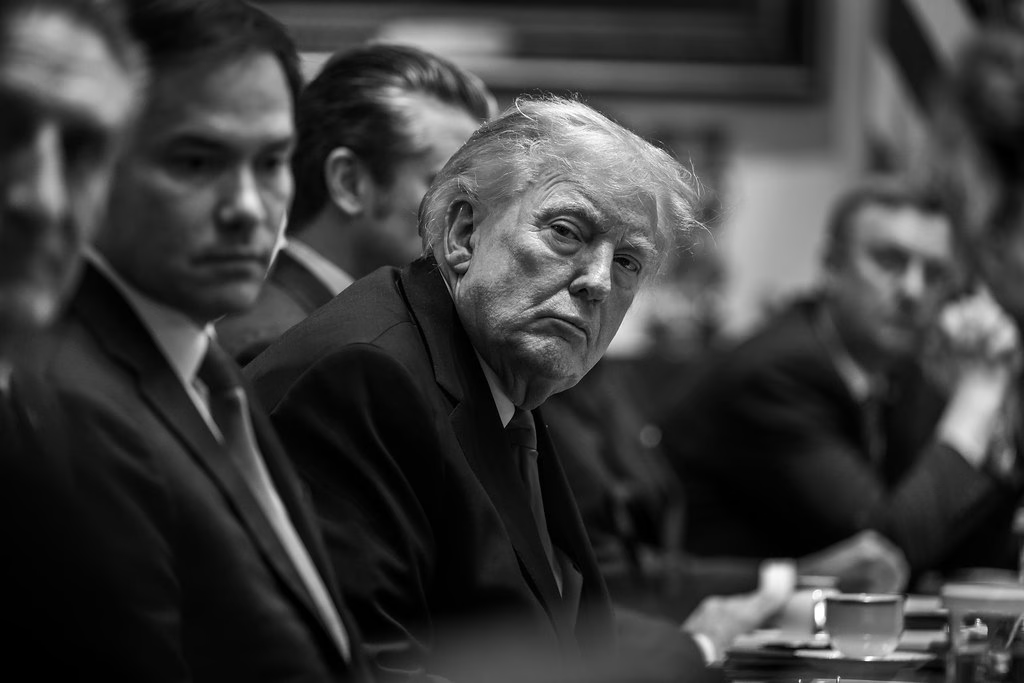
Ezra Klein contends, “The White House Is the Crisis.” His premise:
The strategy of the Trump administration over the last year has been to move so fast, to do so much, that the opposition could never find its footing. This was Bannon’s insight, and it was real: Attention is limited. The media, the opposition, the electorate — they can only focus on so much. Overwhelm their capacity for attention and you overwhelm their capacity to think, organize and oppose.
But what you are doing to the opposition you are also doing to yourself. “It is a strategy that forces you into overreach,” I wrote last year. “To keep the zone flooded, you have to keep acting, keep moving, keep creating new cycles of outrage or fear. You overwhelm yourself.” And that is what happened. The Trump administration is overwhelmed — by its own violence, its own cruelty, its own lies, its own chaos.
My initial instinct is that it doesn’t much matter. If the intention is to delight core supporters with action while instilling opponents with fear and angst, the strategy is working. It overwhelms the news cycle and makes it nearly impossible to keep up with the current state of affairs. While it doesn’t necessarily result in a lot of permanent policy change, it’s effect on the culture is long-lasting.
But Klein’s argument is interesting:
Muzzle velocity was built on the idea that the Trump administration had reserves of attention and focus that the rest of us did not. The reality is just the opposite. The White House has demands on its attention and focus that the rest of us do not. We are not responsible for managing or controlling everything from the labor market to A.I. policy to immigration enforcement and vaccine approvals. We will not be blamed for a measles outbreak or a recession. But the president will.
That is why most White Houses pay such close attention to policy processes and chain of command: These are all ways of filtering the torrent of information and decisions in order to conserve the focus and attention of the president and his top aides. Well-managed White Houses — and personally disciplined presidents — are ruthless in their pursuit of prioritization. “You’ll see I wear only gray or blue suits,” President Barack Obama told Vanity Fair in 2012. “I’m trying to pare down decisions. I don’t want to make decisions about what I’m eating or wearing. Because I have too many other decisions to make.”
But this White House — and this president — have treated freneticism as a virtue and discipline as a vice. Instead of seeking to limit the number of crises and conflicts that they need to remain on top of, members of the Trump administration, from their first day, sought to multiply them. They spent their initial months in office ripping the wiring out of the federal government, including gutting internal teams, like the National Security Council, that are meant to help process information on behalf of the president. They have treated caution and restraint as an admission of weakness.
Counterpoint: Trump pretty much wears only blue suits, white shirts, and red ties.
But, yes, as a student of policymaking, especially defense and national security policymaking, this President’s near-complete abandonment of longstanding processes is fascinating.
Every organization comes to resemble its leader. Trump himself is easily distracted, desirous of flattery rather than counsel, impressed by crude displays of dominance and violence and obsessed with social media and cable news — and so too is his White House. The sycophancy among Trump’s aides is so crude as to be indistinguishable from mockery. Miller, speaking to a New York magazine reporter about Trump’s health, said, “The headline of your story should be ‘The Superhuman President.’” When Miller says this, does he realize he is making his boss look ridiculous? Does he intend it?
But it’s not just Miller. Trump’s cabinet meetings take the form of totalitarian kitsch.
[…]
The joke of Trump’s cabinet meetings is that no one is joking. These meetings are not just a performance; they are a culture. Trump’s favor is won through demonstrations of loyalty rather than competence. The president wants parades, not process, and that is what he gets.
If the main objective is personal validation and aggrandizement rather than making good public policy, though, that’s arguably a good thing.
The irony of Trump’s second term is that he was much better served by the advisers in his first term, who understood that part of their job was to protect him — and the rest of us — from his worst impulses. In 2020, when Trump reportedly responded to the George Floyd protesters by asking the military to “just shoot them, just shoot them in the legs or something,” his advisers weren’t protecting only us when they refused. They were also protecting him.
Trump’s second White House was built to ensure that no one would ever tell Trump no again. He wanted a culture of lies and sycophancy, and he got one. “I hear stories from my predecessors,” Susie Wiles, Trump’s chief of staff, told Vanity Fair in December, “about these seminal moments where you have to go in and tell the president what he wants to do is unconstitutional or cost lives. I don’t have that.”
I’ve been delivering the school’s “National Security Policy and Process” lecture for a decade. During the Trump 45 administration, I essentially caveated that we were in a temporary deviation that could be viewed as a natural experiment to see whether the “normal” way of doing things was right. By the time I delivered it this fall, it was clear that I had to substantially revise the lecture. “This is the way we do it unless Donald J. Trump is President” is not useful to officers who’ve served under Trump half their careers and will do so the next three.
Moreover, it was already obvious that Trump 47 was considerably less constrained by the old processes than even Trump 45. Indeed, one of the driving forces of this presidency is that he’ll no longer let experts talk him out of doing what it is he wants to do.
Trump’s aides flatter him and lie to us. They indulge his constant distraction and so they too are constantly distracted. They are dominated by him and so they seek to dominate us. What they believe to be their strengths are their weaknesses. You can see it in their metaphors. The shock and awe bombing campaign was the prelude to catastrophe, not to victory. And so it is here.
This is a presidency that is, by any measure, failing. Trump is unpopular; his brutality and his tariffs have turned immigration and affordability, once among of his strongest issues, into liabilities. Trump’s opposition is increasingly united and mobilized; Democrats are besting Republicans in elections all across the country and disciplined, brave, beautiful protest movements have emerged in the cities ICE has sought to occupy.
[…]
We are watching an administration that is not only retreating in key areas — dropping its demand for all of Greenland, sending Greg Bovino back to Border Patrol’s El Centro region, meekly backing off its trade war with China — but finding itself cornered by its own cruelty and lies. Miller’s slander of Pretti as a “domestic terrorist” and an “assassin” could not stand even the barest contact with the video of Pretti trying to protect a nearby woman or the quiet heroism of his daily life.
Trump appears to be trying to course correct, but he has neither the discipline nor the personnel to truly change his presidency’s direction. This administration is a reflection of who the president is and what he wants. This White House is not beset by crises. This White House is the crisis.
I’m not sure the framing here is right. The administration is only “failing” by the measures by which normal administrations are judged: making long-term changes in public policy and being sufficiently popular to elect copartisans in the midterms and the subsequent presidential election. But it’s not at all obvious to me that Trump cares about those things.
Trump has been, for over a decade now, the most talked-about person on the planet. No American President—not George Washington, not even Franklin Roosevelt—dominated the country’s politics for this long and he’s got another three years. Furthermore, backing down on policy ideas that garner huge backlash would be embarrassing for most Presidents; because Trump doesn’t really care about policy outcomes, he just shrugs it off and moves to the next thing.

There were a bunch of reasons I got out of politics (long hours, garbage pay, and catering to outsized egos were just some of them), but the biggest reason was that I was just not an adrenaline junkie like most of those around me. They LOVED the go, go, go, go, go nature of the election cycle. I found it exhausting and stressful, in no small part because on top of going 150 mph pretty much constantly, you could NOT make mistakes.
The fact that they’ve designed a White House that treats chaos as a virtue is an incredibly BAD thing. There’s no way that they are paying attention to everything they SHOULD be doing. It’s pure luck that they haven’t had a real collapse of some aspect of government (yet), and as I pointed out the other day, they’ve absolutely eviscerated the public trust.
Trump lacks focus and he is, uh, not a deep thinker. President Obama realized that as a Black man, he had to be as close to perfect as possible. Anything less than that would doom future candidates of color. Trump gets to ride on an awful lot of privilege; being white, yes, but also as a child born into wealth. He’s failed up his entire life. It’s why he’s been able to get away with being arrogant, inattentive, and downright hostile.
I worry that the mess this group is leaving is un-clean-up-able. That future presidents, Democratic and Republican, will not be able to piece together a functioning government from the ashes this crew is leaving in their wake. You can glue a broken pitcher back together after shattering it, but it will probably leak. These clowns have gone one step further and ground several pieces to a powder, all but ensuring that repairs are impossible.
@Jen: In foreign affairs, the damage done to alliances that took generations to build is incalculable. And I suspect damage to trust in government institutions from the CDC on down is permanent. I just don’t think Trump personally cares about any of that.
The real opposition easily found its footing, though. It’s guys like Klein who have been like ‘drr Charlie Kirk practices politics the good way’ and centrists who were wagging their fingers at people who cared about ICE shipping detainees to torture prisons in El Salvador. They’re the ones who didn’t find their footing, not the normal people who figured out who Charlie Kirk was in less than 5 seconds.
I’d also say that Trump’s ideology promotes the idea that everything normal is chaotic and makes no sense. They aren’t into chaos. They don’t understand it. They’re all terrified of a normal day in a city because it’s too much for them. They’re like abusive guys who end up in their ex-wives closets because they need to figure out why their exes keep on changing their phone numbers. The guy in the closet tells his abusive buddies that he’s dynamic and energetic, and that’s why women don’t like him. Trump’s people tell each other that they move fast and aren’t afraid to shake things up. Same lie, different context.
@Jen:
Feature, not a bug, I fear.
Have you ever read Neal Stephenson’s Snow Crash? I recently read (I forgot where, but some place credible) that quite a few of our tech bro overlords see this obvious parody as something to emulate.
We are being ruled by morons. Worse, somehow we let ourselves be ruled by morons.
My suspicion is that Bannon’s concept of chaos is planned and plotted diversions, not random, often counterintuitive thought explosions from a demented man.
From Klein’s POV Trump is failing. From the POV of Trump and his supporters things are fine. Trump has no sense of shame and as long as he is in charge and can order people around he is happy. His supporters are happy as long as he is “owning the libs” and they are abusing POC and liberals. It really is a cult (of personality) and they will always find a way to justify and enjoy what he does. You have to shoot a few eggs to make a white omelet.
Steve
It’s a lot easier to manage chaos when you just don’t care.
There’s no way that Trump actually knows what the people who are directly reporting to him are doing, let alone all their underlings. He wants headlines and flattery, and leaves the rest to them, except when he randomly gets an idea in his head about Greenland, or feels snubbed and declares a tariff or a decertification of every Canadian built plane.
And the people under him know this, and feed him red meat by doing things like arresting Don Lemon (is that his name? I don’t care, he’s a godfather of citrus now) while going about their own projects.
@drj:
Alexis de Tocqueville is weeping in his Heaven.
And I suspect a number of our Founding Fathers are spinning fast enough to power the BPA grid.
@Flat Earth Luddite:
@Jen: Re: …”repairs are impossible.”
That may apply to Trump’s ability to correct the mistake of putting room-temperature IQ fanatics in charge of running things as well. He appears to have recognized they have gone way too far. But who will replace them?
Intelligent people can see the 26 elections are very likely to lame-duck this administration. It’s one thing to staff up with a year and a half to two years clear to get things done, quite another to staff up for six to ten months of fixing-the-mess with a tantrum-throwing spoiled brat as their boss.
He may find only stupid and/or demented rats looking to swim aboard the SS Trump. The ones that are neither will only be there to steal something and immediately jump off.