
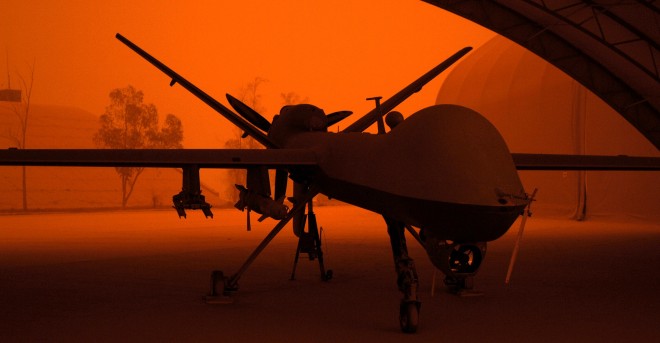

While a recent New America Foundation study found that 30 percent of those killed by drone strikes in Pakistan are civilians, a new study by Bryan Glyn Williams finds the real number is a tenth that.
Spencer Ackerman, who has obtained an advanced copy, reports:
Much like the New America Foundation study, Williams’ team relied on English-language media accounts of the drone strikes in Pakistan to compile a data base of how many civilians and militants were reported to be killed. He conceded from the start that such a reliance is a “serious limitation” of the study — news reports can, after all, be incorrect — but the tribal areas of Pakistan where the strikes occur are often off limits to Western researchers, and even their Pakistani counterparts.
[…]
Williams’ results, which he said have been peer-reviewed, are as follows:
According to our database, as of 1 April 2010, there have been a total of 127 confirmed CIA drone strikes in Pakistan, killing a total of 1,247 people. Of those killed only 44 (or 3.53%) could be confirmed as civilians, while 963 (or 77.23%) were reported to be “militants” or “suspected militants.”
That leaves just over 19 percent of reported deaths out of either category, as their status as civilians or combatants can’t be rigorously determined under Williams’ methodology. But he writes that “even if every single ‘unknown’ is assumed to in fact be a civilian, the vast majority of fatalities would remain suspected militants rather than civilians — indeed, by approximately a 3.4:1 ratio.”
[…]
Both of the principle authors of New America’s drone strike survey, Peter Bergen and Katherine Tiedemann, are on vacation, but they both still (generously) addressed my questions. All three researchers — Bergen, Tiedemann and Williams — appeared to agree that New America was more methodologically aggressive than Williams in counting as civilians all who could not be clearly identified as militants, which perhaps accounts for the variance in their results.
Bergen observed in a Blackberried message that although his civilian death tallies are higher than Williams’, he has observed that the drone program has increased its accuracy over time, “so the later the the date that the study begins the lower the rate [of civilian deaths] will be.” That’s in line with Brennan’s intimation (he never actually uses the word “drones”) that the drone strikes “are more precise and more accurate than ever before.”
Accordingly, Bergen now pegs the civilian death rate from the drone strikes at 20 percent. Williams pegs it at 3.53 percent. What no one knows, however, is how many outraged Pakistanis take up arms against the U.S. or its allies as a result.
FP’s Christine Fair, seemingly independent of other of the aforementioned studies, pushes back against the “we’re creating more terrorists than we’re killing” argument and, in particular, a year-old NYT op-ed by David Kilcullen and Andrew Exum titled “Death from Above, Outrage from Below.”
The only publicly available civilian casualty figures for drone strikes in Pakistan come from their targets: the Pakistani Taliban, which report the alleged numbers to the Pakistani press, which dutifully publishes the fiction. No one has independently verified the Taliban’s reports — journalists cannot travel to FATA to confirm the deaths, and the CIA will not even acknowledge the drone program exists, much less discuss its results. But high-level Pakistani officials have conceded to me that very few civilians have been killed by drones and their innocence is often debatable. U.S. officials who are knowledgeable of the program report similar findings. In fact, since January 1 there has not been one confirmed civilian casualty from drone strikes in FATA.
Not only do drone opponents rely upon these fictitious reports of civilian casualties, they also tend to conflate drone strikes in Pakistan with air strikes in Afghanistan, lumping the two related but very different battlefields together as one contiguous theater. They also conflate different kinds of air strikes within Afghanistan.
These distinctions matter, a lot. In Afghanistan, it is an ignominious truth that hundreds of civilians are killed in NATO airstrikes every year. But most of the civilian casualties in Afghanistan have not stemmed from pre-planned, intelligence-led attacks; rather, civilians are most likely to die when troops come into contact with the enemy and subsequently request air support. This is because when it comes to air strikes, NATO forces in Afghanistan have a limited range of air assets at their disposal. As a result, when troops come into contact with insurgents and call for air support, they get the ordinance that is available, not the firepower that would be best suited to their needs. Sometimes large bombs are dropped when smaller ones would have been better, and the risk of civilian casualties increases accordingly.
Exum dismisses this. Emphatically:
I do not care how many civilians drone strikes actually kill. And I do not care how many civilians Americans think drone strikes in Pakistan kill.
I care only about how many civilians Pakistanis think drone strikes kill. As one of the world’s experts on Pakistani public opinion, you should be able to provide that number to me, right? Because all you can tell me right now is the Pakistani press is dutifully reporting whatever the Taliban tells them … and I already know that. I don’t care in the slightest about what Pakistani generals or the CIA is telling you behind closed doors. It does not matter. I care about what those Pakistani generals are telling their public. I care, in other words, less about reality as defined by verifiable facts and figures and more about reality as it is interpreted in Pakistan and within Pakistani diaspora communities.
That’s exactly right.
Now, of course, the actual truth of the matter is worth investigating. Presumably, having the real numbers will be worthwhile in pushing back against the propaganda of the Taliban and their enablers in the Pakistani military. But the bottom line is that reliance on air strikes — of whatever sort — rather than commandos makes it much more likely that we’ll kill civilians and, more importantly in terms of the information war, much easier for the enemy to distort reality to his own advantage.








