A rather bizarre column by Jeff Jacoby is drawing some blogospheric attention.
YOU’RE A sensible, principled conservative. You want America to be a land of boundless opportunity and freedom, where people are treated as individuals and judged on their merits. You reject the divisive identity politics of the left – what matters most about any of us, you would insist, is not race or class or ethnic origins: it is personal character and achievement. There are few things about contemporary politics you deplore more than the demonizing or scapegoating of entire groups (“white males,” “the rich,” “the Christian right,” “gun owners”), as though every member of the group is interchangeable and indistinguishable, wholly defined by a single disparaging label.
True.
But let someone mention “illegal immigrants,” and your principles fly out the window.
No, not me.
So when Governor Deval Patrick recommends allowing young illegal immigrants – residents of Massachusetts who have graduated from high school – to attend a public college and pay in-state tuition, you flip out. This is outrageous, you protest. It rewards people who broke the rules. It’s unfair to the taxpayers who subsidize public higher education. Why should an illegal immigrant get a valuable tuition break that Massachusetts wouldn’t give to a kid from Maine or New Hampshire?
You vigorously agree with Charlie Baker, a Republican candidate for governor. “If you’re illegally here, you’re illegally here,” Baker said last week. “The notion that we should treat illegal immigrants with the same benefits and opportunities that legal immigrants and legal citizens have doesn’t make any sense to me.”
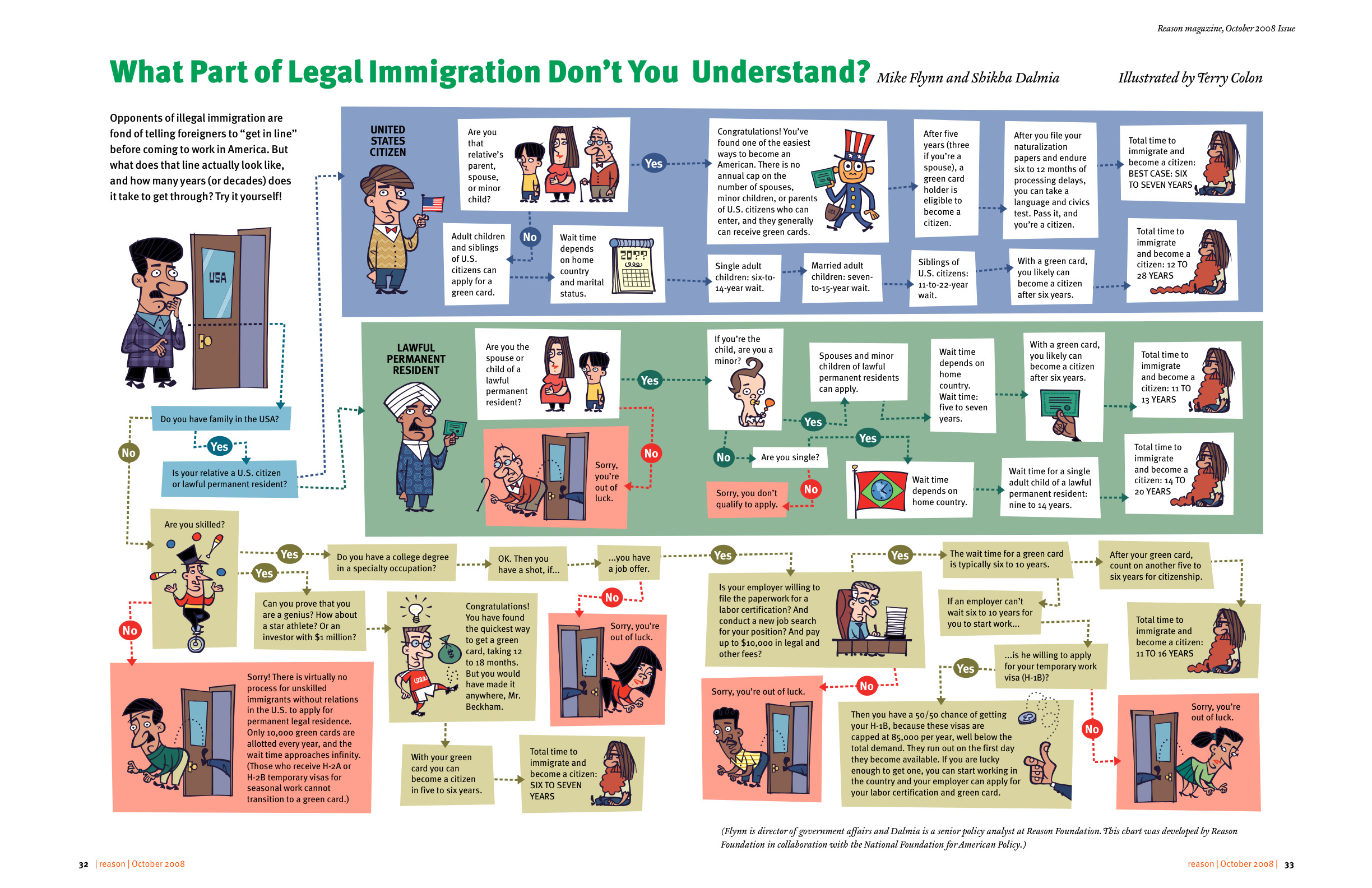
It is dispiriting to see Baker, a man of considerable intellectual heft, stoop to such shallow sloganeering. It is even more dispiriting to see conservatives assail immigrants instead of the insane immigration system that gave most of them no legal way to enter the United States. On the whole, illegal immigrants are just the sort of newcomers Americans should embrace: self-motivated risk-takers, strivers determined to improve themselves, hard-working men and women willing to take the meanest jobs if it will give them a shot at building their own American dream. Why would we want to punish them? Why would we want to punish their kids?
But these aren’t mutually exclusive. I simultaneously agree with Jacoby that our immigration system is broken, that accepting and assimilating more of them is on the whole a good thing, and that it makes sense to educate assimilated immigrants and yet believe that we ought to enforce our laws. The fact that we can’t or won’t enforce our immigration policy is a good reason to change it — not a reason to pretend the laws don’t exist.
Jacoby cherry picks a particularly hard case:
A couple from Brazil, seeking a better life for themselves and their 2-month-old daughter, enter the United States unlawfully. They settle in Massachusetts, where 18 years later the girl graduates from a public high school, as assimilated and acculturated an American as her classmates in every respect – except that they are US citizens, and she, by virtue of a decision made when she was a baby, is not. Her classmates can attend the University of Massachusetts, paying $9,704 a year in tuition, the price tag for Massachusetts residents. She can attend only if she pays the out-of-state rate of $22,157; if that’s more than she can afford, she’s out of luck.
This has to be unrepresentative. What percentage of illegal immigrant children of college age have been residents of the state for eighteen years?
On the other hand, Jacoby has a point about irrationality among conservatives on the issue.
An unsigned piece at Stop the ACLU retorts, “what Jeff is missing is that the people looking for a better life entered the country illegally. Why should we excuse that behavior? We shouldn’t embrace that behavior just so they can build the American dream.” Jacoby doesn’t “miss” that; he argues that the system essentially doesn’t allow these people a legal means of immigration and that millions of them are already here.
Still, the reaction is understandable: These people are here illegally. Granted, in most cases, it was their parents who broke our laws, merely bringing their kids along for the ride. And some percentage of the kids are for all intents and purposes Americans, having grown up here and having no memories of “home.”
But it does seem perverse to reward their parents for flouting the law. Those who are trying to get in legally are waiting years and foregoing this opportunity for their children, after all. Openly declaring a policy that “once here, you’re here” both makes those who play by the rules suckers and ensures fewer will play by the rules.
Clifton B of Another Black Conservative argues that we can’t afford it. “What Jeff Jacoby (like so many in Washington) has forgotten is that America is $12 trillion dollars in the hole. Half of every dollar we spend is borrowed money. Money that must be paid back by a generation that is too young to vote their objections or accept the responsibility. Sure it would be nice not to punish the children of illegal immigrants for the parents’ lawbreaking. However the stark reality is that for us to be generous the way Jacoby suggests, requires us to be cruel to our very own children by robbing their futures to pay for our current mistakes.” A similar argument is made at 24Ahead.
That just doesn’t make sense. Either the in-state rate is a worthwhile investment in the future of Massachusetts residents or it isn’t. Adding in a relative handful of students isn’t going to break the bank.
The latter goes on to make a more compelling argument:
[C]ollege resources and discounts are a finite resource: just like in a game of musical chairs, there are only so many to go around. Any illegal alien who gets a “chair” (education slot or discount) means that a U.S. citizen will have to “stand” (not be able to go to college or not be able to afford it). If any of “400-600 additional students” that Mass can admit are illegal aliens, that means that U.S. citizens could have gotten those slots/discounts but lost out. Mass voters are in effect valuing foreign citizens higher than their fellow U.S. citizens, turning their back on U.S. citizens in order to help foreign citizens.
The problem with that, though, is that there’s no such thing as “citizenship” at the state level — only residency. It’s arguable than an 18-year Massachusetts resident with illegal immigrant parents are more entitled to in-state resident tuition rates than her cohorts who are American citizens whose parents moved to Massachusetts two years ago and have hardly paid anything into the state treasury.
But, surely, it makes no sense to declare a policy that those who are here in violation of our laws should be able to bring that fact to the attention of the government and thereby be rewarded.
Correction: I originally misread Jacoby’s example as saying the parents in question had subsequently attained US citizenship. I’ve rewritten two paragraphs that referenced that erroneous fact, as they confuse the issue needlessly.