Photo by Nietjuh78 from PxHere

European Riots Spread

16

Comments

AP (“From France to Albania, social unrest is setting Europe’s streets ablaze“):

Rising fuel costs, discontent with the state of schools, declining public services and a housing crisis are fueling an autumn of protests in Europe.

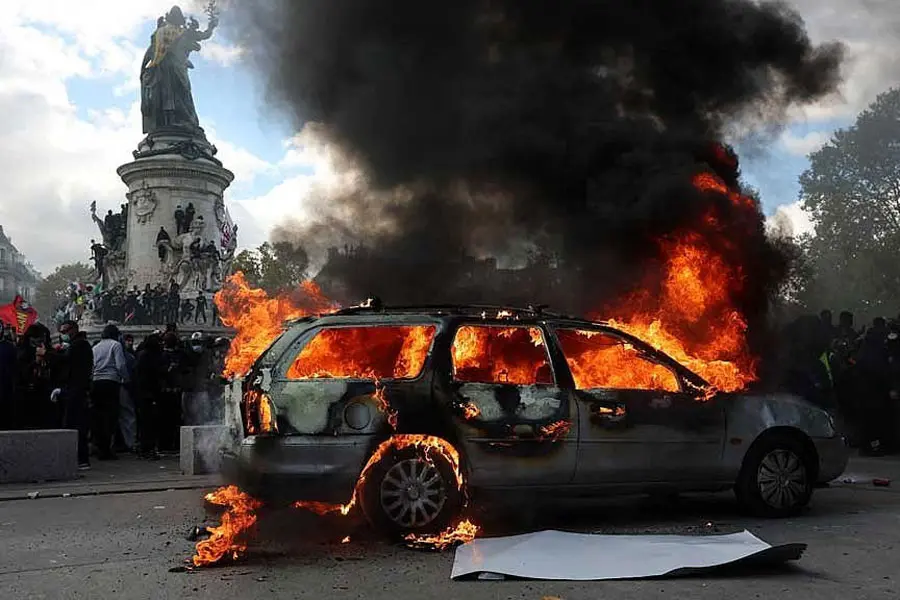
Crowds have protested for weeks in major cities, with some demonstrations marked by arrests, looting, injuries and violence across France, Italy and Albania. In Spain and Portugal, tent camps have sprung up to protest unaffordable housing.

Young Europeans are experiencing “a strong sense of uncertainty and a lack of control,” said María Silvestre, professor of sociology at the University of Deusto in Spain. “And when specific situations come together, a spark suddenly ignites that is capable of channeling that discontent and driving people into the streets.”

Cities have turned into battlefields as top EU economies, including France, Italy and Spain, approach pivotal elections, while far-right parties have made electoral gains in Germany and could do so elsewhere. It also comes as Europe faces a critical moment in its support for Ukraine, with President Donald Trump making overtures to President Vladimir Putin even as Russia is blamed for increasingly frequent arson attacks, cyberattacks and other acts of sabotage in NATO countries.

Right-wing politicians have seized on the chaos. While protests in France have appeared broad-based, Trump portrayed immigrants as responsible for the destruction, writing Monday on his Truth Social platform: “The migrants have taken over France. They must CLOSE THE BORDERS, FAST!”

Many of the protests have been fueled by frustrated young people. Other actors, including black-clad, masked agitators, have fomented violence, but French authorities and police have not blamed immigrants.

NYT (“Huge Riots and Antigovernment Protests in France: What to Know“):

France is moving to reassert order after antigovernment demonstrations devolved into the most destructive riots in decades over the weekend, causing widespread damage and deepening a sense of national reckoning.

Prime Minister Sébastien Lecornu said on Tuesday that he would extend for another night the localized curfews that his government imposed a day earlier. Mr. Lecornu said those curfews had “helped keep the night calm” on Monday.

The move came amid a political blame game over who was ultimately responsible for the chaos.

The protests have heightened a sense of fiscal and social crisis in France, the European Union’s second-largest economy. And there’s more debate to come: The government is trying to pass an unpopular belt-tightening budget before a presidential election in the spring.

[…]

On Monday, high-level officials admitted failure.

Laurent Nuñez, the interior minister, offered something of an apology on national radio, saying that the police had been underprepared to deal with the scale of the riots that spun off from the mostly peaceful protests in the country.

He said he had offered his resignation to Mr. Macron but that it had not been accepted.

Mr. Darmanin, the justice minister, also acknowledged that the authorities had “undeniably failed” in the face of the violence.

Mr. Lecornu, the prime minister, struck a different tone, saying that the French police had done a good job against a “shadowy network” of instigators who he said were seeking to orchestrate “profound disorder” before the elections in April. He blamed the far left for the unrest, as have some far-right leaders and the centrist government.

They have pointed in particular to France Unbowed, a major far-left party. France Unbowed has rejected the accusation, and its leader, Jean-Luc Mélenchon, has blamed the government for actions that he said had made the unrest more likely.

Mr. Mélenchon said on social media that Mr. Lecornu was “responsible for the chaos” because of “incompetence or a worst-case strategy to create a party of order that would make people forget his failure in public finances.”

Catherine Porter, NYT (“France’s Far Right Seizes the Moment as Rioting Stuns the Country“):

After riots erupted this weekend in cities across France, its centrist government blamed the main far-left party, accusing its politicians of inciting the violence. That party blamed the government, accusing it of stirring public anger through years of bad governance and heavy-handed policing.

What did the main far-right party do? It blamed both, and launched into campaign mode.

“We are paying for decades of being soft on crime, of weak authority, of the moral, psychological, and material disarmament of our internal security forces,” Jordan Bardella, the president of the far-right National Rally party, said after emerging from a police station in central Paris on Sunday. He said had gone there to support police officers.

Then he addressed France’s “honest citizens” who were stunned on Sunday by the smashed storefronts and burned-out businesses destroyed by rioters the night before. He said they had a vital role to play in reinstating national stability. And that would be by voting in the coming election for his party.

“People need to wake up now,” Mr. Bardella said. “They need to make the right political choices, and in any case, we stand ready to restore order in the country.”

I can not think of a single case when electing a far-right government didn’t work out.

While immigration is a longstanding target of right-wing populists, with the exception of Italy, none of these countries experienced a significant influx of refugees from the Syrian civil war. France, of course, has long had a large population of migrants from the Middle East and North Africa, resulting from its colonial policies.

The protests continue to baffle me. All of these countries have considerably more generous social welfare programs—from health care to education subsidies to unemployment benefits to childcare support to retirement pensions—than the United States. Most of them have more representative political systems, allowing niche parties to gain representation in the legislature. The justification for rioting in the streets is hard to fathom.

,

16 responses to “European Riots Spread”

  1. I can not think of a single case when electing a far-right government didn’t work out.

    Is this what you wanted to say?

    1
    1. I believe there’s an implicit /s. Trump has driven even our sober, serious, James Joyner to getting pretty snarky lately.

    2. @Rick Dement I was being somewhat ironic.

  2. The basic reason is that budgets are constrained because pensions in particular are gobbling up the money.
    In France 25% of state expenditure is now on pensions, and rising.
    There is no obvious source of further tax revenue, which is currently running at 43% of GDP, and is already thought to be a serious drag on growth.
    The budget deficit is at 5% of GDP,, and becoming increasingly expensive to fund as bond rates increase.

    The only viable route for France is to reduce the pension burden by increasing retirement ages and reducing the amounts going to better-off pensioners. As well as general reform of a public sector that is often rigid and inefficient, and with particularly large pension costs.
    32% of the education budget is spent on the pensions of former teachers and education administrators.

    The problem is, whenever a government suggests that, the far-left and far-right join to condemn it in public and block it in parliament.

    However, AP is overstating things for effect.
    From their reporting you might assume riots are erupting across Europe, and cities across the entire continent are aflame.
    This is not the case.

    Nor is the AfD about to sweep to power in Germany.

    Polling in France indicates that his ambivalence about the riots has damaged support for Melenchon and LFI, and improved that for Glucksmann and the Socialist Party.
    As for Le Pen and RN, they can pose as a “party of order”, but continue to have a weakness in appeal to many French right-of-centre voters because of its fantasy economics.

    The danger is that in next years presidential elections, Melenchon and Le Pen manage to poll ahead of other candidates sufficient for both to get through to the run-off.
    There seems as of now little chance of the multiple other parties of the centre, centre-left and centre-right being able to settle their differences sufficiently to support a common candidate.

    1
  3. Charley in Cleveland Avatar
    Charley in Cleveland

    The economy and chaos in the Middle East – not just Iran, but long standing turmoil in Libya, Syria, Iraq and Israel – have played a huge part in roiling Europe. War and climate change (drought, increased heat) are the drivers of immigration to Europe, and Trump’s illegal – and mostly irrational – tariffs have negatively affected the world’s economy. People need and want food, housing, and the means to afford them. They are increasingly desperate, as well as pissed off.

    1
    1. Yes. Long-term drought has made the Syrians the first large-scale climate refugees.

  4. The protests continue to baffle me.

    It’s the opposite of baffling for me, especially from the students’ perspective. You’re in the French equivalent of high school, but not in an elite institution. You know that you’re not getting as good an education as some of your more privileged peers. You also know that there are flaws in the examination process. Plus, once you pass through the educational gauntlet, the opportunities for someone like you are restricted.
    Meanwhile, you’ve been sitting in a classroom without air conditioning during an historic heat wave, brutalized by 95 to 100 degree Farenheit temperatures. There are teacher and school resource shortages. Meanwhile, the government does seem to find money for the military, for fighting wars in Africa.
    You might be a little cranky, too.
    So are the parents and teachers.

    1. France is not at present fighting any wars in Africa.
      The current temperature in Marseilles is 63F; in Paris 55.

      The violent aspect of the protest seems at first mainly to have been “black bloc” anarchists, who are reliable in these matters, gangs doing opportunistic looting, and bored teenagers up for a fight with the police, with increasing numbers of that last turning up.

      1. I was referring to some of France’s small scale interventions in the recent past, and the questions about investment in those ventures versus domestic concerns. It’s not like the recent withdrawals from Africa have led to a flood of money into the schools in the last couple of years.

        I’m not sure what your point about the temperature today is now, versus what it was just before the summer break. I don’t think the students have forgotten how sweltering it was.

  5. I’m not surprised. I’ve seen videos of doors being kicked in by roving gangs of kids and that seems new, but not surprising.

    Luxury and wealth and everything that goes with it are shoved in the faces of poor people 24/7. You can say that money doesn’t buy happiness and that’s kinda true, but living a life where you can freely afford nice things looks like an illusion or magic to somebody speeding buy on a scooter making their nth delivery of the day before going home to their crowded life filled with the absolute opposite of luxury and wealth.

    The tone-deafness of European socities being held up as great distributors of free goods goes against the entire logic of selling yourself as a working poor person and getting nothing that you see valued in return. No surprise that kids growing up in these environments are enjoying their moment.

  6. The protests continue to baffle me. All of these countries have considerably more generous social welfare programs—from health care to education subsidies to unemployment benefits to childcare support to retirement pensions—than the United States.

    Decline hurts, even if you start off higher. And if your future is also being constrained, that hurts more.

    I’d say even if it is only perceived decline, as you can see in our right-wing grievance machines.

    1
  7. Just Another Ex-Republican Avatar
    Just Another Ex-Republican

    When people lose hope in the future and feel they don’t have any control or prospects riots are one of the milder things that can happen. France went all the way to guillotines once.

    Our modern oligarchs (tech-bro, AI, and a bunch of other billionaires) need to read more history.

    PS: Anyone reading the prior sentence as supporting guillotines is an idiot. I simply think some level of violence is inevitable and not surprising the way Western society has developed and the massive tax and wealth redistribution schemes that funnel gains to older and/or more wealthy individuals is paralyzing younger generations. When you can’t afford a place to live except with multiple roommates or staying at home and have crippling student loan debts (a more US specific problem, but housing issues are widespread), then the path to middle class married prosperity with 2.2 kids seems like a hopeless pipe dream. I had 18 first cousins in my Gen X block. We’ve produced only 10 more kids, and the generation after that just coming into their 20’s almost universally believe they’ll never be able to afford kids and aren’t planning on having any.

    It would be more surprising if we weren’t seeing violence spreading across our societies.

    1
  8. NYT led their front page with a piece on a family compound near Palm Desert, CA.

    1% of the world’s population is super-rich, some are living comfortably, and most are living beyond their means due to the expected standard of living. Something’s gotta give–but it doesn’t appear that it will be the super-rich sharing their wealth.

    I am not condoning violence, but I am afraid people are turning to violence.

    1
  9. The argument that France has a public expenditure problem because it fails to tax the rich has problems.

    The income tax rate on those earning over c. €180,000 is 45%; those over €250,000 48%; those over €500,000 49%

    Capital gains tax on investments is about 30%.
    There is also a varying “social charge” on investment income of 17%.
    (It gets complicated)
    On “real property” assets of value over €1.3 million there is also an annual levy that maxes out at 1.5%
    Inheritance tax is also complicated, but for children inheriting over €1.8 million, the tax would be 45% of the value.

    1. What’s the corporate tax rate?

  10. Yes, there are problems with mismatches between the taxburden that the citizens can sustain and the social problems that the government has promised to ameliorate, but the unrest appears excessive to me. I don’t see how busting luxury stores is going to help. In 1968, there were disruptive riots in Paris, and we Americans were puzzled. We Americans were involved in a crazy war in Vietnam, important politicians were being assassinated, racial unrest was burning in our inner cities, and the National Guard was shooting peaceful protesters at Kent State, and yet the events in Paris looked like everything was turned up a notch or two compared to us. Is French society simply less cohesive than the US?

Leave a Reply

This site uses Akismet to reduce spam. Learn how your comment data is processed.