Hiroshima Bombing’s 80th Anniversary
The last survivors want us to remember the horrors of nuclear war.
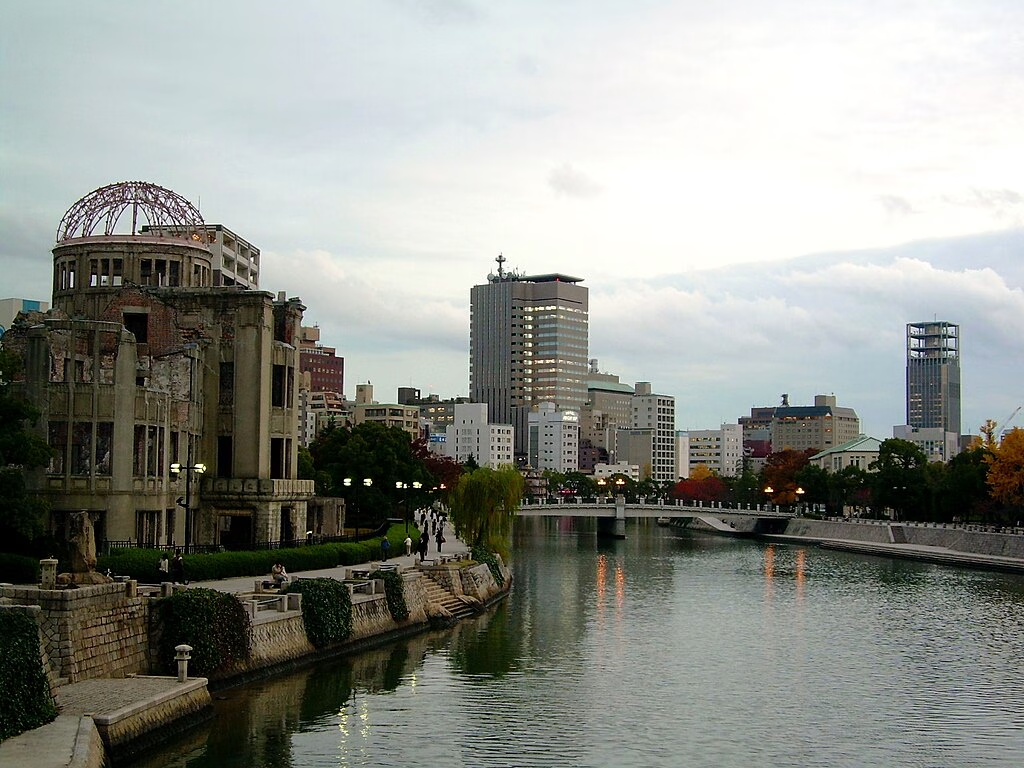
AP (“Hiroshima survivors fear rising nuclear threat on the 80th anniversary of atomic bombing“):
Hiroshima on Wednesday marked the 80th anniversary of the U.S. atomic bombing of the western Japanese city, with many aging survivors expressing frustration about the growing support of global leaders for nuclear weapons as a deterrence.
With the number of survivors rapidly declining and their average age now exceeding 86, the anniversary is considered the last milestone event for many of them.
“There will be nobody left to pass on this sad and painful experience in 10 years or 20 years,” Minoru Suzuto, a 94-year-old survivor, said after he kneeled down to pray at the cenotaph. “That’s why I want to share (my story) as much as I can.”
The bombing of Hiroshima on Aug. 6, 1945, destroyed the city and killed 140,000 people. A second bomb dropped three days later on Nagasaki killed 70,000. Japan surrendered on Aug. 15, ending World War II and Japan’s nearly half-century of aggression in Asia.
Hiroshima Mayor Kazumi Matsui warned against a growing acceptance of military buildups and of using nuclear weapons for national security during Russia’s war in Ukraine and conflicts in the Mideast, with the United States and Russia possessing most of the world’s nuclear warheads.
He urged younger generations to recognize that such “misguided policies” could cause “utterly inhumane” consequences for their future.
“We don’t have much time left, while we face a greater nuclear threat than ever,” said Nihon Hidankyo, a Japanese grassroots organization of survivors that won the Nobel Peace Prize last year for its pursuit of nuclear abolishment.
Alas, while a longstanding nuclear taboo has arguably restrained possessor nations from using the weapons and a nuclear nonproliferation regime has long been part of international law, the reality is that we can’t uninvent 1940s technology and we have seen time and again that there is serious value in being part of the nuclear “club.”
While we’ve spent most of the decades since the bombings of Hiroshima and Nagasaki debating their morality, the fact of the matter is that they resulted in an almost immediate end to the war on the Allies’ terms. While it’s debatable whether unconditional surrender was a reasonable war aim, dropping the bombs saved the lives of untold hundreds of thousands of Allied soldiers. Harry Truman’s decision was a no-brainer.
Those weapons were merely “atomic.” Successor weapons have massively more destructive power and the US, Russia, and China possess them in great number. It’s more than a city or two being held at risk. And, of course, the calculus is much different when only one power has the capability. The risk of their use rises considerably as the number of possessors increase. That’s especially the case when proliferation extends to less savory actors.
What’s interesting to me, as someone who came up as the son of a soldier and later a soldier myself in the last years of the Cold War, is how little we talk about great power nuclear war now compared to then. In those days, the expectation that a war between NATO and the Warsaw Pact would inevitably escalate into an existential crisis was at the center of our discussions. Deterrence was at the center of our Cold War strategy. Now, even though China possesses a significant nuclear arsenal, most of the talk in Defense Department circles is about how a conventional war with the PRC would unfold.

Saved the lives of Millions of Japanese civilians too. The civilian death toll for Okinawa, 466 sq miles, is believed to be over 100,000. Take that total to the big Japanese island Honshu which is close to 200 times larger, well the cost could have been extreme.
Japan was trying to negotiate a settlement after the Allies ended nazi rule, but between the USSR entering the Pacific War and the posture of unconditional surrender, none would be forthcoming.
This is not to say the war was nearly over anyway. Even had Roosevelt/Truman and Churchill not insisted on unconditional surrender, and even absent the atomic bomb, both sides would have tried to apply military pressure to get the better terms. See how long Germany fought on in WWI after shutting down the eastern front and moving troops west.
Perhaps the US would have invaded the home islands, perhaps not. Stalin would have waged war against Japanese forces in China. The US would certainly have continued the policy of firebombing Japanese cities.
Again, counterfactuals cannot be falsified.
BTW, the idea of demonstrating the bomb to the Japanese before actually dropping it on one of their cities was considered. One major concern was what would happen if the demonstration failed. Another was the fact there were like three bombs in existence.
In any case, we don know Japan did not surrender after one atomic bombing. it took two.
I read long ago (can’t verify) that the Soviet Union was planning invasion from the north which could have ended up splitting Japan like Germany. There are still the Kuril/Sakhalin islands north of the main northern Japanese island of Hokaido that is still treated in popular culture as disputed. That would have been another element for the US to consider in timing and Japan to consider in surrendering.
I visited Hiroshima in 1980 (45 years ago). It was an awesome (inspiring awe) experience.
I also remember participating in the nuclear freeze demonstrations in DC in the early ’80s. Nuclear war was way more top of mind then. (Think Sting’s If the Russians Love Their Children Too as a popular song.)
I would like to keep a world where this no longer has to be top of mind, but that will take affirmative work, not whistling by the graveyard.
We’ve almost lost the word, ‘war’. It’s been defined down and down til it’s tossed off to describe a marketing contest of Coke vs. Pepsi, or a government ‘war’ on plastic water bottles. Our expectation now is that war means the American style of war: lots of gear, incredible precision and few dead. For Americans war means some small, far-away, sputtering conflict where the dead are measured in single or double digits most days. Even Ukraine’s WW1-with-drones doesn’t come close to something like Gettysburg where total casualties hit 50K in basically three days of fighting, including ~7,000 KIA.
I’ve talked to people in their 20’s who with a straight face will tell me that the threat of war is at a peak now, and no other generation has been as stressed as they are by all of life’s threats, particularly climate change. Um, no. My generation spent decades believing that at any moment, without warning, the sirens would go off and 20 minutes later the first Soviet sub-launched nukes would be popping off. We grew up expecting that the annihilation of the human race might happen during our lifetimes. I mean, unless we all got under our desks.
The US/Japan war was more like the way war has been fought since Genghis. Back then if your local Lord decided to defy the Khan you, personally, and your family, were either going to die right away, or live on as slaves. Enemy soldiers wouldn’t be fighting friendly soldiers somewhere far away, the enemy soldiers would be in your house painting the walls with your family’s blood. That’s still what war means to me – I’m a history nerd, and old – but the word doesn’t seem to carry much emotional weight now, which is why we have to reach for superlatives like genocide. Because the horrors we see in Gaza can’t just be war, right? Because this is worse than war. Like war needs a hype man to get us to care.
In a back and forth with Prof. Steven some time ago, I made the point that under the current definition of ‘genocide’ the US certainly committed genocide in WW2, and probably the Civil War as well, given General Sherman’s fine work. @Bill Jempty: is right that our best alternative to continued bombing of Japanese cities, was either invasion or starving the Japanese people to death, which, given Japanese reluctance to surrender, would have ended up being a real, no bullshit genocide.
I suppose it’s progress that we’ve managed to re-define ‘war’ to mean something far away that has no impact on our lives, and genocide as a small, far-away, bloody war that has no impact on our lives. You can’t say homo sapiens never makes progress, because back in my day war meant the deaths of tens, maybe hundreds of millions, maybe billions of people over the course of a few hours.
It’s a pretty dark way to see the world, but on this day, 80 years ago, the people of Hiroshima were sacrificed to the gods of war, and ended up bringing us decades of relative peace.
Backing up a bit, the push for the bomb was almost entirely to get it before Elon’s nazi regime in Germany could.
Later it turned out the nazis were trying, but not very well and not very hard. Certainly they did not dedicate the resources the Americans and British did, and unlike Stalin had no spies in Los Alamos.
After the defeat of Germany in Europe, the bomb wasn’t quite ready. Germany surrendered early in May 1945, the Trinity test took place in July 16th. So, there was no occasion to use it against Germany.
Having defeated the nazis, the push to deploy the bomb waned rapidly among the scientists and engineers involved in the Manhattan Project. This includes even Leo Szilard, who had been instrumental in getting Einstein to send the famous letter to FDR that set the whole project in motion.
The Department of War naturally had different ideas. The military will use the tools it has to achieve the objectives it wants, after all.
The timing is also of interest. Nuclear fission was discovered in 1938, just before WWII formally got started (at that, Japan started it early). As noted, the pressure was on to make an atomic bomb. The first reactors ever made, were breeder reactors to make plutonium, not ones to produce power. Those came after the war.
Here’s a counterfactual for anyone who wants it: suppose fission had been discovered in the 1920s instead, and WWII launches with several countries already in possession of atomic weapons.
Werner Heisenberg, arguably the most brilliant physicist of his generation, was in charge of the Nazi’s atomic bomb program. Some have argued that the reason the Nazi program never got off the ground is that he deliberately delayed it. Most likely the reason was that Hitler didn’t believe in it and didn’t provide the funding. Also, despite having Heisenberg as head of the program, most other of Germany and Europe’s physicists had fled to England and the U.S. in the 30’s.
@a country lawyer:
I have long believed that US victory in WW2 was assured in 1933 when Albert Einstein moved to Princeton and brought most of physics with him.
@a country lawyer:
Heisenberg had a meeting with Neils Bohr during the war, before the Brits spirited Bohr away. The substance of it is not known, but there’s speculation about how it might have steered Heisenberg’s efforts thence.
Then, too, the Brits managed to sabotage the nazi’s supply of heavy water twice.
In addition, Elon had too many other things going, from large phallic guns to rockets to jet engines (the British also developed jet engines during the war), and let’s not forget the resources wasted in exterminating Jews, Roma, and others.
The Soviets and the Japanese also did research on the bomb. Even with Stalin’s espionage on various parts of the Manhattan project, the USSR didn’t manage to make a bomb util a few years later.
@Kathy: There is both a play and a movie about the meeting. Daniel Craig who played James Bond played the part of Heisenberg in the movie.
@a country lawyer: Heisenberg was no Einstein, no Feynman, no Oppenheimer, no Sakharov. Lise Meitner gets left out a lot due to being a woman. These lists are barroom bet materials.
Some years ago, my older daughter took a course in the Japanese Language from a local community college. Her instructor was a woman who was a child in Japan when the bombs were dropped.
She endorsed the bombing. She said that without it, she would probably have been handed a gun and been sent out to die honorably defending her home. She thought pretty much everyone in Japan would have died defending from an invasion.
@Slugger: @Slugger:
And how.
When Hahn and Strassmann produced uranium fission in the lab, they had no idea what they had done. It took Meitner and her nephew, Otto Frisch, to figure out what the results of the experiments meant.
Sure, eventually someone would have figured it out, maybe even Hahn himself. But despite nuclear decay and neutron absorption and even artificial radioactivity, there was much doubt whether splitting a nucleus was even possible.
IMO it would be more accurate to say Hahn and Strassman found fission, but Meitner and Frisch discovered it.
@Kathy:
Even with the intel from the US I would characterize the Soviets managing to conduct a successful bomb test in just a few years as a staggering achievement, particularly considering how tore-up they were by WW2. But the Soviets had been “in the game” as far back as the 1920’s. They had heap-good physicists of their own and utterly ruthless butchers like Beria to “motivate” people.
@dazedandconfused:
The hardest part was figuring things out. Namely, how to enrich uranium, how to breed plutonium*, and how to implode a subcritical mass into a critical one. For all the merits of Kurchatov et al., they were working with well over half the problem solved by someone else.
Of course, they still had to build the plants to enrich uranium, the reactors to breed plutonium, and the machine tools and chemical factories for the explosive lens and everything else, among like a million other things.
So, yes, it’s remarkable. But without the extensive espionage, they’d have had a bomb some years later.
*It’s weird to apply a term like breeding to a lifeless, not to mention toxic, element. But the reactors that produce plutonium are called breeder reactors.
@Michael Reynolds: We’ve implemented the Geneva Conventions and all manner other laws of armed conflict in the aftermath of WWII in an attempt to limit the barbarity of war and, in particular, limit the killing and suffering of noncombatants. Many actions that the Allies undertook during the war would indeed be considered war crimes now. We rightly, for example, call what Russia is doing in Ukraine “war crimes” even though it would have been merely “war” once upon a time.
At the same time, I have to constantly remind my students that the Rules of Engagement the United States has used in the various limited conflicts fought since the end of the Cold War would go out the window in a war with China. Yes, our exquisite targeting systems allow much more precision. But we’re going to be much less concerned about “winning hearts and minds” in a major power war than we’ve been in a long time.