
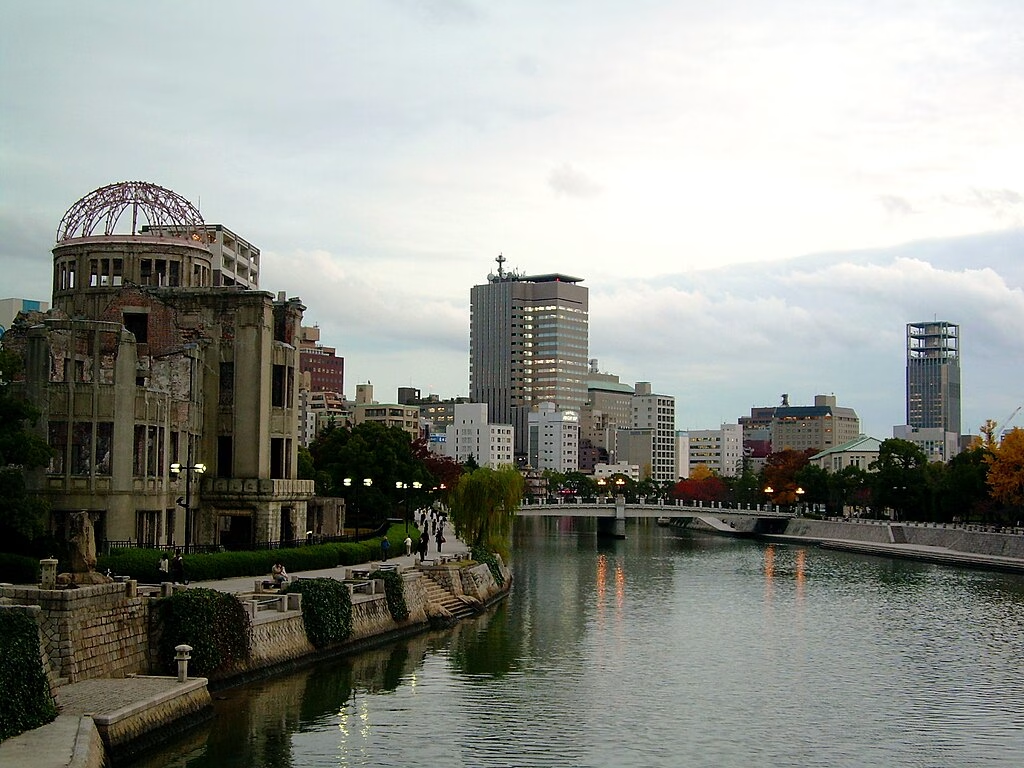
AP (“Hiroshima survivors fear rising nuclear threat on the 80th anniversary of atomic bombing“):
Hiroshima on Wednesday marked the 80th anniversary of the U.S. atomic bombing of the western Japanese city, with many aging survivors expressing frustration about the growing support of global leaders for nuclear weapons as a deterrence.
With the number of survivors rapidly declining and their average age now exceeding 86, the anniversary is considered the last milestone event for many of them.
“There will be nobody left to pass on this sad and painful experience in 10 years or 20 years,” Minoru Suzuto, a 94-year-old survivor, said after he kneeled down to pray at the cenotaph. “That’s why I want to share (my story) as much as I can.”
The bombing of Hiroshima on Aug. 6, 1945, destroyed the city and killed 140,000 people. A second bomb dropped three days later on Nagasaki killed 70,000. Japan surrendered on Aug. 15, ending World War II and Japan’s nearly half-century of aggression in Asia.
Hiroshima Mayor Kazumi Matsui warned against a growing acceptance of military buildups and of using nuclear weapons for national security during Russia’s war in Ukraine and conflicts in the Mideast, with the United States and Russia possessing most of the world’s nuclear warheads.
He urged younger generations to recognize that such “misguided policies” could cause “utterly inhumane” consequences for their future.
“We don’t have much time left, while we face a greater nuclear threat than ever,” said Nihon Hidankyo, a Japanese grassroots organization of survivors that won the Nobel Peace Prize last year for its pursuit of nuclear abolishment.
Alas, while a longstanding nuclear taboo has arguably restrained possessor nations from using the weapons and a nuclear nonproliferation regime has long been part of international law, the reality is that we can’t uninvent 1940s technology and we have seen time and again that there is serious value in being part of the nuclear “club.”
While we’ve spent most of the decades since the bombings of Hiroshima and Nagasaki debating their morality, the fact of the matter is that they resulted in an almost immediate end to the war on the Allies’ terms. While it’s debatable whether unconditional surrender was a reasonable war aim, dropping the bombs saved the lives of untold hundreds of thousands of Allied soldiers. Harry Truman’s decision was a no-brainer.
Those weapons were merely “atomic.” Successor weapons have massively more destructive power and the US, Russia, and China possess them in great number. It’s more than a city or two being held at risk. And, of course, the calculus is much different when only one power has the capability. The risk of their use rises considerably as the number of possessors increase. That’s especially the case when proliferation extends to less savory actors.
What’s interesting to me, as someone who came up as the son of a soldier and later a soldier myself in the last years of the Cold War, is how little we talk about great power nuclear war now compared to then. In those days, the expectation that a war between NATO and the Warsaw Pact would inevitably escalate into an existential crisis was at the center of our discussions. Deterrence was at the center of our Cold War strategy. Now, even though China possesses a significant nuclear arsenal, most of the talk in Defense Department circles is about how a conventional war with the PRC would unfold.









