

It was probably sometime in 1993 that I stood in the parking lot of the apartment complex we lived in in Austin, TX complaining to a dear friend about the cost of air conditioner repairs to our car. I don’t recall all the details exactly, although the overall conversation is quite vivid in my memory. I was complaining either about fees associated with the repairs or about changes in how refrigerants were used under relatively new regulations which made them more expensive (or both). The bottom line was that I was in graduate school and didn’t have a lot of money, so I was complaining about my perception of the costs as related to environmental regulations. I would have preferred a version of the bill without the added costs (or, indeed, no bill at all).
My friend, instead of commiserating, said “Good!”
This, I must confess, annoyed me at the time. All I was worried about was the bill I had to pay (and that car had been an ongoing pain in the ass and pocketbook in terms of its AC–something that was unpleasant to live without in Texas).
However, he was right and I was wrong.
I relay this story for at least two reasons. One is that my friend was correct to be concerned about global warming in ways that I was not at the time and the other is that I think my attitude at the time is indicative of a lot of the core resistance (then and now) to climate change policy.
To the first point, the NYT provides the following graph:
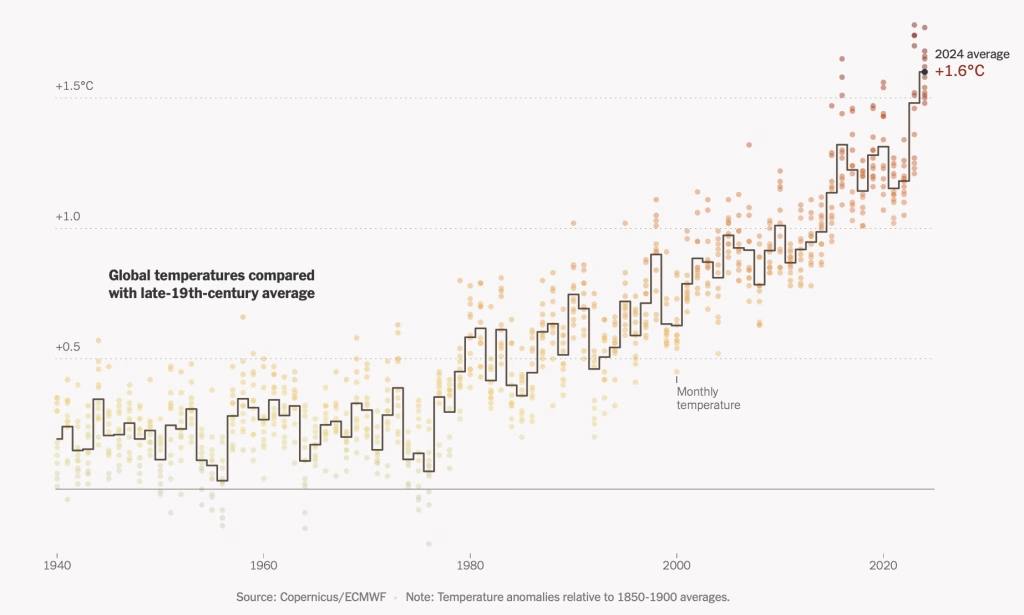
The piece starts thusly,
At the stroke of midnight on Dec. 31, Earth finished up its hottest year in recorded history, scientists said on Friday. The previous hottest year was 2023. And the next one will be upon us before long: By continuing to burn huge amounts of coal, oil and gas, humankind has all but guaranteed it.
The planet’s record-high average temperature last year reflected the weekslong, 104-degree-Fahrenheit spring heat waves that shuttered schools in Bangladesh and India. It reflected the effects of the bathtub-warm ocean waters that supercharged hurricanes in the Gulf of Mexico and cyclones in the Philippines. And it reflected the roasting summer and fall conditions that primed Los Angeles this week for the most destructive wildfires in its history.
“We are facing a very new climate and new challenges, challenges that our society is not prepared for,” said Carlo Buontempo, director of the Copernicus Climate Change Service, the European Union monitoring agency.
But even within this progression of warmer years and ever-intensifying risks to homes, communities and the environment, 2024 stood out in another unwelcome way. According to the World Meteorological Organization, it was the first year in which global temperatures averaged more than 1.5 degrees Celsius, or 2.7 degrees Fahrenheit, above those the planet experienced at the start of the industrial age.
Paul Campos at LGM summarizes this well.
By 1980 or so there was a very powerful theoretical basis for thinking that anthropogenic carbon emissions were bound to heat up the planet in a serious way. But up to that point the empirical evidence for this theory was still largely missing. If you look at the charts in the article, you’ll see that by the late 1970s global temperatures still remained very close to the preindustrial baseline.
So at that point, climate science consisted of a lot of people warning that what has since happened was going to happen, while at the same time having to deal with the fact that it wasn’t happening yet. This of course made any kind of ameliorative policy initiatives completely impossible, at a time when such initiatives would have been exponentially cheaper to undertake than they are now.
To put all of this as succinctly as possible: that which was predicted by the science has happened. There is no denying this. The world is warmer than it was and we are seeing the consequences.*
The NYT piece shows what kinds of emission reductions would have been necessary in 2005 vs. now to achieve desired outcomes. Let’s just say we didn’t meet them and aren’t going to now (if you click through you can appreciate my dry understatement, pun partially intended).
Back to my anecdote: people don’t like to pay for something that they don’t think they benefit from (and, really, often don’t want to pay for things they do benefit from, preferring instead that others pay either in money or consequences). I think a substantial amount of anti-global warming/climate change politics has been based on fears of either increased regulatory costs (as per my car AC repair decades ago) or worries about increased taxes (I would hypothesize that a huger percentage of climate denial is really about taxation and regulation fears). Indeed, I think these are the main ways that conservatives have mobilized anti-environmental politics. And, of course, it is not hard for Republicans to mobilize simplistic individualism against more collective concerns (that’s socialism, dontcha know!).
At the heart of all of this is the tension between collective action/responsibility and the fantasy that we are all just a bunch of individual masters of our own destinies.
Still, as we have seen with tropical systems, with sea-level rise, with the fires in LA, or even the growing zones across the country, the climate has changed and there are (and are going to be more) consequences. Such problems require serious minds and solutions. Alas, this is not where we are as a country.
*One clear bit of evidence for the changes that come not from liberal politicians nor climate scientists is from insurance costs. This is a clear market-based signal of the problem here which cannot be attributed to some ideologically-driven position. Note: I am not saying climate scientists are ideologically driven, but critics often accuse them of being such. Insurance costs are, however, a useful proxy to demonstrate the obvious effects of a changing climate.
See the CBO: Climate Change, Disaster Risk, and Homeowner’s Insurance.









