Joint Chiefs Chairman Cautious About Iran Fight
Will POTUS listen?
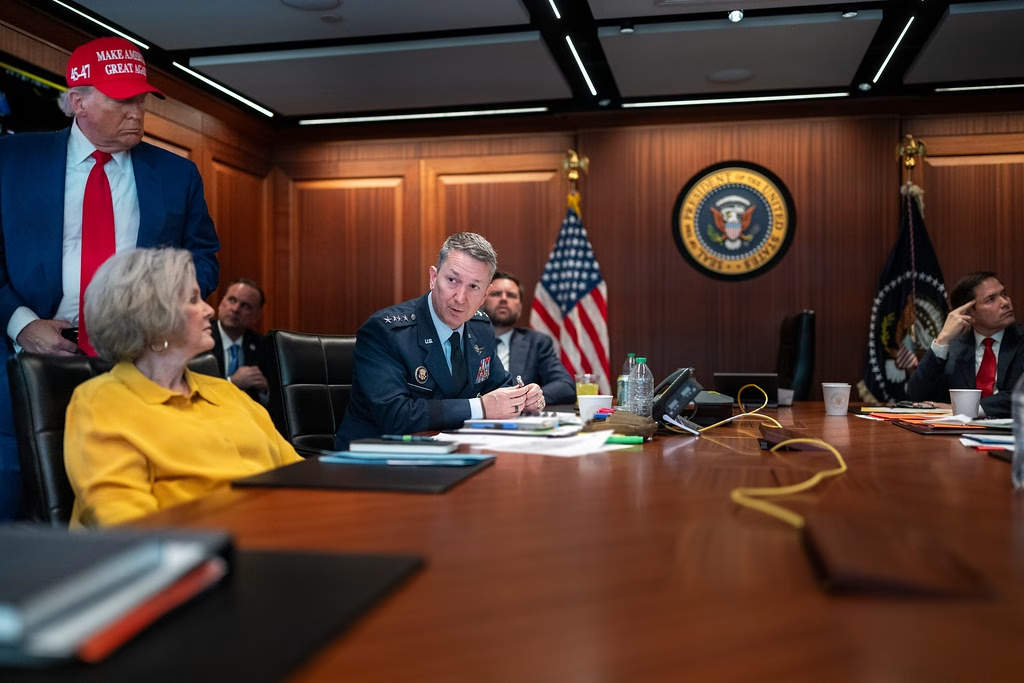
WaPo (“Trump’s top general foresees acute risks in an attack on Iran“):
As the Trump administration weighs an attack on Iran, the Pentagon’s top general has cautioned President Donald Trump and other officials that shortfalls in critical munitions and a lack of support from allies will add significant risk to the operation and to U.S. personnel, according to people familiar with internal discussions.
Gen. Dan Caine, chairman of the Joint Chiefs of Staff, expressed his concerns at a White House meeting last week with Trump and his top aides, these people said, cautioning that any major operation against Iran will face challenges because the U.S. munitions stockpile has been significantly depleted by Washington’s ongoing defense of Israel and support for Ukraine. Caine’s remarks at the White House meeting have not been previously reported.
Separately, in Pentagon meetings this month, Caine also has raised concerns about the scale of any Iran campaign, its inherent complexity and the possibility of U.S. casualties, one person said. The general has said that any operation would be made all the more difficult by a lack of allied support, this person said, speaking like others on the condition of anonymity to discuss private conversations.
In a statement, Caine’s office said that in his role as the president’s top military adviser, the chairman “provides a range of military options, as well as secondary considerations and associated impacts and risks, to the civilian leaders who make America’s security decisions.” Caine, the statement adds, “provides these options confidentially.”
Caine is, in other words, carrying out his statutory duty, laid out in the Goldwater-Nichols Act of 1986, as the chief military advisor to the President and the National Security Council.
White House spokeswoman Anna Kelly said Trump listens to a “host of opinions on any given issue and decides based on what is best for U.S. national security.” She described Caine as a “talented and highly valued member of President Trump’s national security team.”
I think everything about that, except the basis of the decision, is correct.
Trump, after this article’s publication, posted on social media that it is “100% incorrect” that Caine is “against us going to War with Iran.” Trump said that the general would not like to see a military confrontation with Iran but that if it did happen, “it is his opinion that it will be something easily won.” The people who spoke to The Post about Caine’s thinking directly contradicted Trump’s optimistic characterization.
Alas, I don’t think any of that is true.
First, while a retired National Guard three-star would not have been my top choice for Chairman (indeed, I would have retained CQ Brown), he’s by all accounts a professional. Caine isn’t offering his opinion as to whether we should attack Iran. Rather, he’s providing military options and conveying the associated risks. And no one in his position would tell the Commander-in-Chief that such a war would be “easily won.” There’s a reason—several of them in fact—why none of the eight U.S. Presidents since the 1979 Revolution have gone beyond very limited military incursions into Iran despite our belligerent status.
The White House meeting on Tuesday included Vice President JD Vance, Secretary of State Marco Rubio, CIA Director John Ratcliffe, Defense Secretary Pete Hegseth and White House adviser Stephen Miller, one person told The Washington Post.
Caine’s views, reported earlier by Axios, are seen as highly credible by the administration because of the successful execution of two other major operations he has overseen: the assault on Iran’s nuclear sites in the summer and the January raid to capture Venezuelan President Nicolás Maduro. Caine, said one person familiar with his conversations, will support whatever decision the president makes, as he did with previous operations, and does not want to be seen as taking any option off the table.
A recent episode of the Ezra Klein show was titled, “Who Has the Power in Trump’s White House?” The short answer, not shockingly, is President Donald J. Trump. But Klein’s guests, Atlantic journalists Ashley Parker and Michael Scherer, do a credible job of explaining who has access to the President, who he takes seriously, and how he ultimately decides.
POTUS listens to Caine. Trump likes his confidence, sees him as loyal, and the success of MIDNIGHT HAMMER and ABSOLUTE RESOLVE has cemented the impression that he’s a winner. If he’s saying this has significant risk, it will give the President some pause.
Further, it’s pretty clear that Trump is leery of “forever wars.” He wants big, quick wins. So, if he’s convinced there’s a substantial risk of either getting bogged down in a messy fight or coming away with an L, he’ll change course.
I can’t imagine Steven Miller and most of the other major voices in the administration much care about Iran; their motivations are almost entirely domestic culture wars and the like. Caine is the biggest voice on military affairs, though Marco Rubio (who I would expect to be similarly cautious about an overly ambitious mission set) also has some sway. And Trump will also listen to his chief of staff, Susie Wiles, if she tells him that the risks will play out poorly with the public.
Still, the biggest takeaway is that, unlike the first Trump administration, there’s no one who is going to tell POTUS “No.” If he decides he wants to take a high-stakes gamble, they’ll rally around him and carry out the mission.

There’s the rub. Trump surrounded himself with sycophants, ideologues, power hungry asshats and grifters…his kind of people. They feed his childish fantasies…none of them give a damn about what’s right or good for the country. Nor do any of them know, or care, what comes the day after Trump does something stupid.
@Charley in Cleveland:
The day after, El Taco usually blames the bad outcome on someone else.
“Daily Beast”
…
…
Trump is issuing extreme demands that Iran is unlikely to comply with. So if this starts, hard to see the end point.
Not knowing your end point is not a good way to start a war.
ETA: The joint chiefs told Dubya it would take 500,000 troops to do an Iraq occupation. All Dubya/Cheney had available was 130,000 so they decided to go with that, they were that determined to have their war.
@charontwo:
I had not heard that. I knew the Brits had refused us Diego Garcia. I wonder if this includes Qatar, and/or Jordan, because that would be more than just a logistical complication. I really hope Donald isn’t going to try and take on Iran with carriers and US-based bombers alone.
I was a bit surprised that Portugal let us use Lajes for refueling. US presence on Terçeira (Azores) has been drawn way, way down and the island doesn’t really rely much on the US for the local economy. I wonder about Rammstein. Are the Germans going along with this? Is Iraq OK with US overflights out of Jordan? How about the Saudis? Is overflight OK, bases not so much?
I am all for regime change in Iran – in theory. Who doesn’t like watching a murderous regime brought down? But Bush/Cheney botched Iraq and as incompetent as they turned out to be, they’re strategic geniuses compared to the Trump gang.
I can’t believe that neither Biden nor Trump launched an all-out effort to build our stockpiles of missiles. How are we proposing to fight China, if that war comes?
“Drezner“
It’s rather telling that the mere implication an attack won’t be a cake walk and carries any level of risk, is interpreted by El Taco as being against any kind of attack.
The proof of the pudding is in the eating as they say. For all our big talk and saber rattling, Bush era debacles left the US war weary and with zero appetite for more. Lack of arms replenishment or military-industrial buildup show Obama, Biden, Trump and their NATO pals have no interest in tangling with China, in defense of Taiwan and Japan against China, in war with Russia or Iran, or in any real defense of Ukraine and Europe. Watch what the West does, not what we say. (One wonders which crooked politicians, parasitic billionaires, and crony capitalists are pocketing these bloated defense budgets.)
It’s been noticed the US is deliberately not amassing ground troops anywhere near Iran. People have remarked on it. So perhaps the plan is another non-regime-change, ‘meet new boss / same as old boss’ strike, a la Venezuela. Wasteful, useless, but flashy. It would impress Substack bros and legacy media neocons/neolibs anyway.
I have pointed out before that the administration appeared to be going through missile supplies (of all sorts) at much higher than replacement rates. Meanwhile, China has been giving tours of some of their new, heavily-automated missile factories. Maybe they’re fake factories, but somehow I don’t think so.
@DK:
Who in the neighborhood would allow the US to post tens of thousands of ground troops on their territory? I’m waiting to hear about any of the Marine expeditionary strike groups moving into the area.
@Michael Cain:
A report this morning, that China and Iran are nearing an agreement that will have Iran buying some of China’s hypersonic anti-ship missiles. No delivery date specified.
@Michael Cain:
Because threatening a ground invasion would not be credible after Iraq,
Iran relative to Iraq:
Three times the area, mountainous terrain, three times the population, better and more competently armed and lead. Na ga hoppen and even Donald the Dim can understand the absence of credibility.
Donald likes easy flashy wins without American casualties.
@Michael Reynolds: @DK: I’ve had students writing their capstone papers on this subject for a couple years now. The last couple of administrations have paid lip service to replenishing stockpiles, re-establishing serious shipbuilding capacity, and the like. Congress has ordered DoD to take steps in several NDAAs now.
The problems are manifold. Congress is more interested in spending massive amounts on new end items than in buying more missiles, rockets, and shells. Like most other sectors, the defense industry long ago shifted to just-in-time logistics. Our supply chains are a mess and are so entangled with China that it’ll take years to overcome. We don’t have nearly enough people with the necessary skillsets because we’ve offshored everything—and most of those with those skills are reaching retirement age.
“Laura Rozen”
@charontwo:
If the Mullahs reject a deal with El Taco and manage to sink a carrier, El Taco will be more upset about being spurned.
@Kathy:
It is all but impossible for Iran to hit let alone sink a carrier. They are moving targets, which for a missile strike requires satellite surveillance which Iran does not have. And of course carriers have layers of defense against anti-ship missiles. Even the Chinese supersonics it all comes down to targeting. And then, if Iran managed to hit a carrier somehow it would not be sunk, but more likely just be forced to reduce air operations for a few days.
If the US really wants to gut Iran it can be done quite easily: burn Kharg Island down and that would be the end of Iran’s oil export business. They’d need western or Chinese help and a lot of time to get the facility back up. They’re not pumping much at the moment so it likely wouldn’t have much effect on the market, but it would devastate Iran short term and long term.
@Michael Reynolds:
Would that not be the end of Iran’s disincentive to block the Strait of Hormuz?
@charontwo:
And where would El Taco pump his stolen oil for sale?
What a list of incompetents. Absolute proof of the need for DEI.
@Michael Reynolds:
The UK is allowing Lakenheath and Fairford bases (and I suspect Diego Garcia and Akrotiri) to be used for transit flights of all sorts.
Same applies re bases in Germany, Italy, Spain, and Greece.
What appears to have been refused is use for direct strike operations.
Reports on whether the Arabians are onside or not for base use seem to vary.
I suspect they fear be saddled with a half-arsed botch and Iranian counter-strikes and an ongoing issues in the Gulf and Straits of Hormuz.
The main point here is that the US has not assembled any significant land or amphibious forces, or support logistics for such.
Therefore there is zero intention of a major land operaration of any sort.
So, if Iran does not offer up some sort of “deal” that can satify Trump’s amour propre, what are the options?
1) Some combination of strikes on targets such as nuclear-related, missile production and storage
2) Attempted limited “decapitation”
3) Wide ranging attempt at “regime destruction”
None of which have any guarantees of decisive results.
I suspect one hope is that the operation may prompt a widespread revolt.
But given the dug-in nature of the IRGC/Basiji forces, theres a quite high probability the regime would prevail, even with some sort of US air support (which would lack effective ground coordination).
And if, so, what then?
The Pasdaran can hunker down, attempt ride out the storm with dispersed leadership, and counter by attacks in the Gulf to spike the oil prices, and wait for the US weapons stocks amd maintenance issues to run down the operation.
And probably the Arabians to lose patience with a US failure.
Of course, all could fall out for the best, and the Iraninan regime capitulate or collpase in short order.
But I wouldn’t bet heavily on that.
Hopes is good; but hope is not a strategy.
@charontwo:
Iran is pretty incentivised to do that right now.
It may well calculate it can better ride out a price spike and revenue collpase than can respectivley the global economy and the Arabians.
The question is, if Iran attempts that, how prepared and capable are the US and others to obliterate everything that floats on the Iranian coast?
@charontwo:
This is a major point: from the Iranian regime pov, what’s the benefit of any concessions and agreements if Israel and the US are likely to come back for more, at some point?
It appears Iran was prepared to do nuclear-realted deal in return for ending sanctions. But not to capulate to a degree that removed all their regional leverage, and perhaps fatally collapse their domestic prestige and the morale of the IRGC.
While on the US side, everything points to Trump having no plan at all beyond a symbolic win, or performative attacka without a coherent end-state.
The first of which seems to beyond what Iran will concede without war.
And the second of which seems to have no way to make certain the US can win such a war.
@JohnSF:
I have no real understanding of what assets Iran has for attacking the Strait, but I expect that is something Iran has given a lot of thought to, and has plans and assets in place for that.
Also, there are lots of Arab facilities in the area that are susceptible to attack.
@JohnSF:
Trump
A) Can’t be trusted
B) Has a demonstrated predilection for abandoning or unilaterally revising agreements.
Given Iran’s prior experience, Trump will have a hard time getting to yes.
ETA: Iran has probably noticed that Trump is impetuous, cognitively impaired by dementia and delusional. See, as an example, yesterday’s Greenland hospital ship fiasco. It’s all out in the open for all to see.
@charontwo:
The obvious modes are:
– ballistic missiles (hard to hit a moving target)
– land based sea skimmers, drones etc (probably the most dangerous threat)
– fast boats (highly visible)
– mines
Doubtless Iran has plans, various.
Doubtless there are counters, various.
But the main point is that there seems no clear path to ensuring regime removal in Iran.
And even a limited Iranian threat in the Gulf is likely to send hydrocarbons prices through the roof.
Wars are easy to win if the aggressor never stupilates the war aims. That way, whatever the outcome, it can be acclaimed as total victory. I’ve no doubt America will be able to bomb pretty much whatever it likes in Iran with no significant opposition. What it will achieve beyond killing people and blowing things up remains to be seen.
I have nevertheless been encouraged by the number of comments I’ve seen on MAGA websites opposing the war, and reminding readers that the Iranian nuclear weapons program had already been “totally obliterated” according to Trump.
@charontwo: I suspect the objective is to secure Israel, and those one-issue big political donors, as an exclusive asset of the Rs, undoing the long-existing condition of Israel and it’s big-spending US friends supporting both Rs and Ds to protect the alliance from the pendulum swings of US politics.