Let’s Talk Violent Crime
Trump exploits our mistaken beliefs about crime to consolidate his power.
Violence is dreadful. Crime is awful. I’ve lived a blessedly peaceful, comparatively victimization-free life, but even peaceful lives in this broken world must cope with the heartbreak and fear caused by crime and violence.
A friend of mine from my years in Austin was murdered. My home has been burglarized twice—once where I live now and once in another state. And, like nearly everyone, I have female friends and family who’ve been victimized in other devastatingly intimate ways.
Though one political party in the United States may make more political hay of exploiting the issue than the other, every rational (and competitive) political party should take crime seriously as a significant barrier to a richer quality of life—and one that citizens themselves should, and typically do, take seriously.
Criminal violence (and crime more generally) is a scourge, and we should use the most rational and effective strategies—consistent with our liberal democratic values—to reduce it.
What we should not do, however, is lie about it.
The Myth of Rising Crime
Violent crime is not rising. Yet we are told again and again by President Trump that it is. This is false. President Trump almost certainly knows it is false—and for the purposes of this paper, I assume he has been informed of the facts and therefore knows what he says is false.
He lies because it serves his interests to lie. But it does not serve our interests to believe his lies.
Crime data, like virtually all social data, are complicated, but their overall direction within the United States is clear: crime, including violent crime, is falling.
The decline is not linear, and it has not been without significant upward moments from time to time. And of course, for those who are victimized by crime, the reality of its national decline is cold comfort. Nonetheless, it’s worth noting, publicizing, and even taking heart in the fact that the overall trajectory is in the right direction
A Long Decline
Violent crime is falling across three different time scales—centuries, decades, and recent years.
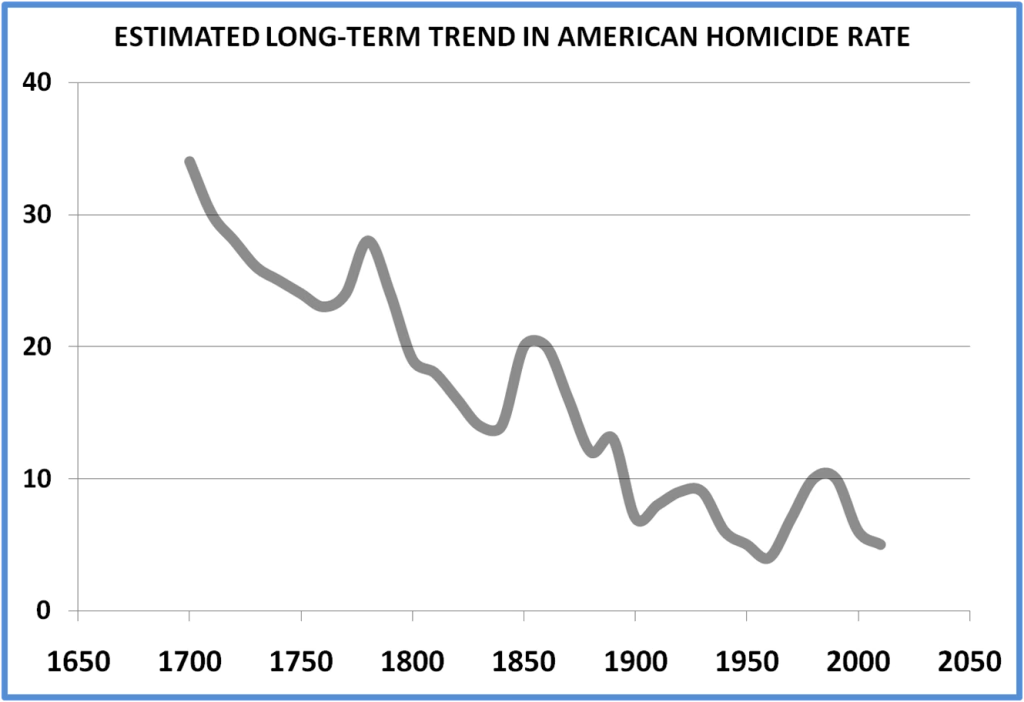
In his impressive 2011 book The Better Angels of Our Nature: Why Violence Has Declined, Steven Pinker assembles extensive data to show that across virtually every society and culture, violent crime (especially homicide) has declined dramatically since at least 1700. That includes the United States.
Pinker identifies several factors that have contributed to this reduction (which, to be fair, includes both violent crime and violent deaths owing to war). One is the improved capacity and effectiveness of centralized states to reduce blood feuds and tribalistic small-scale fighting. Think: Thomas Hobbes. (An aside: This factor alone throws into question the wisdom of any literal recommendation to “defund the police.”)
Other factors that Pinker notes include the spread of democracy with its commitment to rights and property, the rise of mass media and literacy, and cultural shifts emphasizing empathy and cooperation.
There’s plenty of room to debate Pinker’s work, especially the relative weight of each cause he identifies. Some critics have argued that Pinker’s avalanche of data sheds little interpretive light. Others question his minimization of twentieth-century militarized violence, and for others, it’s a hard sell to claim we’re becoming more empathetic as a species.
Pinker has faced many criticisms, but I find the book on the whole very impressive because one criticism that’s notably muted—or nearly absent—is a substantive challenge to his central claim that violent crime, especially on a per capita basis, has decreased over the centuries.
Put concretely, today’s American violent crime rates—including homicide—are only a fraction of what they were at our nation’s founding, a period often idealized as America’s Golden Era. The following graph is very much in keeping with Pinker’s findings. (Homicide rates per 100,000 population.)
Crime in Recent Decades
Crime rates have also declined significantly since the early 1990s, after rising between 1960 and 1980, when they plateaued. (I focus below on homicide rates, but the trend line for homicide rates and for violent crime more generally track fairly closely. All data noted below taken from here.)
In 1962, the homicide rate in the United States was 4.6 per 100,000 people, after which it rose steadily until 1980, peaking at 10.2 per 100,000–more than double its earlier level. The rate dipped and bobbed for the next dozen years without a major decline, so that by 1993 it remained relatively high at 9.5 per 100,000. From that point forward, however, it dropped steadily until 2014, bottoming out at 4.4 per 100,000—slightly below the 1962 homicide rate and less than half the 1980 peak.
Following its 2014 nadir, homicide rates fluctuated modestly, but for both 2018 and 2019, the rate was a flat 5.0, or essentially the same as its 2014 nadir. And to repeat myself, violent crime more generally also fell along with homicide. The overall picture since 1993 was by nearly all measures a huge improvement in personal security.
I’m no criminologist, so I’m not in a position to assess the comparative merits of the causes experts propose for this drop, but some common explanations for the drop include:
- Improved police technology and data analytics
- Targeted policing focused on hot spots
- Social and economic factors such as a strong economy, an aging population, and better education
Also mentioned quite often as an explanation was the United States’ globally unique high levels of incarceration. To be sure, despite its moral and human costs, it’s hard to imagine that our extraordinary incarceration rate had no effect on crime levels. On the other hand, it’s equally clear (to me, at least) that our uniquely high incarceration rates removed men from homes, weakened families, and made future crime by their children left at home more likely. Crime is a complex social phenomenon.
One of the more counterintuitive theories offered for the decline during this period was proposed by Steven Levitt and Stephen J. Dubner in their book Freakonomics. Their theory links the legalization of abortion in the early 1970s to the decline in crime two decades later. The theory is that unwanted children were aborted, thereby reducing the number of children raised in homes most prone to producing future offenders. (Again, I am no criminologist, and I welcome your own commentary in the comments below.)
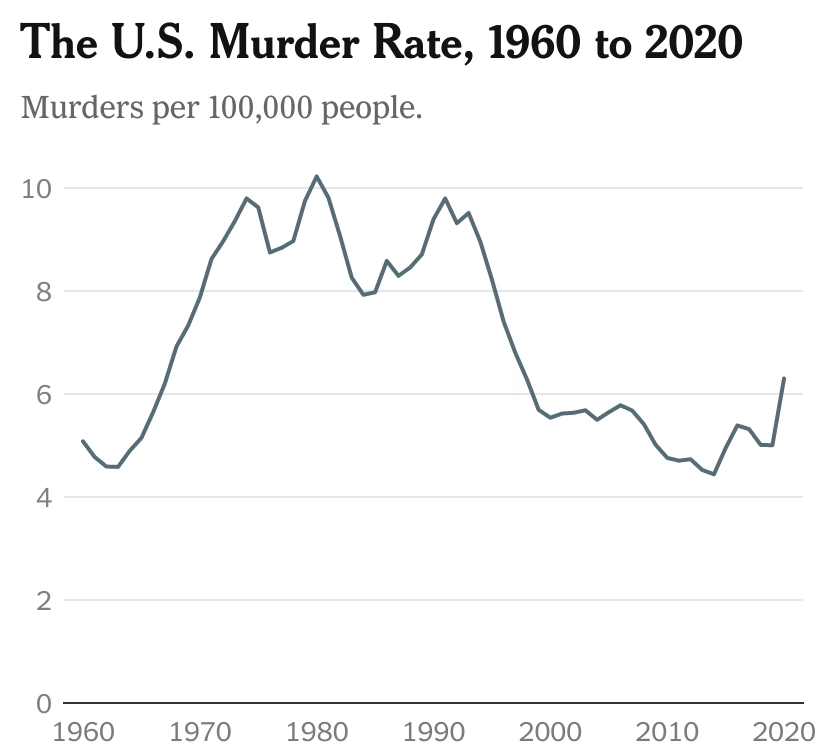
The chart above illustrates both the initial upward swing, the two-decade plateau, and the welcome precipitous drop in the 1990s. It also shows a more recent uptick, with a notable rise in 2020 followed by a smaller increase in 2021, leaving the homicide rate in 2021 at 6.9 per 100,000—the highest since 1996.
What caused this surge of violence? The angry nationwide response to George Floyd’s murder is sometimes blamed for this 2020 spike, but a Brookings Institution analysis debunks that theory. The same analysis finds that “the spike in murders during 2020 was directly connected to local unemployment and school closures in low-income areas.” (Italics mine.) In other words, this upward tick of violent crime–and the source of national handwriting– was almost certainly yet another social upheaval caused by the pandemic.
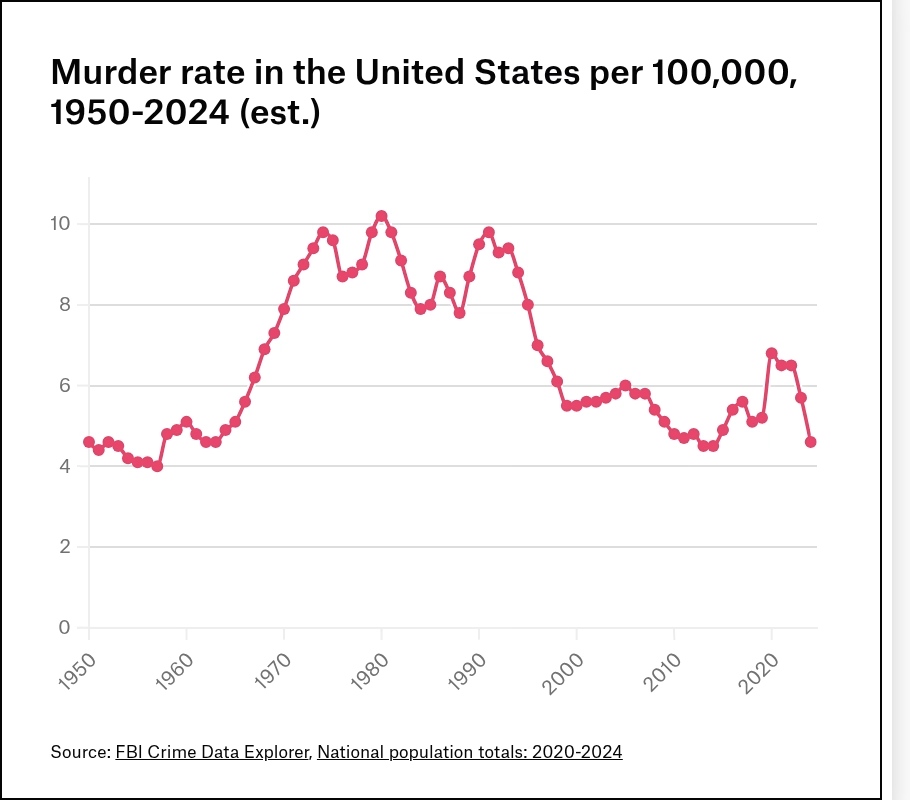
The 2020–2021 spike covered Trump’s final year in office along with Biden’s first. Since then, predictably, as the pandemic has receded, homicide rates have returned to pre-pandemic levels. In 2024 (Biden’s last year in office, it’s worth noting), the homicide rate was 5.0 per 100,000—the same rate as in the immediate pre-pandemic years of 2018–2019. (The following chart is a close estimate for 2024.)
Violent crime overall also declined during Biden’s final two years and almost certainly continues to do so under President Trump’s first year in office.
We should not allow willful falsehoods about “rising crime” to become a pretext for abandoning our constitutional and democratic values. Due process, state-led law enforcement, and limits on executive power are not peripheral values; they are core to the American experiment and ought not to be abandoned absent an extreme emergency.
Our President has personal motives for consolidating power by having us believe that we are in a crime epidemic. He believes it will serve him. He tells you it will serve you. It will not. It will make us less safe.
But Immigration Makes Us Unsafe, Right?
Not only is crime dropping—contrary to what Trump claims—but two other favorite claims of his are also questionable and very likely flat-out false.
One commonly asserted (and widely accepted) falsehood is that crime and immigration are closely linked. On inspection, this proposition is dubious at best, and likely false. One peer-reviewed study finds that “cities with the largest increases in immigration between 1990 and 2000 experienced the largest decreases in homicide and robbery during the same time period.” (Italics mine.) And according to a meta-study of immigration-crime scholarship, most research reveals little connection between immigration and crime, and those that do tend to show a negative correlation—with “the most rigorous studies showing immigration lowering crime.” (Italics mine.)
Ironically, the actions of ICE and other agencies bent on deporting immigrants may be interpreted as confirming the weak or non-existent link between immigration and crime. According to TRAC Reports, “only 1.59% of FY 2025 new (deportation) cases sought deportation orders based on any alleged criminal activity of the immigrant, apart from possible illegal entry.” Similarly, a study from the conservative Cato Institute found that 93% of persons taken by ICE had no convictions for violent crimes. The overwhelming majority of folks are detained to meet quotas, not because they pose a threat to their communities. ICE markets itself as targeting the “worst of the worst,” but in practice mostly it targets brown-skinned persons (individuals and families) lacking legal documentation.
The overwhelming majority of violent offenders–the worst of the worst–remain homegrown in the good ol’ United States of America, and the overwhelming majority of immigrants being rounded up, detained, and deported by ICE have committed only the crime of illegal entry.
Whether one believes that the absence of documentation is sufficient reason to deport an individual is a matter of judgment. What is far less a matter of judgment is the falsehood of the administration’s justifications for these actions. These are pretty well established.
But Democratic Cities Will Kill You, Right?
Evidence shows that crime is dropping (in the long term, mid-term, and short term) and also that immigration has no firm connection to higher crime–and in these particulars, President Trump has been feeding the American public a steady stream of falsehoods. But can we perhaps agree with President Trump that Democratic cities are highly dangerous?
At the highest level of abstraction, the claim is hard to refute if for no other reasons than what feels dangerous is subjective. It’s also the case–again, speaking in broad generalities–that urban areas are more criminally violent than rural areas and, moreover, urban areas vote more Democratic than do rural areas.
But there is a massive leap in logic from acknowledging these broad sociological realities to concluding that certain “blue” cities should be effectively occupied by the American military–in contradistinction to American custom and traditional interpretations of the Constitution. Yet this is precisely the leap President Trump is making, and it’s the leap he is pleading with us to make along with him. He is leveling specific accusations against specific cities and calling for unprecedented presidential intervention—without any remotely discernible crisis or emergency to justify it.
Let’s focus on President Trump’s stirring and perfectly coherent—and not at all coo coo for cocoa puffs—address to American generals and admirals last week in Quantico. In that address he described San Francisco, Chicago, New York, and Los Angeles as “very unsafe” and “dangerous” places. He described Portland as a “war zone.”
He declared that there is a “war from within” and even suggested “we should use some of these dangerous cities as training grounds for our military.” He promised he would “straighten them out one by one.”
Trump’s unprecedented claim that deploying the National Guard or military to Democratic cities is justified—even as crime rates continue to fall—appears to have genuine political traction. For example, Republican Arkansas Governor Sarah Huckabee Sanders has said that Democratic governors and mayors should be “begging for (federal) help” because they “can’t do the job.” She has also urged conservative parents to move to Arkansas from California to protect their children.
Crime Rankings (Per 100,000 Residents)
Safety is partly subjective, of course. But the FBI tracks and publishes data on the 200 largest U.S. cities. Facts require interpretation, but we have to start with what we know.
To assess Trump’s specific claims, let’s begin with San Francisco, for two reasons: first, it’s the city Trump mentions first for “cleaning up” with federal troops, and second, it’s where one of my daughters lives.
Looking at crime rates per 100,000 population (to compare apples to apples), what we find is that among the 200 largest American cities, San Francisco is
- 6th worst in property crime,
- 4th highest in violent crime,
- 6th in rape,
- 21st in homicide.
Ouch! One must admit, that’s pretty rough. Perhaps President Trump has a point.
I beg your pardon! I was looking at the wrong data! Those numbers aren’t for San Francisco—they are for Governor Huckabee Sanders’ own Little Rock, Arkansas! Here’s how San Francisco actually ranks:
- 28th worst in property crime,
- 77th highest in violent crime,
- 121st in rape,
- 120th in homicide.
San Francisco’s homicide rate is slightly lower than the national average, which of course includes rural areas, and is roughly the same as the mean streets of Kansas.
Let’s take a broader look at the cities Trump mentions by name as highly dangerous and compare them to Little Rock, a city situated in the red paradise state touted by Governor Huckabee Sanders.
The following homemade chart ranks the following select cities (Little Rock along with those mentioned by Trump in his address) from among the 200 largest U.S. cities according to their respective crime rates, with 1 representing the most criminal city and 200 the least criminal city.
| Homicides | Rape | All Violent Crimes | Property Crimes | |
| Little Rock | 21 | 6 | 4 | 6 |
| Chicago | 22 | 60 | 92 | 41 |
| Portland | 56 | 81 | 57 | 5 |
| San Francisco | 120 | 121 | 77 | 28 |
| New York | 127 | 164 | 68 | 105 |
| Los Angeles | 88 | 114 | 67 | 166 |
None of these cities are perfect, and all have serious problems. But none of these “blue cities” mentioned explicitly by Trump resemble the horror stories we’re being fed. In fact, they’re all far safer—by virtually any measure—than Governor Huckabee Sanders’ own Little Rock.
So what’s the point?
Crime is real, and it’s personal—and it’s always bad. My heart goes out to anyone who has been victimized by crime. But it’s also plain as day that what motivates Trump’s rhetoric about using the military in U.S. cities is not concern for crime but a desire to punish Democrats. It’s but one more push toward autocracy.
A Fearful and Misled Public
Part of the reason Trump gets away with his falsehoods is that he plays on fear, no matter how unfounded. That, frankly, is why I decided to write this post. We need to counter falsehoods with what we know to be true.
In one recent poll, three times as many Americans (48%) believed (falsely) that crime had increased over the past year as believed it had decreased (16%). Such sad findings are common. For example, a Gallup poll from October of last year found that 64% of those polled believed crime had worsened over the previous year. Both 2023 and 2024, in fact, saw significant decreases in crime.
The public almost always believes that crime is getting worse. According to the same Gallup poll, from 1989 to 2024—a period marked on the whole by dramatic declines in crime—there were only two years in which less than a majority of people believed crime had dropped from the previous year. In the public imagination, crime is always going up. The apparent wonder of it is that there is anyone left un-murdered to respond to the pollsters.
People tend to believe their own neighborhoods are safe but that things are dangerous elsewhere. You know—in places like Los Angeles, New York, Portland… those places. Elsewhere.
These views are mistaken, and they’re the very fears President Trump exploits to justify sending National Guard troops or the military into American cities—to intimidate and terrorize Americans, especially those in blue states and cities.
And it’s terribly wrong and utterly un-American.
We need honest debates about crime. No ideology has a monopoly on wisdom. But building policy on lies is both immoral and ineffective—and we’re a lot better than that.

Excellent post!
Tangential to this excellent post, I saw a graph yesterday that showed that perception of crime is highly partisan; that Republicans were particularly susceptible to their preception of crime varying depending on who is in the White House.
I’m waiting for a study that proves landscaping by trained soldiers reduces crime by 7,000%
It would be a shame not to mention the late Kevin Drum’s efforts over many years to demonstrate a close association between the removal of lead from gasoline and lower rates of violent crime, not only in America but globally.
It’s a standing joke in Australia that Laura Norder always plays a prominent role in the right’s election campaigns.
I suppose she got her information from “countless members of the FBI.” It’s been more than eight years since she said that as WH press secretary, so I think that lie has been expunged from the public consciousness. In 2024, the public didn’t even seem to remember the sh!tshow that was the presidential administration of Nov 2020 to Jan 2021.
Were you to present this piece at a conservative blog, commenters would advance a dozen reasons your statistics are wrong. They seem to very deeply need to believe what they believe. And any hint that crime is a result of poverty and poor education would be rejected, as would the leaded gasoline hypothesis @Ken_L: notes. Crime must come from hereditary or cultural flaws among minorities. Much more comfortable to blame the victims than to hint maybe it’s something we did to them.
Law and Order as an issue under Nixon was largely just aimed at black people. Now it’s aimed at all brown people. I would agree with others above that if you argue this with people from the right, they will deny the numbers are accurate but note they are very selective. If the official numbers show someplace like Chicago or Baltimore are bad then they cite those numbers with complete belief. If the numbers show that cities with blue government and/or lots of immigrants, like San Jose, New York or Chule Vista have low crime rates then the numbers from the same source they quoted about Baltimore are then wrong.
Steve
Great post which explains why I’ve always felt safer living in urban cities than more rural places. I remember a similar compraision between crime per capita in Fairfax Va and Washington DC.
However, it is a red-herring when you look at crime stats. I know fellow liberals will roast me for pointing this out, but murder in DC by year gives conservatives the amo they need. Local liberals need to get a handle on crime:
Year Number of Homicides
2025 112 (Year-to-Date as of early October 2025) for Washington, DC
2024 187
2023 274
2022 203
2021 226
2020 198
2019 166
2018 160
2017 116
2016 135
2015 162
2014 105
2013 104
2012 88
@HelloWorld:
No. Not a red herring. It’s math, and it matters. Raw numbers do not tell the same story as per capita metrics.
That’s not a “liberal” observation. It is just true.
St. Louis had 158 homicides in 2023
Los Angeles had 324!
But the population of St. Louis is just under 300,000, while the population of LA is almost 4 million.
(Source).
This is not to say that homicide numbers in DC aren’t a problem, nor is it saying that different policies aren’t warranted.
BTW, as much as those numbers may, in fact, give Reps rhetorical ammo, I would note that it doesn’t get them elected in DC. Moreover, I would argue that the largest racial category in DC is Black, which gives the GOP the ammo they need to criticize DC.
I have not trouble talking about how raw numbers are important, but let’s not dismiss basic math in the process.
@Steven L. Taylor: Not sure what you mean about math. Facts are facts and violent crime is up in DC. Now, let’s talk pragmatic solutions. Having a conversation about where it’s up more sounds futile to me.
@HelloWorld:
Raw figures v. per capita.
@HelloWorld: It’s important to point out when crime is going up, as you point out. It’s not okay to mis-represent facts–which I’m not suggesting that you’re doing but that Trump-world does routinely, really nearly as a matter of policy.
@HelloWorld: Also speaking of raw numbers, it seems kind of noteworthy that there was a significant decline from 2023 (274) to 2024 (187). And to note that the 2025 number is on pace to be the lowest since 2017 (I assumed (112/9)*12, which equals 149. A simplistic estimate, as I do not know if Oct, Nov, and Dec are seasonally high for murder or not, but the general trend is positive.
But also to my point about, the real issue is the relationship of those raw numbers to the population size if we want a truly useful metric.
@Steven L. Taylor: DC has a stable population of the last 20 years, seeing some increase. Demographically becoming more white as population does change. As you point out, 2025 – the year Trump invaded the city – crime is going to see a drop. I have no data other than noticing that I’m reading about stabbings and gun fights in Arlington, not sure if it’s moving crime around. In any case, to say DC or any other city is improving, you need at least 5 years of data. Additionally, the claims of “30 year low” is/was false. We have different standards, and I won’t be happy about the state of crime in DC until I see the numbers at or below 100, like it used to be when they really were at a 30 year low.
@Michael Bailey: Agreed, I don’t think Trump CAN tell the truth. But I also want liberals to tell a realistic story that holds up to scrutiny, and allows them to change their strategy when the public at large is on a different page.