More on the Attack in the Caribbean
It is unusual and a problem.
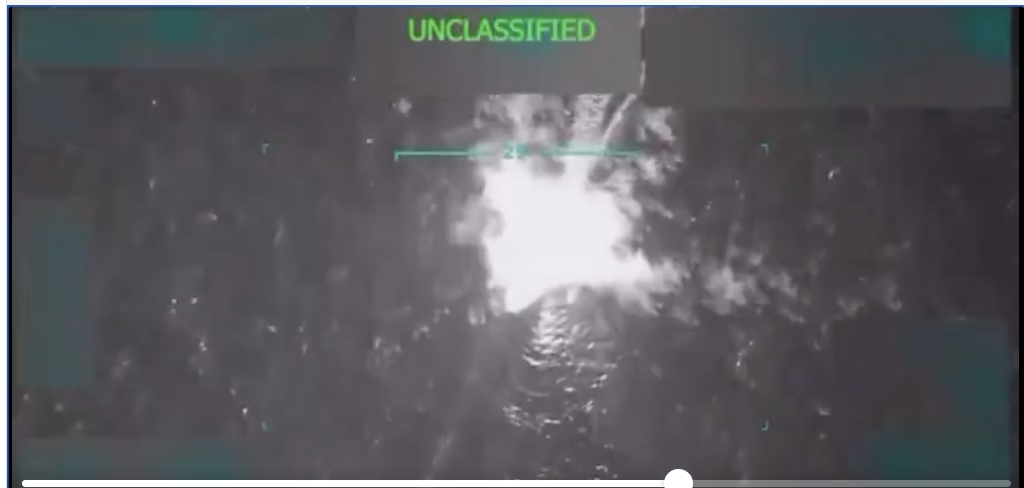
To add to my post from yesterday (US Blows Alleged Drug Smuggling Boat Out of the Water) here’s a run down of why the strike is unusual and a problem.
For example, here’s Brian Finucane (a legal scholar whose credentials include “over a decade as an attorney-adviser in the Office of the Legal Adviser at the U.S. Department of State”) writing at Just Security (a publication based out of the NYU Law School), Legal Issues Raised by a Lethal U.S. Military Attack in the Caribbean.
Despite labelling the targets “narcoterrorists,” there is no plausible argument under which the principle legal authority for the U.S. so-called “war on terror”—the 2001 Authorization for the Use of Military Force—authorizes military action against the Venezuelan criminal entity Tren de Aragua.
[…]
Further, though Trump and others in his administration have emphasized the prior designation of Tren de Aragua as an FTO, such designation does not by itself convey authority to use force. Nonetheless, such FTO designations are widely and mistakenly perceived as authorizing such action within the executive branch. Thus, designation of Tren de Aragua and a number of other Latin American criminal entities as FTOs in February foreshadowed this week’s attack in the Caribbean, despite providing no actual legal authority for it.
The designation of TdA as an FTO is clearly the pathway the administration is taking to justify this and future attacks. But it is worth underscoring that simply designating a group as a foreign terrorist organization does not convey the legal authority to kill suspected members with impunity. Further, the notion of an FTO is that it is a politically motivated group willing to engage in political violence against US interests. Criminal activity is not the same thing.
The following is noteworthy as it further confirms the various reactions, mine included, that see this as a real deviation from the past.
Working in collaboration with the U.S. Coast Guard, the U.S. Navy has for many years conducted maritime interdictions of suspected drug smugglers under a law enforcement paradigm—including during the current Trump administration. In such operations, U.S. Coast Guard law enforcement personnel board the suspect vessel and take the crew into custody.
The attack on the smuggling vessel in the Caribbean was so extraordinary because there was no reported attempt to stop the boat or detain its crew. Instead, the use of lethal force was used in the first resort. According to Secretary of State Rubio, President Trump was given the option of conducting a maritime interdiction but instead elected to blow up the vessel to send a message. Such use of lethal force raises a number of distinct legal issues.
Please note: no known attempt to stop the boat, but lethal force was the first resort. This is central to understanding how unusual this is as official policy touted directly from POTUS.
I would note “law enforcement paradigm” includes presumptions of innocence and due process of law. It does not mean summary execution based on mere suspicion.
From his conclusion (emphasis mine).
The Trump administration’s military attack on this alleged smuggling vessel is not only extraordinary and unsettling in its own right, but also because of the context in which it occurs and for what it may portend for future action.
The use of lethal force in this attack appears gratuitous and the administration has not explained why law enforcement tools were inadequate to address the situation. Of a piece with the deployment of troops to U.S. cities, the strike is an unnecessary and performative use of the U.S. military—a use that is legally fraught at best. (Indeed, Trump threatened Chicago with a troop deployment in the same Oval Office appearance in which he announced the strike.) And the use of lethal force against these supposed terrorists is ominous both because the Trump administration has vowed further such strikes in Latin America and because this administration has deployed the “terrorist” label more broadly domestically, including against migrants and political opponents.
I commend the whole piece, which notes a long list of areas of law and practice that are raised by this action.
I think that dismissing this action is a mistake. One of my fears is that the broader public will just see this as eliminating “bad guys” and shrug it off.
I will stress again that, in addition to the moral and legal objections, there is no reason to assume that this kind of action will actually stop drugs from entering the United States. So, even if one thinks that this is justifiable, it isn’t an efficacious policy. The President of the Philippines, Roberto Duterte, a person that Trump admires, thought that killing suspected drug dealers was the way to go. Guess what: there are still illegal drugs in the Philippines.
I will note that El Salvador’s President Bukele has managed to drive down gang violence, but it meant putting a lot of innocent people in jail and dispensing with due process. Side note: There is still crime in El Salvador.
In terms of precedents, Axios quotes former U.S. Attorney Patrick Sullivan:
“We’ve never seen this before,” Sullivan told Axios. “This is a totally different approach. No one fired a missile at a go-fast boat and just destroyed it. It’s just totally unheard of.”
Ok, why does it matter? I would point to this essay in The Atlantic: Trump Is Crossing a Line That Dates Back to the Revolution.
Both domestically and internationally, the U.S. armed forces are tackling threats once assigned to police officers, Drug Enforcement Administration agents, Coast Guardsmen, and other law-enforcement personnel. They are escorting immigration officers as they arrest undocumented immigrants in American cities, combatting crime with their presence in the U.S. capital, and stopping drugs at the southern border. Off the shores of Venezuela, U.S. ships are massing in a show of force against drug traffickers, a threat long addressed through interdiction at U.S. points of entry or in international or U.S. waters—not through lethal strikes.
[…]
The new tactics represent a shift away from the vision, dating back to the colonial revolt against an overbearing superpower, that U.S. armed forces should defend the country from external threats but not be used to routinely enforce the law.
While I would be concerned about the boat incident even if were singular, or if the issue was just expanding the drug war, we need to note the broader context. Trump is using pretexts like “emergencies,” “invasions,” and “terrorism” to engage in dubious, if not highly problematic, deployments of federal assets in the US and is further using such logic to disappear human beings from US streets and send them to foreign prisons.
We are not talking here about some singular puzzle piece with hysterical inferences being drawn. The use of “emergency” powers and the politicization of the military, all the while stoking fear to justify such actions, are all classic authoritarian moves.
I would add that the notion that enough force can be deployed to make crime go away is an ahistorical fantasy.
I will add, since it is on the minds of many, yes, some policies can be deployed to help alleviate crime. Most of them take money, and none of them are perfect. Further, the fact that some Democrat somewhere said something wacky does not mean that any of what Trump is doing is justified, nor is the blame to be laid at the feet of the wacky.
Blame the person doing the thing.
If your sister was super annoyed and you kicked her, your Mom isn’t going to accept, “She made me!”
If a woman is raped, it is never appropriate to point to her dress and say, “She was asking for it.”
At any rate, back to the Atlantic piece:
Under the Trump administration, the mission has changed. Terrorist threats are no longer limited to groups or individuals plotting violent attacks against America, and invasions don’t just come from foreign adversaries. A threat could be someone carrying drugs bound for the United States; an invasion could be a collection of migrants crossing the border. And just as the military has used precision strikes to eliminate al-Qaeda and Islamic State leaders thousands of miles from U.S. shores, it can now target drug runners operating far closer to home.
If it is unclear as to why this is a problem, let me know, and I will try to better explain it.
I recommend the whole piece, by the way.

Before engaging in the Action movie theory of foreign policy, one should remember action movies are highly unrealistic.
@Kathy: Exactly.
See also, the action movie theory of law enforcement.
This is all of a piece with the Trump administration’s constant declarations of [waives hand broadly] “emergency” and “invasion,” thus justifying the President to do “anything [he] want[s].” Without a close reading, I will give the many judges who have supported this as a prudential excuse that they don’t want to hamstring a president dealing in good faith with the exigencies of the world. What these judges won’t accept or confront is that a president who has manifestly stopped dealing in good faith must someone how be called out for the failure on that basis premise of governance.
Well, the US naval presence outside Venezuelan waters increasing… an increased bounty on Maduro.. Blowing up Venezuelan civilian boats.. there’s a lot of provocation going on here.
The administration has also justified the strike as part of a “war on drugs.” I’d hate to see them execute a war on illiteracy, war on poverty, etc., seeing as they think “war” has just one literal meaning.
Just as sending troops to LA and DC, and outfitting ICE agents in masks and unmarked vans is designed to send a message. This mentally ill ignoramus understands the importance of marketing and branding and “sending a message.” That the actions underlying the message being taken are unlawful is something for others to worry about.
And quoting Joe: What these judges won’t accept or confront is that a president who has manifestly stopped dealing in good faith must somehow be called out…. Amen! Almost everything the Trump administration is doing is done in bad faith….whether it is pardoning the J6 cop attackers or filing complaints against Jack Smith and the judge who ordered the CECOT planes to be turned around, the actions/filings are rife with bad faith and there should be repercussions to both Trump and the stooges doing his bidding.
It occurs to me that this Administration is running or a warped low level Monroe Doctrine operation here in the Western Hemisphere.
The signs? (1) Renaming the Gulf of Mexico, Slapping a 50% tariff on Brazil because Trump is angry that his soul brother autocrat and personality cult leader is being prosecuted the current government for planning a coup to overthrow the current government, (3) this current Venezuela drug boat incident.
There were a few posts on Bluesky yesterday saying the boat carried immigrants rather than drugs.
Either way, such a small boat isn’t worth taking out, even if it carried armed troops with a sign saying “MIAMI INVASION FORCE!!11!!1!”
For one thing, it’s too small to go far. You’d expect the crew was going to meet a ship, or travel somewhere along the coast, and transfer the cargo, if nay, to get it to it destination. So, even if you’re a troglodyte just mashing perceived enemies with your club, you lose more than you gain in this instance.
I suppose there are reasons why someone in charge of a super power nation might want to appear as a troglodyte just mashing perceived enemies with a club. But is there a reason to want to appear as a stupid troglodyte?
There are 7 US Navy vessels deployed to this task. Among them is a USMC carrier of aircraft (Harriers and helicopters, so it’s not a “carrier”), and some infantry forces in a troop carrier.
So, this is way overkill for blowing up some small boat carrying drugs. Something else is going on. That may not have been a drug smuggling boat at all.
I mean, it’s fair to take them to task for what they are saying happened.
Meanwhile, according to what I’ve seen, Maduro is dirty. He did not legitimately win the last election. He is involved with a territorial dispute (with oil at stake, guess what?) with Guyana.
Venezuelan forces threatend a US Flag Exxon oil ship (something other than a straight tanker, I’m not sure) and fired on Guyanan election officials while they were on a boat on the river which makes part of the border between the countries.
AND, there is some kind of sense that Russia might be trying to strengthen ties with Maduro.
So there is a whole bigger picture for what is going on.
My main source in this comes from a man named William Spaniel, who is a political science professor at UPitt He seems pretty credible to me, maybe the hosts know more?
The number of Marines, compared to the number used to take out Noriega, does not seem to be sufficient to invade Venezuela. Maybe there are smaller tasks possible? Maybe this is a threat display?
@Jay L. Gischer:
If there’s a plan, it’s not El Taco’s plan. A lot of what he does is the Project 1939, sometimes dressed up to flatter himself, or done in word salad verbiage to appeal to him.
Now, Venezuela has the largest proven oil reserves in the world, over 300 billion barrels. But it also produces relatively little oil, under 1 million barrels daily. The US on the other hand produces more oil than anyone else, over 13 million barrels daily, but has small proven reserves at around 74 billion barrels.
Further, much of the oil the US produces is not the grade that most US oil refineries can make use of. therefore America still imports lots of oil (and maybe also because it uses more than it can produce). Until 20 years ago, Venezuela was the US’s largest oil supplier…
Until last January I’d have thought taking over a country to strip off its resources was not something even El Taco would do. Now I’m not so sure. He hasn’t said he wants to gobble up Venezuela, as he has claimed of the Panama Canal, Greenland, and Canada. But I can totally see a coup or an invasion to overthrow Maduro, in order for US oil companies to move in and take charge of “developing” Venezuela’s oil industry.
It probably won’t be an outright conquest and a 51st state (those people would vote Democrat!!1111!!!!), but a puppet government that charges ridiculously low royalties for the oil extracted, and “relaxes” environmental rules so it’s cheaper to pump, well, that’s just good business.
Rubio was commendably honest about the regime’s motives. You see, just intercepting drug shipments “didn’t work”. The cartels kept trying to send more! So obviously the solution is to kill them and keep killing them until they stop. Really, they left America no choice!
Needless to say this kind of “reasoning” could (and probably will) be used to justify the use of deadly force to “solve” all sorts of problems in America that persist despite decades of efforts to fix them with constitutional law enforcement methods. And the response of half the country will be “About time!”
@Kathy:
Eleven dead does seem an oddly large crew for a small smuggling speedboat.
Should be long past obvious that Trump has no “lines” drawn inside his warped atavistic brain. At least none that comport with civil society. And he has surrounded himself with people of similar defect. So, why are we surprised?