One of the Dumbest Things I Have Read in a While
And I read a lot of things.

So, I noted a reference to this piece at NRO’s The Corner: Let’s Hire Professors Purely on Merit that took me down a bit of a rabbit hole. The piece was by George Leff, which starts thusly:
The diversity mania that has swept over American education for the last 50 years or so has had a malign effect on the quality of professors. Many of those hired to fill quotas for certain groups are, to be blunt, not especially qualified.
Working backwards, while I know I run the risk of there being some weird counter-example across thousands of faculty hires a year, but faculty hires are not driven by filling quotas. I suspect that many hiring committees have improperly used racial and other categories in how they talk about, and sometimes have made decisions in hiring that were legally improper, but the process is not driven by quotas. And the obsession in the academy for qualifications is off the charts. Leef is just telling me that while he has taught at the university level, he has not been subject to the c.v.-measuring contests that are faculty hiring committees.
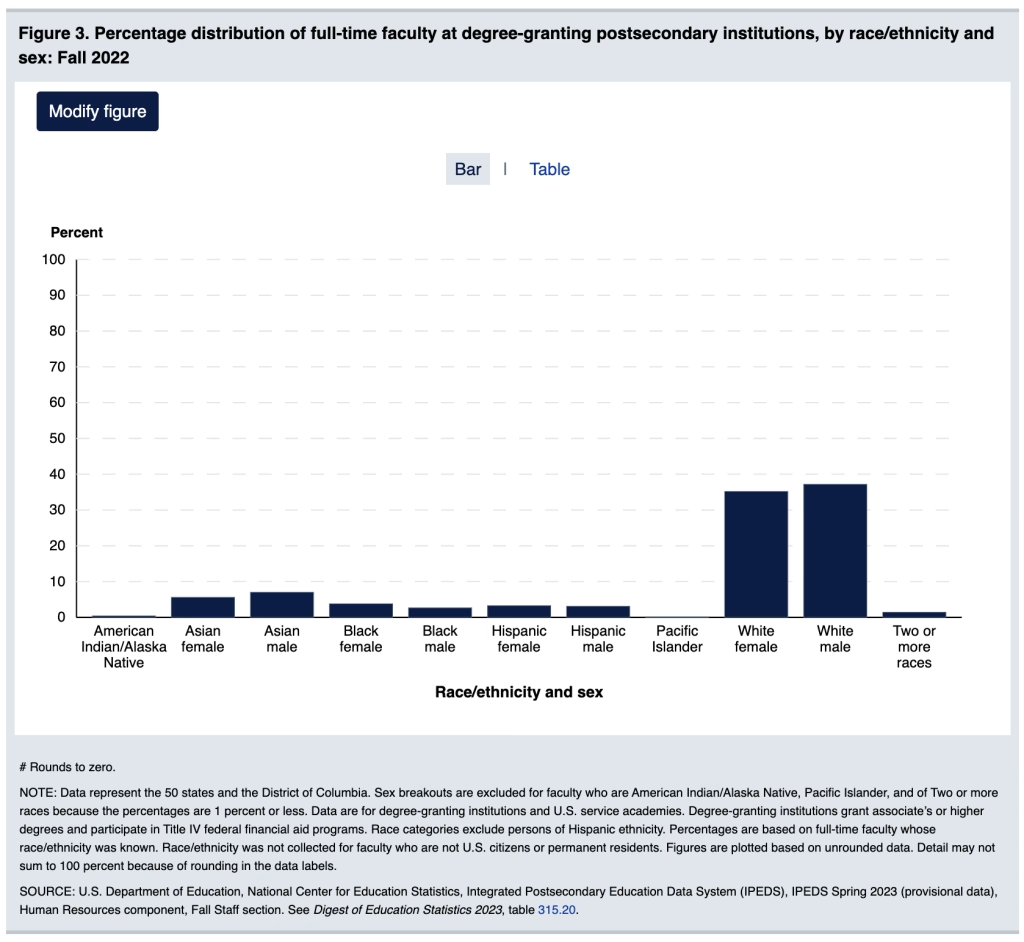
Further, the notion that there has been some crazy, over-the-top “diversity mania” gripping faculty hires is undercut by reality.
Here are several sets of data. See if you can spot the pattern.
The National Center for Education Statistics.

American Council on Education:
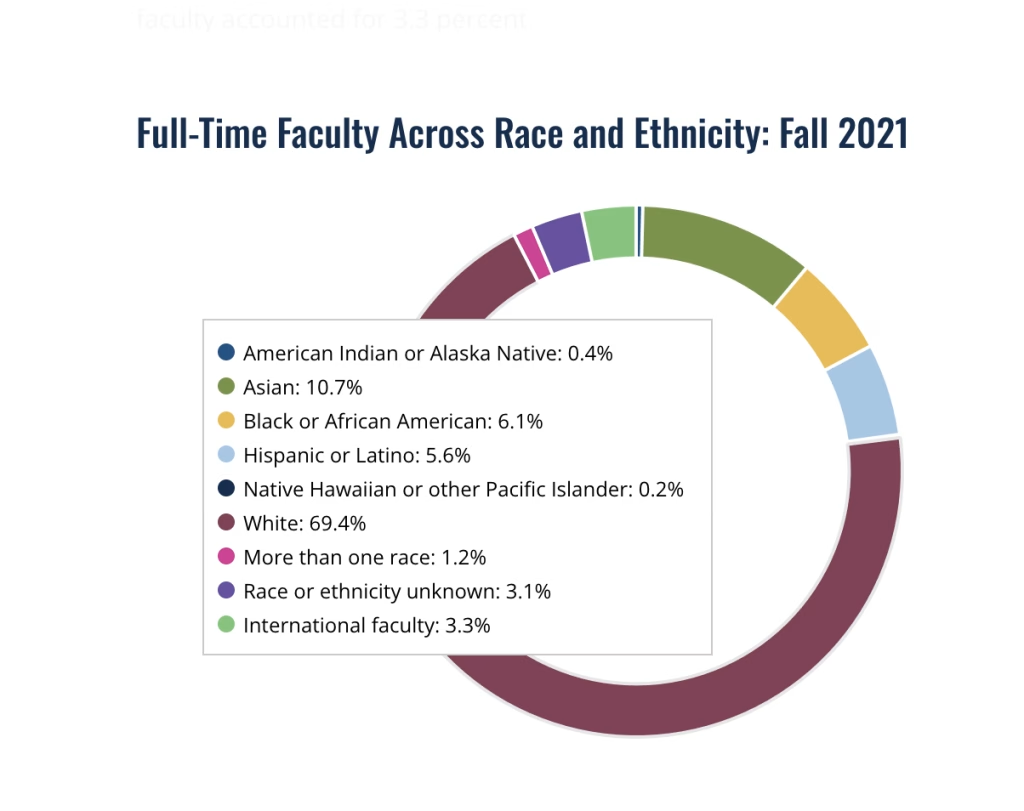
Owing to different methodologies and data-collection techniques, the three sources do not produce identical figures, and yet they all are pretty clear: university faculty in the United States are overwhelmingly White. While yes, there have been conscious efforts at increasing racial, ethnic, and gender diversity in higher education, the notion that a White man can’t catch a break because of “diversity mania” is just not true. Just as the notion that hiring non-whites detracts from “merit” and quality is also absurd.
So, what is the proposed “merit” based solution to this non-existent mania?
Well, it’s the adoption of the National Association of Scholars’ Faculty Merit Act, of course!.
The Faculty Merit Act would solve that problem by requiring schools to get the SAT scores of all applicants.
That’s right! The solution to all of this diversity mania is to use a standardized test score used for undergraduate admissions as a means of determining which applicants for faculty jobs are the most meritorious!
Leef states in his impressive analysis of the proposal that “This is a very good idea.”
No, it really isn’t.
I went over to the actual proposal (It’s Time to Mandate Merit).
The Faculty Merit Act requires state universities to publish every higher-education standardized test score (SAT, ACT, CRT, GRE, LSAT, MCAT, etc.) of every faculty member, as well as the standardized test score of every applicant for the faculty member’s position—of every applicant selected for a first interview and every applicant selected for a final interview. It requires everyone in the hiring process, both applicants and administrators, to affirm under penalty of perjury that they have provided every standardized test score.
An SAT score isn’t the same thing as being able to write an interesting book or discover something interesting in a lab. But a standardized test score isn’t a bad proxy for student merit in undergraduate admissions, and it isn’t a bad proxy for faculty merit in the hiring process. If the public and policymakers can see that a faculty search had 300 applicants, that the standardized test scores dropped during each round of the selection process, and that the person who got the job had a lower SAT score than 290 other applicants, then they can see that something is wrong. If they see that a “cluster hire” search had only five applicants, or just one, they can tell that the search process was rigged. Requiring applicants, search committees, and university leaders to affirm they have provided full information, under penalty of perjury, ought to deter the education establishment’s standard urge to bamboozle the public.
Even better, collecting and publishing information about standardized tests will help the victims of discrimination in the academic-hiring process sue colleges and universities. The Faculty Merit Act opens the black box of faculty hiring. It will give plaintiffs a fighting chance to win in lawsuits against academic discrimination.
Well, at least it’s not just SAT scores!
But seriously, I cannot get over how dumb this is.
The suggestion here is that standardized test scores that are designed for one function (admissions to certain kinds of programs) should be used for a wholly different kind of process for which they are not designed. Even better, the output of these scores would be before additional education and training relevant to the job being pursued.
The absurdity is off the scale. If you want to hire an engineer to design a bridge, I really don’t care much about what they scored on the ACT when they were 17. I would really like to know about their training, what they learned, and how much they understand about their field of expertise.
And we can’t ignore the fact that standardized tests are known to be racially biased in favor of whites and that affluence is a factor as well, including the fact that the more money a given parent has, the more likely a given student will get tutorials and other support for taking these tests. But maybe all that is the point.
Indeed, I think it is the point.
The Faculty Merit Act will make academic discrimination transparent and should deter the education establishment from discriminating so blatantly and so massively when it hires faculty.
The core assumption being made is that there are too many diversity hires, and that diversity hires (i.e., non-White men) are inferior. The hypothesis undergirding this policy is that we would find out that diverse candidates would be lower-SAT candidates (i.e., lower-IQ) types. What is this based on? Nothing, except maybe the knowledge that the affluent Whites tend to do better on standardized tests than do other groups. Although I suspect that in your typical pool of persons holding Ph. D.s, they have pretty damn good standardized scores (not that I would want to be judged on my SAT nor my GRE as opposed to my actual career if I were looking for a job). What’s next? Are we going to tattoo our GPAs on our foreheads?
And what does this even mean?
But a standardized test score isn’t a bad proxy for student merit in undergraduate admissions, and it isn’t a bad proxy for faculty merit in the hiring process.
Yes, it is a bad proxy. And just saying it isn’t doesn’t make it so. The “argument” here is practically nonexistent. (By the way, that isn’t even a very good sentence.)
All I know is that if we are going to start making hiring decisions on standardized test scores, we should look out for the massive spending by affluent parents to help jack up those scores a few more points. You never know when a tenure-track job might be on the line!
And let’s revisit this:
An SAT score isn’t the same thing as being able to write an interesting book or discover something interesting in a lab.
Weirdly, when I was involved in hiring chemists or biologists, I was kind of interested in their demonstrated ability to discover interesting things in labs, not SAT scores. And the ability to write books is a lot more essential to being a professor than how an applicant scored on their LSAT.
Anyone out there choosing their next surgeon based on their MCAT score instead of, you know, their actual resume?
Look, American higher education isn’t perfect. Hiring committes makes mistakes, and some faculty members and administrators are off the chain. But I cannot stress how much US higher education was (I fear the past tense may be the proper one), the envy of the world. Moreover, the US economy is fueled by people who need college degrees to do the jobs they do. For all its flaws, I am just a huge booster and believer in America’s colleges and universities.
Proposals such as these sound like they exist because some White dude somewhere didn’t get a tenure-track job right out of grad school. And instead of blaming their lack of hire on their own lack of academic output, they decided that the problem was that a brown woman got the job due to some non-existent quota. I mean, they had a 1450 on their SAT, and their Mom told them that that meant they could be whatever they wanted to be!
It seems worth noting that there are more job candidates than there are jobs, and so the process is very competitive (at all kinds of schools). Further, the number of really good jobs at highly prestigious schools and desirable locales is practically zero, especially once specific expertise is taken into account. It should be stressed that the issue is not “who is the best?” in the abstract, but “who is best given our needs?” For example, if what a department needs is someone to teach Middle Eastern History, the fact that you have a prize-winning book on the history of Paraguay, but you have no training or expertise in the Middle East, means you are put on the reject pile, even if you are a White guy who went to Harvard. Departments need what they need and have limited faculty lines to meet those needs.
And I cannot stress enough how much your SAT score doesn’t matter.
One last note, as all of this reminds me of Hillsdale College’s “Aims” on their Mission page:
The College values the merit of each unique individual, rather than succumbing to the dehumanizing, discriminatory trend of so-called “social justice” and “multicultural diversity,” which judges individuals not as individuals, but as members of a group and which pits one group against other competing groups in divisive power struggles.
Like the NAS, they want to focus on “merit” and not diversity.
Any guess what that looks like? Well, here’s their faculty page. I’m sure that no one has any idea what to expect. Lots of “merit” shall we say.
Likewise, here’s the University of Austin’s faculty page. You know, the bold place where dangerous ideas are on tap and wokeness goes to die. They may not be quite as merit-based as Hillsdale, but they are pretty close.

I’ll note in passing that Musk’s biographer claims to know Elon’s SAT score was 1400. On his second try. Good, but hardly exceptional.
Don’t forget many in the oligarch and desperately-wants-to-be-oligarch class can, and often do, pay others to take their SATs for them.
Scores on admissions tests are not indicative of much. I scored high on my admission to El Tec, for high school. I got a very high score in math, which was simple arithmetic and basic geometry. I then went on to flunk Math I (set theory and algebra), and Math III (trigonometry and analytic geometry).
It gets weirder. I aced Math II (equations and logarithms), because the tests were multiple choice. If you’d no idea how to solve a polynomial equation with multiple variables, you just substitute each option until one yields the equation’s result. Calculators were allowed during the test. Not only I got good grades in Math II, I finished my exams in record time.
Math IV was intervals, inequalities (equiton-like things where X+1>2; the solution is an interval), derivatives and integral functions. At the high school level, I found them rather straightforward, though I can’t for the life of me recall just what any of these were for. And, naturally, polynomial inequalities could be solved by subbing the intervals in the multiple choice. Even so, I got barely a passing grade in summer school.
I also flunked Chemistry II (organic chemistry).
I hired dozens of docs and hundreds of nurses. Never looked at SAT scores.
Steve
“And instead of blaming their lack of hire on their own lack of academic output, they decided that the problem was that a brown woman got the job due to some non-existent quota.”
I do believe this is part of the problem. But it’s also very useful for the newer classes of university administrators to insist that the reason a qualified candidate didn’t get a tenure-track job was because of an unqualified minority so that they don’t understand that the real reason is that these administrators have been slashing tenured faculty in order to hire vastly cheaper adjuncts and put that money where it really matters — in constructing new sports facilities, paying coaches tens of millions of dollars, and giving themselves salaries fit for a corporate CEO.
An evergreen statement for almost all of the anti-DEI nonsense out there. If these clowns want to be scored on merit, I’m somewhat inclined to say okay if this is what they come up with, because there’s no way they’ll be at the top of the pile.
And to think that the founder of the Nat’l Review is quoted famously saying that
By any definition, the Harvard faculty would be considered an example of merit.
You have to wonder, if these people who are honestly, as opposed to cynically, proposing merit, have ever been involved with hiring.
@Sleeping Dog: That quote has long bugged me, even in my youth when I was more predisposed to see Buckley in a positive light.
Buckley’s whole career was built on him being some kind of erudite, over-educated, intellectual. The derision of the educated and his appeal to the common man never tracked and seemed too cute by half.
@Jen:
I decided not get into it, but neither the NRO guy nor the NAS guy writes particularly well. Neither has had a conventional academic career, and one wonders how much that plays into the resentment of it all, especially the guy at NAS who has a PhD in History from Rutgers, but appears to have never had a real faculty position. The NRO guy has taught, but it seems at a very consciously conservative private school.
@wr: TBH, upper administration just cut the lines once they are vacant, instead of going through any charade about not finding a qualified candidate.
” TBH, upper administration just cut the lines once they are vacant, instead of going through any charade about not finding a qualified candidate.”
I get that… but it still works to turn the anger of the unemployed. “Hey, we only had this one job left, so we were forced to give it to the black chick.”
And they hit “black chick” so hard the rejected applicant never stops to say “Hey, why did you only have one job when you’re cramming your departments full of adjuncts?”
@Steven L. Taylor:
Oh I agree, look in any dictionary for the definition of pompous ass and there will be a picture of WFB Jr.
The only book of his worth reading is Airborne: A Sentimental Journey. A memoir of a trans Atlantic sail with his son and some friends.