
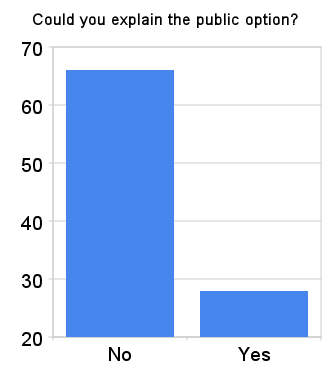
 Ezra Klein passes on word that the public doesn’t understand the public option. Or, more specifically, when asked, “Could you confidently explain what exactly the public option is to someone who didn’t know?” 66% answered no; the others lied or were in error.
Matt Yglesias is bemused by this because, after all, this has been written and talked about a whole lot. Helpfully, he explains that,
[T]he bills would create health insurance exchanges that would facilitate the purchase of health insurance on an individual market for people who don’t get insurance through their employers or Medicare or Medicaid. Part of how this works is that everyone who doesn’t get insurance through their employers or Medicare or Medicaid is going to be required to sign up for an exchange plan. Families will also be given subsidies to help them afford insurance. Presumably this large pool of potential customers is going to make insurance companies want to offer plans that meet the criteria for inclusion on the exchange. The “public option” proposal is the idea that in addition to whatever private industry wants to offer, the government ought to create a plan that consumers on the exchange can sign up for. As currently constituted, the public option doesn’t get any extra money from taxpayers beyond the premiums it takes in, and has no special links with Medicare, Medicaid, the VA health care system, or any other existing public sector program.
Which demonstrates simultaneously that Matt understands what the public option is but that, no, he could not explain it to someone who didn’t know.
I’d explain it simply as “the Federal Government would get into the business of selling health insurance.” That’s simpler and easier to understand but leaves out some important nuances. But bringing those in makes the idea too complicated for most people to intuitively grasp.









