Rubio’s War
Little Marco has come a long way.
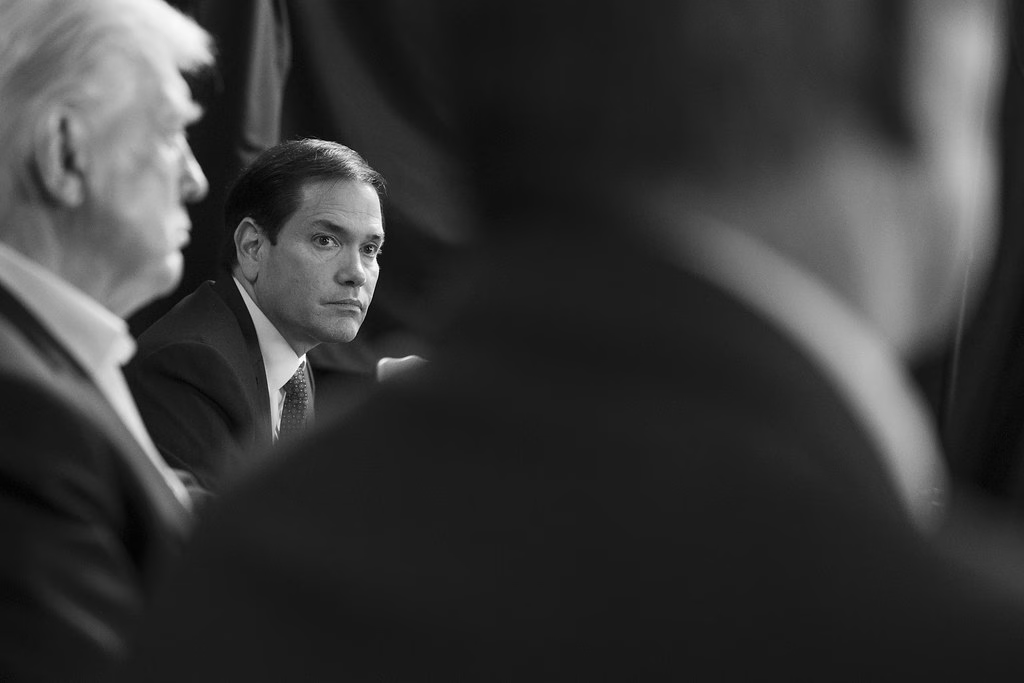
NYT international reporters Edward Wong and Michael Crowley, who “travel with the U.S. secretary of state,” offer an analysis of “Trump and Rubio’s Vision of War: The Art of Destroy and Deal.”
Throughout his long political career, Mr. Rubio has advocated toppling governments hostile to the United States. He was once considered so ideologically out of step with Mr. Trump that many officials and politicians doubted he would last a year in the administration. But today, Mr. Rubio is at the helm of Mr. Trump’s aggressive campaigns to reshape the governments of Iran, Venezuela, Cuba and beyond.
The U.S. president, who promised to end American wars, is now embracing the policies backed by Mr. Rubio and the secretary’s ideological compatriots, dismaying supporters who thought Mr. Trump had ushered in a new era of military restraint.
But Mr. Rubio is not trying to convert Mr. Trump to George W. Bush-era neoconservatism, which sought to remold other nations’ political systems, sometimes with military force, American officials and analysts say. Instead, he seems to be pursuing a new approach built on power free of principle. It is a merger of neoconservatism with Mr. Trump’s transactionalism, and it amounts to using U.S. military and economic power to turn authoritarian countries into client states.
It is regime compliance rather than regime change, a doctrine of destroy and deal.
Traditional neoconservatives saw promoting democracy and doing nation-building in the world as a moral good, even if it was done at gunpoint. And they viewed those as a means of transforming adversaries wholesale and extending American influence by spreading ideas. The Trump administration’s approach, so far, leaves internal politics to the rival nations as long as they show obeisance.
“For Rubio and other members of this younger group, foreign policy isn’t as much about regime change as much as it is about power,” said Emma Ashford, a scholar at the Stimson Center, a research group in Washington. “It is about sustaining American military primacy, making other states fear and respect us.”
[…]
The influence of neoconservatives reached its zenith under that president and his post 9/11 wars. But their ideas still hold sway in Washington, and some of their views are now at the fore of Mr. Trump’s foreign policy, championed by Mr. Rubio.
One is bolstering the American military partnership with Israel and striking at Israel’s adversaries — Iran in particular. The United States first attacked Iran last June, during the 12-day war started by Israel.
Mr. Rubio, who is also Mr. Trump’s national security adviser, helped plan that assault and most if not all of the administration’s other major military operations. Mr. Trump has ordered attacks in eight countries in the last year.
Meanwhile, Amie Parnes and Julia Mueller of The Hill report “Vance, Rubio jammed into high-stakes horse race for Trump’s favor.”
When President Trump gave his first press conference since the start of the Iran war, he brushed past Vice President Vance, instead lavishing praise on Secretary of State Marco Rubio.
“Marco Rubio is doing a great job. I think he’s going to go down as the greatest secretary of State in history,” Trump told reporters Monday. “He’s been successful no matter where he’s been.”
When asked whether he and Vance, known for imposing foreign wars and entanglements, disagreed on any points related to the conflict, Trump only offered: “He’s philosophically a little different from me.”
Over the course of the rest of the roughly 30-minute press conference, he never mentioned Vance again directly by name.
The moment reflected the clearest sign yet of the internal horse race that is playing out in Trump’s orbit over who will succeed him.
Vance and Rubio, by just about every estimate, are the two leading contenders.
[…]
Some political observers say Trump relishes the political intrigue around the Vance-Rubio question.
“It’s very Trump to constantly do a pulse check on how folks feel about Marco versus Vance. That is very much in the president’s DNA, to get a sense of where donors are and politicos and even folks in the media,” GOP strategist Brian Seitchik said.
“The president is always evaluating and comparing, and he’s well aware also that, by nature, those types of questions generate competition, which anyone who’s watched ‘The Apprentice’ knows he values,” said Seitchik, who worked on Trump’s 2016 and 2020 campaigns.
[…]
Trump’s decisions on Iran could shape a GOP primary in 2028, and there are risks related to the war for any GOP candidate who might run for president then.
Rubio came under criticism last week after remarks he made appeared to suggest the U.S. joined attacks on Iran in part because Israel was going to do so regardless of Trump’s decision, and that it needed to strike first before Iran counterattacked. That angered MAGA proponents wary of the U.S. being dragged into a war by Israel.
It’s possible it will benefit Vance in 2028 if he’s seen as a brake on those who want to push a more aggressive foreign policy in the Middle East, though there would also be clear dangers to anyone in Trump World who is seen as not backing the president’s decision.
“The things he’s doing now, these are not popular, win-the-midterms moves,” the fundraiser said of the Iran war.
In an ideal world, the decision to start a major war should not be aimed at winning the midterms.
The degree to which Rubio’s hawkishness influences President Trump’s decisions is impossible to know from the outside. Clearly, the Trump 47 foreign policy is much more aligned with Rubio’s vision than was the Trump 45 foreign policy, which was much more in keeping with the postwar elite consensus. It’s certainly possible that Rubio being his chief foreign affairs advisor is a major reason for that.
Regardless, using the military to blow up purported drug cartel boats, arrest the head of government of Venezuela, decimate the Iranian security apparatus, and threaten the government of Cuba is a far cry from the “Peace President” Trump campaigned as.

I’ve mentioned here a recent New Yorker profile of Rubio that quoted an old associate as saying Rubio has never had a mentor or a principle he hasn’t betrayed.
The United States first attacked Iran by aiding the overthrow of their elected government in 1953, replacing it with the dictatorship of the Shah, which the Iranians overthrew in 1978. Since then we’ve exchanged attacks. Besides blowing up a school, we shot down an airliner. It takes two to tango and the JCPOA was an effort to break the cycle.
Indeed.
And I’m left wondering what horrors Rubio has in mind for Cuba. But I suspect he’ll be distracted for awhile.
“…destroy and deal”? I believe the technical term is “smash and grab“.
Remember when some were saying Rubio was the least offensive member of Trump’s Cabinet? Those were the days, a mere 14 months ago, when we could still pretend there were reasonable, decent Republicans.
The idea that either Rubio or Vance could be allowed to present themselves to the American electorate as somehow fit for the Presidency after bending the knee to the manifestly unfit Trump is offensive to me. These two are much more suited for a cell at The Hague than the Oval Office at the White House.
The GOP delenda est. When Trump is finally (hopefully) removed from office, all his Republican supplicants need to be shown the door as well. Otherwise, we will know the voters have learned nothing about how they’ve brought this sh!tshow on us all.
I suspect part of the problem in all this is that Rubio is overstretched in trying to act as both SecState and NSA at the same time.
And a lot of the other political appointees at State and NSC are either dimwits or ideologues, or both.
That in addition to Rubio himself being a “demolish, don’t bother about rebuild” variant of neocon.
At any rate, for whatever reason, the almost certain cautions from CENTCOM about the vulnerability of the Straits of Hormuz seem not to have registered at senior appointee levels.
The remarkable thing is, Trump himself in the past had tweeted about their importance.
(Assuming, of course, that Trump actually wrote those tweets.)
It strikes me that Rubio has been allowed to play in his own Hispanic back yard, but Trump has entrusted the issues dear to his heart to Witkoff and Kushner. Rubio hasn’t had much to do with Ukraine, Russia, Israel or Iran. Indeed while he’s made some well-publicised speeches in Europe, there’s no evidence he’s engaging in any important diplomacy there.
It was the same in Trump’s first term, where Pompeo was allowed to deal with the shithole countries but eastern Europe was entrusted to Rudy Guiliani (!). Trump himself, of course, was directly responsible for the Korean fiasco.
The regime seems to want western hemisphere nations to be bound to the US in a kind of Warsaw Pact. It’s hostile to Canada and Denmark because they won’t cooperate. It’s likely we will soon be in a new “Yanqui go home!” era of instability south of the border.
@Ken_L:
Well, Brazil, at least with Lula as president, seems little inclined to bow the knee.
Nor Canada with Carney as PM.
Rubio’s core international policy concerns seem to begin and end with pleasing the “liberate Cuba!” lobby.
The problem there being that pair have stupidity that is only exceeded by cupidity.
(Or sometimes vice versa)
It seems a reasonable bet that re Iran they were acting more to press Trump on behalf of Netanyahu than the other way around.
Likewise re Putin on Ukraine.
Perhaps the most incompetent, venal, and mendacious, diplomatic representatives in US history.
However, Rubio as SecState and NSA has a central role in this.
Perhaps he just hopes to keep a low profile and do whatever pleases trump on the daily?
Same goes for Hegseth, who must have been given the CENTCOM contingency assessments.
But was perhaps to hung-over to grasp their significance?
And when asked by Trump: “Can you do this?” responded “Hell yeah, Mr President sir! Team America! Unwoke warriors! Highway to the Danger Zone!”
Besides Witkoff and Kushner, this entire current US Cabinet and White House staff is an utter clown-show.
It’s really difficult to think of any US administration ever so incomptenbt and out of its depth.
Perhaps Imperial Japanese or Nazi German governments are in the running in the “totally useless” stakes?
@JohnSF:
Agreed with everything posted here; I just wanted to comment that I never realized that those were the lyrics to the song. A lo-fi period in my life, I guess.