Texas Gerrymandering Could Set Off Game of Tit for Tat
Here we go again.
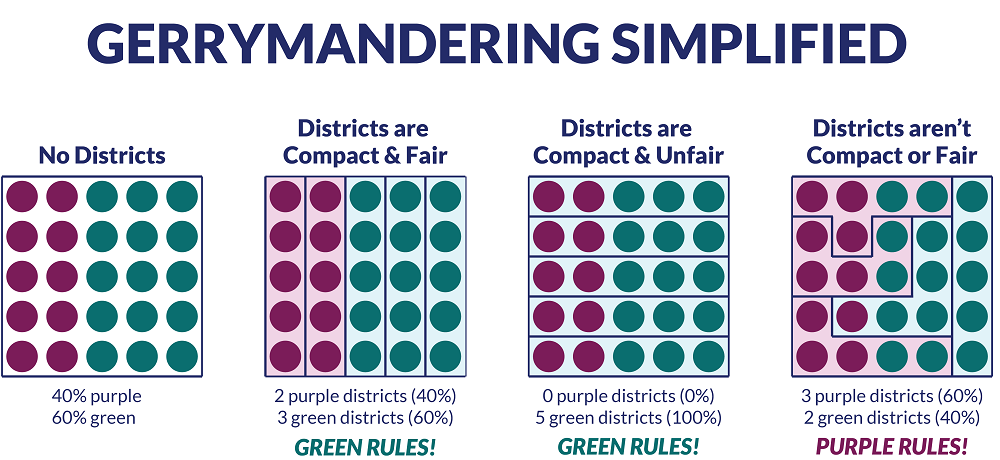
AP (“How redistricting in Texas and other states could change the game for US House elections“):
Redistricting usually happens after the once-a-decade population count by the U.S. Census Bureau or in response to a court ruling. Now, Texas Republicans want to break that tradition — and other states could follow suit.
President Trump has asked the Texas Legislature to create districts, in time for next year’s midterm elections, that will send five more Republicans to Washington and make it harder for Democrats to regain the majority and blunt his agenda. The state has 38 seats in the House. Republicans now hold 25 and Democrats 12, with one seat vacant after the death of a Democrat.
“There’s been a lot more efforts by the parties and political actors to push the boundaries – literally and figuratively – to reconfigure what the game is,” said Doug Spencer, Rothgerber Jr. Chair in Constitutional Law at the University of Colorado.
Other states are waiting to see what Texas does and whether to follow suit.
The rules of redistricting can be vague and variable; each state has its own set of rules and procedures. Politicians are gauging what voters will tolerate when it comes to politically motivated mapmaking.
This is followed by some Explainer paragraphs that basically say that, while mid-cycle redistricting violates tradition, there is no Federal law precluding it and the Supreme Court has effectively signaled that politically-motivated redistricting is within the Constitutional prerogatives of states, so long as it’s motivated by partisanship and not race or other protected statuses.
And, indeed, we’ve been here before:
Texas has done it before.
When the Legislature failed to agree on a redistricting plan after the 2000 census, a federal court stepped in with its own map.
Republican Tom DeLay of Texas, who was then the U.S. House majority leader, thought his state should have five more districts friendly to his party. “I’m the majority leader and we want more seats,′′ he said at the time.
Statehouse Democrats protested by fleeing to Oklahoma, depriving the Legislature of enough votes to officially conduct any business. But DeLay eventually got his way, and Republicans replaced Democrats in five seats in 2004.
We blogged about it quite a bit at the time and, even though most of us were Republican voters at the time, cried foul. But none of us were surprised when the Supreme Court mostly upheld the move 19 years (!) ago. Indeed, we’d predicted it months before.
My co-blogger Steven Taylor dubbed this round “An Attempt at Blatant Election Manipulation” a few weeks back when President Trump first floated the idea. I don’t have much to add on that front. In a follow-up after California Governor Gavin Newsom threatened to retaliate in kind, he wondered whether “any of this is good for democracy.” It’s hard to imagine an argument in the affirmative.
Subsequently, other Democrats have joined in:
Washington Rep. Suzan DelBene, who leads House Democrats’ campaign arm, indicated at a Christian Science Monitor event that if Texas follows through on passing new maps, Democratic-led states would look at their own political lines.
“If they go down this path, absolutely folks are going to respond across the country,” DelBene said. “We’re not going to be sitting back with one hand tied behind our back while Republicans try to undermine voices of the American people.”
In New York, Democratic Gov. Kathy Hochul recently joined Newsom in expressing openness to taking up mid-decade redistricting. But state laws mandating independent commissions or blunting the ability to gerrymander would come into play.
And, not surprisingly, other Republican governors are jumping on the bandwagon:
Among Republican-led states, Ohio could try to further expand the 10-5 edge that the GOP holds in the House delegation; a quirk in state law requires Ohio to redraw its maps before the 2026 midterms.
Florida Gov. Ron DeSantis said he was considering early redistricting and “working through what that would look like.”
Alas, many Democratic states have tied their own hands via various initiatives that make partisan gerrymandering much more difficult. Many of them have delegated the power to independent commissions. While I support that in principle, as I argued three years ago, it amounts to unilateral gerrymandering disarmament when only one party is playing fair.

I have been thinking more about this but have not had time to really develop said thoughts into writing on the subject. It strikes me that as we move to make electoral outcomes almost forgone conclusions, the more we resemble competitive authoritarianism rather than than representative democracy.
At a minimum, this is more of “We, the maps” instead of “We, the people.”
This is just another element of a disturbing reality we find ourselves in: One party doesn’t care any longer about right/wrong and will simply do anything to win. So much that happens, like obedience to Trump, has that at the root. How do we fix that?
You’ll be lucky if midterm election interference stops with gerrymandering and voter suppression.
As I point out regularly, in the 13-state Census Bureau western region, a very large majority of the voters in the region live in districts drawn by a commission and >90% vote using mail-distributed ballots. Sometimes it feels like a whole ‘nother country.
This is where we’re at now. The Court, with a super majority of Justices fully aligned with and supportive of the current radical right revolution, has said, ‘have at it.’
I believe that on this issue, as with Dobbs, The Court supports States’ Rights as long as the result is aligned with the radical Right agenda.
It’s not going to get better any time soon.
Very strange and contradictory distinction, except of course, that this distinction was made by a hyperpartisan MAGA Supreme Court. No soft peddling of their anti-democracy ideology now. The best dreams and aspirations of our immediate ancestors are being crushed under the wheel of the economic self interest of the power aggregators, who have been employing their vast resources to seek every loophole advantage, every workaround for accountability to the masses. Hacked our political system, hacked our media, and hacked our brains. Often with our own money. Real gamers.
Yesterday in Texas:
Texas House redistricting committee’s Houston hearing draws criticism over absence of maps
@Steven L. Taylor: I’m at a loss to steel man the opposite view.
@al Ameda: @Rob1: But note that the ruling in question came 19 years ago. It was a 4-4 court with Kennedy as the usual swing vote. Neither the Tea Party nor MAGA were yet a thing.
Another illogical decision of the Roberts Court. How, realistically, does one distinguish between Republicans partisanship and racism?
@gVOR10:
Bingo.
@James Joyner:
Thank you James. I understand that point. It does go back a few years.
However, I was looking back to 2013 and the Shelby County Decision wherein Justice Roberts de-facto threw out a significant portion of the 1965 Voting Rights Act and said, paraphrasing, ‘if Congress want to re-up what I (we) just threw out, they can do that.’ In Dobbs The Court basically said ‘it’s (abortion) with the states now, see you later.’
We really need a new round of initiatives on the west coast that suspend the nonpartisan commissions creating district maps until TX, FL, OH, and WI adopt similar.
(Not sure where Initiative Land starts — we didn’t have initiatives in NY, we have them in WA, and I’ve heard that the middle of the country exists, although I secretly doubt it)
I really think a California redistricting that has 0 safe Republican districts is possible, and would trigger a Supreme Court review. (WA often has shockingly close governor elections, so I don’t think we can do as well)
They *might* be able to gerrymander only safe Democratic districts, but I expect a few would be competitive despite best efforts.