The Ayatollah Is Dead. Now What?
I'm sure there's a plan for that.
Elliot Cohen is a plankholder in both the neoconservative foreign policy school as a co-founder of the Project for the New American Century and the #NeverTrump movement as a signatory to the initial open letters urging his fellow Republicans that Donald J. Trump was unfit for the presidency. His latest Atlantic essay, “Trump Rolls the Iron Dice,” is quite sobering.
He begins with the obligatory throat-clearing disclaimers:
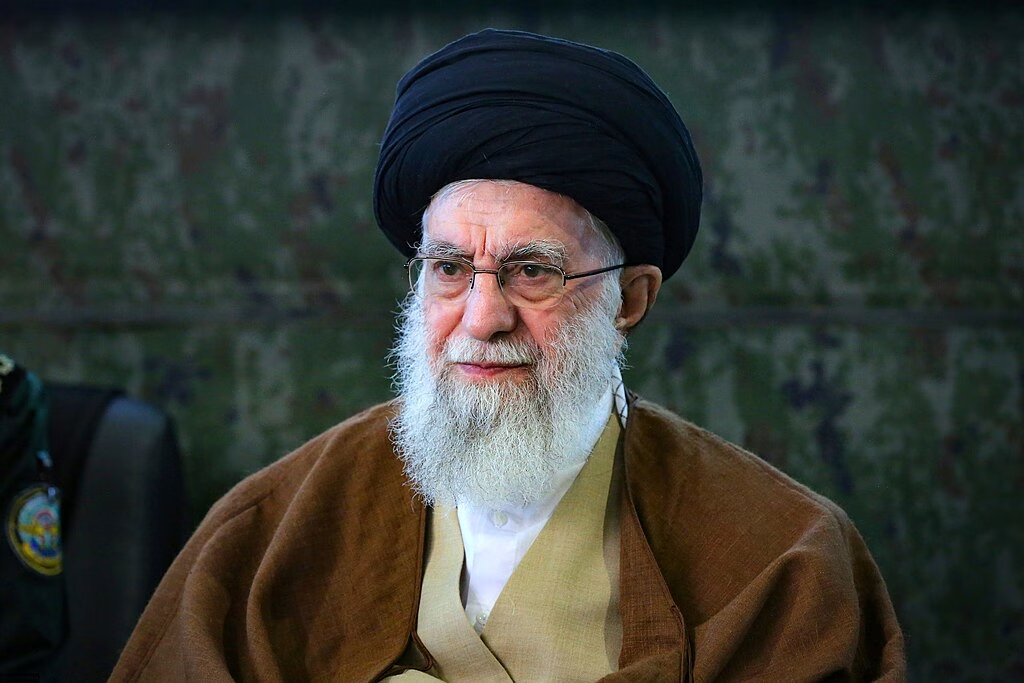
No tears should flow for the supreme leader of Iran, Ayatollah Ali Khamenei, or for his associated butchers in the Islamic Revolutionary Guard Corps, the Basij militia, and the rest of the Iranian security apparatus. The obliteration—or perhaps one should say, re-obliteration—of the Iranian nuclear program is a good thing, as is the elimination or drastic reduction of its arsenal of drones and missiles, and the weakening of its proxy forces. The overthrow of the Iranian regime is a consummation devoutly to be wished, not only for the United States but above all for the Iranian people, most of whom hate a regime that has impoverished, oppressed, and murdered them.
I suspect very few Western observers would quibble with a single comma of that. But, as many of us have been saying since the idea of a regime change mission was floated, killing the Iranian leadership is the easy part. The hard part is replacing the regime with something that’s better for the Iranian people, the region, and American national interests.
In the aftermath of the 9/11 attacks, Cohen was among the earliest and most fervent advocates for a massive response that extended well beyond Afghanistan and even al Qaeda. In a November 2001 WSJ op-ed, he advocated launching World War IV (he was among many who retconned the Cold War as World War III), taking out the regimes in Iraq and Iran, and remaking the region.
A quarter century later, he’s more sanguine.
First, he believes President Trump failed to get the American people on board. After recapping his Mar-a-Lago speech announcing the war, Cohen observes,
The objectives, then, are total: the utter destruction not only of the Islamic Republic’s nuclear potential, not only of vital elements of its armed forces and its proxies, but of the regime itself.
Any normal president launching a war with such aims against a country of some 90 million people; with an area roughly that of France, Germany, Spain, and Italy combined; with a GDP (in nominal terms) of $400 billion; and that has close relationships with Russia and China would probably have doffed the baseball cap, put on a tie, and delivered a somber speech from behind the Resolute Desk in the Oval Office.
More important, a serious president would have prepared over months the ground for such a war—including by discussing the Iranian challenge at length during the State of the Union. He would have tried to explain to the American people why this, rather than their economic problems, was a matter of top urgency. He would have avoided unnecessarily antagonizing, let alone mocking and baiting, the opposition party, which is likely to control at least one house of Congress after the midterms. He would have worked on unifying support within his own base, which is internally divided among isolationists, Israel haters (who will react badly to this), and old-line Republicans who are queasy about wars launched without congressional sanction. Trump did none of these things.
He then shifts to the prospects of success.
How will the war unfold? Conceivably, it could work. The air attacks are probably coordinated with more sophisticated clandestine and special operations by both the U.S. and Israel. Perhaps an opportunity will indeed open up for the regime’s overthrow, either by a mass revolt or a coup by a hitherto-unknown insider or military figure willing to break with the regime’s past.
Or not. The regime has planned for this kind of event and, deeply unpopular though it is, has millions of adherents who are either complicit in its crimes or beneficiaries of its largesse. They, not the masses, are the ones with the guns.
And, one would think, they’ve seen what happens to state enforcers after a regime collapse. They’re unlikely to lay down their arms willingly.
Perhaps there is a master plan for the day after—not an American or an Israeli strong suit in recent times—in some vault in the Pentagon or the Kirya. Conceivably, Trump is prepared to stay the course and come to the aid of the Iranian people whom he has incited to rise up. One may hope (but should not expect) that there are enough precision missiles and interceptors in Israeli and U.S. arsenals to let this war roll on for weeks or longer, and that there are plans for refilling empty bins after some intense fighting. Maybe the American people will rally to support a war that a few days earlier barely one in five favored. With such uncertainties, however, a queasy doubt that Trump knows what he is doing is entirely in order.
I can’t imagine CENTCOM doesn’t have a numbered operational plan for this contingency. It has, after all, been under consideration since 2001, if not 1979. But we ignored the Iraqi version of that plan in 2003, under a considerably more seasoned foreign policy team.

I see more parallels to the aftermath of Gulf War I. A broken, battered, bruised, maimed, Iraqi army was plenty, and then some, to beat the crap out of any rebellious populace.
No, of course he’s not going to help stabilize Iran or prop up a democratic government, don’t be ridiculous. Trump’s plan for after is to steal Iranian oil and put the money in a Qatari bank account. It worked in Venezuela, why not in Iran? It’s wonderfully convenient: Iranian oil goes through Kharg Island, and which billionaire’s got a great big navy to seize control of a little island?
Except from the deteris of the Islamic regime, it’s hard to see where new leadership comes from. The populous opposition is not a movement, but individuals expressing justifiable grievance. The son of the former Shah has more support in DC than in Iran and far less than the Iraqi savior, Ahmed Chalabi had when the Bushies hoped that he could consolidate power in Baghdad.
Beyond that you have several restive ethnic groups that should be tempted to take this opportunity to establish nationalist states. One of which are the Kurds that will guarantee Turkish intervention to ensure its suppression.
Any leadership emerging from the rump of the regime that is amenable to DC would engender opposition from hard liners that would likely result in a civil war. But hey, the US conducts FP in the spirit of the Alfred E. Newman school of international relations.
@Michael Reynolds: A democratic government? As I’ve said here about W Bush, Cheney, and Iraq, Republicans don’t want a democratic government here. Why would they work to create one there?
Can almost hear Cohen’s laughter as he writes this.
About third of Iranians poll as supporting the Islamist regime as is — jarring to see celebrating Iranians juxtaposed with thousands taking to the streets weeping, mourning Khamenei. As we see here in the US, a hardcore religious base of 30-35% is foundation enough for an authoritarian to attain and retain power. Especially one that slaughters opponents wholesale, without hesitation.
Issues Bibi, MBS, and Trump need to quickly address for Iranian regime change: the opposition is fractured in different secular and sectarian groups (some of whom also hate Zionist/American infidels), there is no American-Israeli-Saudi occupying force nor appetite for one, no charismatic revolutionary to lead a mass revolt, no armed domestic org to back him/her against other contenders to the throne.
So, um, good luck to regime opponents inside and outside Iran. If serious past the Death to Khamenei sugar high, they’d better find some very tough Persian leaders and get them armed to the teeth real quick.
@DK:
The hope seems to be that an Army officer will lead a military take-over. I imagine some ambitious colonel will give it a try. An IRGC strongman will counter. Soon, both will be warlords with weapons coming from the west for one, and Russia/China for the other. The colonel will control Teheran and announce a plan to start down the path to a Saddam-level tyranny. . . sorry, I mean representative democracy. The IRGC strongman will dominate in the countryside and his path to victory will involve all women wearing full burka.
But let’s not forget the surviving Pahlavi who will present himself as the leader of oil executives, bankers, mobsters and MAGA hustlers, promising stability and no doubt mentioning AI.
So stop being so cynical. It’s going to be just fine.
Iran’s ex-president, Mahmoud Ahmadinejad, has been killed in an Israeli airstrike.
@DK: I was going to highlight that segment as well. When your plan requires “a hitherto-unknown insider or military figure willing to break with the regime’s past” then you are not a master planner.
@DK:
There is no Saudi anything, no Saudi troops, no Saudi pilots over Tehran, no Saudi missiles, probably no Saudi ships and boats. Just a couple billion for Trump and his kids and son-in-law. Cheap at twice the price.
@Steven L. Taylor:
Mater Plan:
1) Bomb the crap out of Iran
2) ???
3) PROFIT!111!!11!
@Kathy:
Not this time, I suspect. I suspect Trump is feeling his mortality. The docs have all but certainly told him the toll all those Big Macs have taken, and those bruised hands an cankles can’t be ignored. All the re-naming stuff is not profitable, the Arch du Trump is not profitable.
This is the danger: A Trump obsessed with his legacy. No great president (or dictator) achieves greatness without “interesting times”, with Bibi and Bone $aw whispering in his ear. Potentially a nightmare which dwarfs that of Transactional Trump.