The Main Takeaway from Last Night: Democracy Lives
Although it is still on life support.
I had intended to write a post a few days ago that Tuesday’s elections were going to be a big test of the fundamental democratic health of the country. The test was not about who was going to win or lose, but whether there would be any attempts to disrupt the process. While there were reports of some bomb threats in New Jersey and Gavin Newsom made some accusations about voter intimidation at Dodger Stadium, there was nothing of consequence, let alone anything systematic.
For example, as much as I have profound problems with National Guard and federal law enforcement deployments in US cities, we saw no attempt to deploy such actors to disrupt elections, despite understandable fears that such usage was part of the plan.
Understand: I am not saying that there will not be attempts at electoral disruption in 2026, when elections will be widespread and it will be easier to engage in any number of bad behaviors. But as much as I have been (and remain) concerned about the Trump administration’s attacks on American democracy (more on that below), I think that concerns about a significant authoritarian takeover can be dialed back given how smoothly last night went.
And no, I haven’t forgotten January 6th and the pardons/commutations, and we should all continue to remember.
But if the core definition of a democratic regime is, to paraphrase Adam Przeworksi, a system wherein parties lose elections, then we are still functionally democratic.
BUT, that does not mean that the substantial dysfunction at the federal level, wherein the president continues to ignore Congress, is not a problem; it is. It does not mean the terrorizing of citizens and noncitizens alike by masked “law enforcement” agents isn’t a problem; it is. It doesn’t mean that the rampant corruption taking place in the White House isn’t a problem; it is. It doesn’t mean that engaging in extrajudicial killings in international waters isn’t a problem; it is.
I could go on.
I still consider Trump to be governing as an authoritarian and believe that fascist continues to be an appropriate descriptor of his politics. This is not, therefore, a sunshine and unicorns post.
For example, Trump’s response to the free and fair elections that took place yesterday is, as has been his pattern, utterly corrosive to democracy.
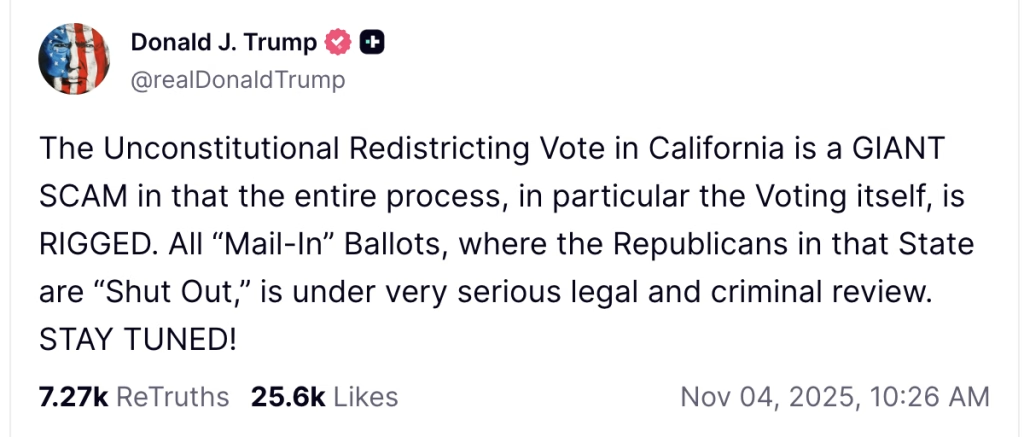
Note that he made this assertion before the votes were even counted.
The fact that the President of the United States constantly decries elections he doesn’t like to be fraudulent is how we ended up with J6, and also how many Americans will be radicalized against democracy.
We now wait to see what kinds of tactics will be deployed against New York City by Trump, given its audacity in electing a mayor that Trump doesn’t like.
The fact that such concerns legitimately exist is another reason that while democracy can be said to be holding, it cannot be said to be healthy.
About a month ago, I wrote a post entitled, Has the Constitution Failed? In that post, I noted that I thought our most likely way forward was two-party competitive authoritarianism:
In this version, the Democrats are able to win back power, but the system is sufficiently broken that they will govern like Trump has: by fiat and with the Congress being basically a vestigial organ. This is a broken democracy at best.
I know I promised to return to this topic, and a partially written draft needs my attention. But I will say that last night is evidence that two-party competition is holding. The big test will be 2026.
I will add this to the mix: while I supported Proposition 50 in California as an appropriate corrective to extreme partisan gerrymandering as an anti-democratic tactic in other states, I would note that it fits into my competitive two-party authoritarians frame: it is having to use the power of the state where avaialble to engage in anti-democratic practices as a means of combating other anti-democratic practices. It is not something that a healthy democracy does.
To flesh out the point: Trump acted in a blatantly anti-democratic fashion when he simply told the Texas legislature: Get me five more seats, and they did because they could and because it was good for their party.
That California has to fight anti-competitive, voter-nullifying fire with anti-competitive, voter-nullifying fire is the kind of tactical spiral I am concerned about. The real test for this proposition is going to be if a Democrat can win the White House in 2028 and how they govern, you know, on day one.
I have thoughts on the actual outcomes, but will leave those to subsequent posts.

Would you consider the country to have been a healthy democracy in the late 19th century, when the South all but established one-party rule through mass disenfranchisement of blacks (and even poor whites to a degree), and when the GOP carved out a bunch of low-population western states to consolidate power, including slicing the Dakota territory into two for no reason other than as a raw power grab?
Without a hint of irony, Trump rails about unconstitutional gerrymandering in California while ignoring the unconstitutional gerrymandering in Texas that he ordered and received. And as usual, Trump threatens “serious legal and criminal review” by his personal law firm, Blanche & Bondi LLC, while his tools/stooges in Congress claim the Biden DoJ was weaponized. Pass the bourbon….
@Kylopod:
Well, the excessive number of low population states have massively skewed the senate to favor one side.
On the other hand, the California maneuver is supposed to be temporary.
Agree and I hope Virginia does not go down that path. Just because you can do something doesn’t necessarily mean you should.
I am heartened to see Democrats fighting back. I do not buy the equivalency between fascist authoritarianism and anti-fascist authoritarianism. Cancer kills healthy cells, so does chemotherapy, but the two are not the same.
The aggressor is presumptively in the wrong, the defender is in the right. If the defender takes power and becomes the aggressor, then he will be in the wrong. But there will not be moral equivalency between an authoritarian attack on an institution, say the FDA, and an ‘authoritarian’ repair of the damage done. People in Pacific Palisades were ordered out of their homes as a result of the fire, an authoritarian act which is in no way equivalent to a government policy of Juden raus.
The No Kings protest events raised the energy and the awareness of voters, likely prodding the less inclined to action on election day.
As the Trump outrages mount, the protest events need to continue.
Royal ballroom construction, sweetheart deals, “let the needy eat cake,” self-dealing self-enrichment from the office of the Presidency, brutal masked policing, loud coersive threats towards political opposition, suppression of democratic precedents —- Trump is looking every bit the “king” and this needs to be “rammed home” in the minds of the public.
Let the No Kings protests continue to underscore Trump’s dastardly misdeeds.
@Kylopod: Perhaps you could clarifiy your point?
@Michael Reynolds:
Whom do you think is making that argument? Because it isn’t me.
You did read the part in which I said I supported Prop 50, yes?
@Charley in Cleveland: Sadly, SCOTUS has noted that such gerrymandering is, in fact, constitutional.
@Steven L. Taylor:
That needs to be rectified as does a SCOTUS that would agree to such. A heavy lift to be sure, but a threat to democracy until resolved.
@Steven L. Taylor: Yes, the ol’ umpire, John Roberts, said gerrymandering is a political question that is not within the Supreme Court’s purview, and got 4 other partisan hacks to agree with him. But my point was the irony of Trump decrying California’s act that was identical to what he had ordered, er, asked, Texas to do. Soon, Roberts will put the final nail in the VRA’s coffin.
@Rob1: One of the things that I would want a future Democratic Congress to do is create some form of national standard for districting.
@Charley in Cleveland: Indeed. And I fear for the outcome of the VRA ruling.
@Steven L. Taylor: I’m just saying there have been points in the past that fit what you describe as competitive authoritarianism, the late 19th century a prime example. And what both parties did back then left relics that still exist today: certain policies today are remnants of the voter disenfranchisement under Jim Crow (even the filibuster to a degree), as well as the state-gerrymandering the GOP practiced that got us the two Dakotas and a bunch of mountainous, sparsely populated western states.
I guess you could say what we’re seeing now is democratic backsliding. It just isn’t something our country hasn’t experienced before.
Being a nerd, I tend to relate these things to one of the main themes of The Lord of the Rings: It can be difficult to fight evil while not being shaped by the conflict into being evil one’s self.
It takes faith and dedication to the long haul. If one were to pick up The One Ring and use it against Sauron, one would likely end up in Sauron’s thrall, and become Sauron one’s self. See Saruman, for instance.
Of course, that’s just fiction.
In some sense, it’s about whether people are willing to accept suffering into their life. We have suffered, and we will likely have to suffer more to restore and repair the damage we have taken.
For some, the suffering has been real and serious. If you are dependent on food stamps, or a federal worker, or someone who looks kind of Mexican, or a trans person, you have been suffering in a real way.
People like me will need to spend money they thought to use elsewhere. Spend time they would rather spend watching YouTube or playing video games. Introverts will need to talk to strangers. This is not suffering on the scale of that in the previous paragraph, but it is discomfort that needs to be accepted and budgeted in. (I’m really giving myself a pep talk here!).
@Steven L. Taylor: MR can speak for himself, but it looks like he’s speaking in general about a prevailing narrative, to no one in particular.
***
I view what’s going on as “the people keeping democracy alive by any means necessary.” Democracy lives, but not on its own accord.
The argument has been made that No Kings rally are proof America is not yet an authoritarian state. Yes, America is not yet an authoritarian state: because the people will not let anyone stop them from having No Kings rallies.
Related, republiqans already filed suit in California.
I’m fairly confident Newsome did look into the legality of this proposition before getting it into a special election. But the matter will likely end up, one way or the other, with the fixer court.
If state and “lower” federal courts tule for redistricting, one can be sure the fixers will hear it in record time and find a California/Democratic exception for partisan gerrymandering.
If rulings go against redistricting, the fixers will kill it by taking past 2050 to hear argument or issue a decision.
J.V. Last has an interesting column up at The Bulwark. It features the swing back to the Democrat in the Latino vote in NJ. I wonder how much the Texas redistricters relied on the trend of Latinos toward Trump and Republicans in redrawing their lines. It would make me chuckle if that move backfired in 2026.
@Joe:
From what I’ve read, the Texan R’s are counting on the Latino vote to continue voting for R’s, as some of these revised R districts are weakly +R and it is possible, though faintly, that Dems could end up with more Texas congress critters after redistricting.
@Steven L. Taylor:
At the top of my action list. Comes the day, I will be hammering this hard where ever, whenever I can.
Seems like there’s an opening for federal legislation that says something like: If an election for the House results in seating that is more than (DELTA) difference from what (this specific PR scheme) would produce, that election is invalid and the representatives elected shall not be seated.
I think that the House could adopt this as a rule, and not even need Senate approval? But I’m not that much of an expert on the House. Hmm, but rules can be changed by a simple majority. Kind of a chicken-and-egg problem. Maybe it needs to be an actual law.