

I had intended to write a post a few days ago that Tuesday’s elections were going to be a big test of the fundamental democratic health of the country. The test was not about who was going to win or lose, but whether there would be any attempts to disrupt the process. While there were reports of some bomb threats in New Jersey and Gavin Newsom made some accusations about voter intimidation at Dodger Stadium, there was nothing of consequence, let alone anything systematic.
For example, as much as I have profound problems with National Guard and federal law enforcement deployments in US cities, we saw no attempt to deploy such actors to disrupt elections, despite understandable fears that such usage was part of the plan.
Understand: I am not saying that there will not be attempts at electoral disruption in 2026, when elections will be widespread and it will be easier to engage in any number of bad behaviors. But as much as I have been (and remain) concerned about the Trump administration’s attacks on American democracy (more on that below), I think that concerns about a significant authoritarian takeover can be dialed back given how smoothly last night went.
And no, I haven’t forgotten January 6th and the pardons/commutations, and we should all continue to remember.
But if the core definition of a democratic regime is, to paraphrase Adam Przeworksi, a system wherein parties lose elections, then we are still functionally democratic.
BUT, that does not mean that the substantial dysfunction at the federal level, wherein the president continues to ignore Congress, is not a problem; it is. It does not mean the terrorizing of citizens and noncitizens alike by masked “law enforcement” agents isn’t a problem; it is. It doesn’t mean that the rampant corruption taking place in the White House isn’t a problem; it is. It doesn’t mean that engaging in extrajudicial killings in international waters isn’t a problem; it is.
I could go on.
I still consider Trump to be governing as an authoritarian and believe that fascist continues to be an appropriate descriptor of his politics. This is not, therefore, a sunshine and unicorns post.
For example, Trump’s response to the free and fair elections that took place yesterday is, as has been his pattern, utterly corrosive to democracy.
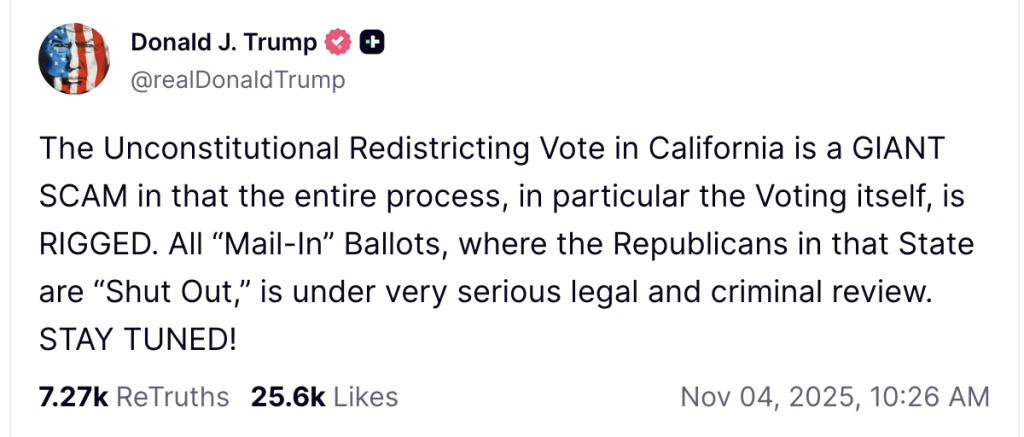
Note that he made this assertion before the votes were even counted.
The fact that the President of the United States constantly decries elections he doesn’t like to be fraudulent is how we ended up with J6, and also how many Americans will be radicalized against democracy.
We now wait to see what kinds of tactics will be deployed against New York City by Trump, given its audacity in electing a mayor that Trump doesn’t like.
The fact that such concerns legitimately exist is another reason that while democracy can be said to be holding, it cannot be said to be healthy.
About a month ago, I wrote a post entitled, Has the Constitution Failed? In that post, I noted that I thought our most likely way forward was two-party competitive authoritarianism:
In this version, the Democrats are able to win back power, but the system is sufficiently broken that they will govern like Trump has: by fiat and with the Congress being basically a vestigial organ. This is a broken democracy at best.
I know I promised to return to this topic, and a partially written draft needs my attention. But I will say that last night is evidence that two-party competition is holding. The big test will be 2026.
I will add this to the mix: while I supported Proposition 50 in California as an appropriate corrective to extreme partisan gerrymandering as an anti-democratic tactic in other states, I would note that it fits into my competitive two-party authoritarians frame: it is having to use the power of the state where avaialble to engage in anti-democratic practices as a means of combating other anti-democratic practices. It is not something that a healthy democracy does.
To flesh out the point: Trump acted in a blatantly anti-democratic fashion when he simply told the Texas legislature: Get me five more seats, and they did because they could and because it was good for their party.
That California has to fight anti-competitive, voter-nullifying fire with anti-competitive, voter-nullifying fire is the kind of tactical spiral I am concerned about. The real test for this proposition is going to be if a Democrat can win the White House in 2028 and how they govern, you know, on day one.
I have thoughts on the actual outcomes, but will leave those to subsequent posts.








