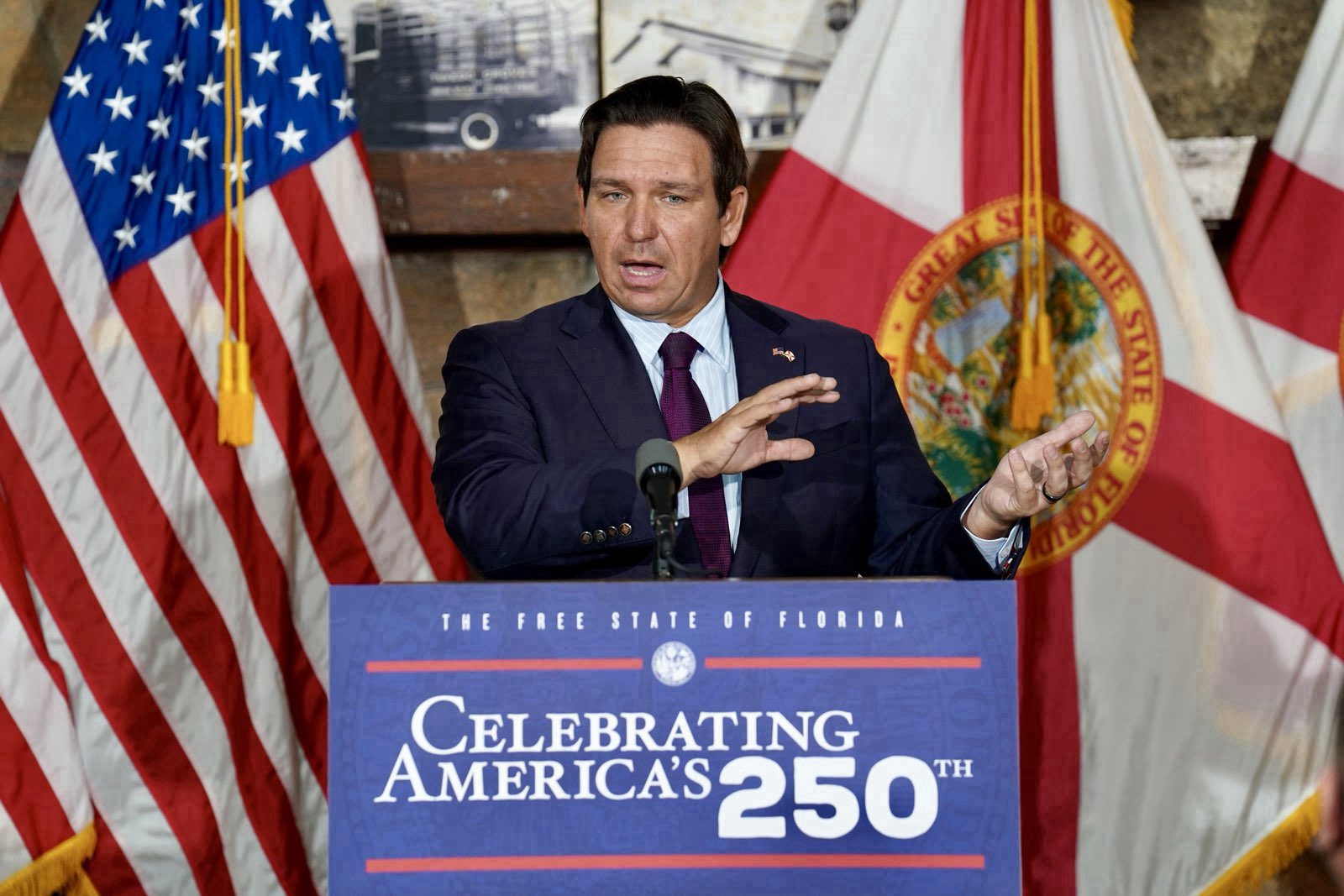
WaPo (“Florida Gov. Ron DeSantis planning another White House run“):
Gov. Ron DeSantis is preparing to run for the GOP’s 2028 presidential nomination, according to three people briefed on his plans, after his home state of Florida was one of the few conservative bastions to survive the Democrats’ sweeping midterm victory.
“Florida’s walls not being breached by the blue wave gives DeSantis more credibility than nearly anyone in the opening days of the 2028 primary,” said Dan Eberhart, a longtime Republican donor and energy executive, who served as a surrogate for DeSantis’s unsuccessful 2024 presidential campaign.
Already, DeSantis has reached out to at least one national political consultant about working on his campaign, according to one person close to him, who spoke on the condition of anonymity to discuss internal deliberations. His federal super PAC also sent out a text this week to try to raise money, another step that signaled an intention to run to those who know him.
Allies say the governor sees an opening politically after voters resoundingly rejected the Trump agenda this week. DeSantis called the elections a “close to an extinction-level event for Republicans.”
“It’s the political equivalent of a meteor strike that went all around the United States, blue states, red states, everything in between,” DeSantis said at a news conference in Tallahassee.
[…]
Before Tuesday, Vice President JD Vance seemed like the heir apparent to President Donald Trump’s political fortunes and the front-runner in the nascent 2028 race: an assumption upended by voters’ wholesale rejection of Republicans and the administration’s policies.
From his 2024 bid, DeSantis has learned he will need to do more media appearances if he wants to succeed, said the person close to him. He also learned he cannot wait too long before entering the presidential race; in 2023, he opted to wait until after Florida finished its state legislative session. Those months of anticipation gave the Trump team ample time to define and attack him.
DeSantis took advantage of the Republican losses this week to make several high-profile media appearances, on Fox News and elsewhere, and pitch himself as an alternative to Trumpism.
He has also tried to stand out from the crowded field of Republican politicians on policy decisions on AI, becoming a big opponent of data centers in Florida.
The invisible primary is already underway, and the campaign will soon kick off in earnest. In the most recent cycle with an open primary, 2020, Democratic candidates began announcing as early as August 2017, and more than half a dozen serious candidates had filed by January 2018. Joe Biden, the eventual nominee, formally announced his candidacy in April. In the last cycle with two open primaries, 2016, the first announcement (Ted Cruz) was March 23, 2015. The eventual Democratic nominee, Hillary Clinton, announced April 12. The eventual Republican nominee, Donald Trump, didn’t announce until June 15.
Yesterday’s elevation of Stephen Miller to White House Chief of Staff would seem to signal that President Trump plans to double down on his most unpopular policies. Doing so would make it even harder for Vance or anyone else in the Trump orbit to get elected.
It would seem obvious, then, that the party’s best hope would be to nominate a governor or other major figure who could plausibly run without having Trump’s policies tied to them. Alas, Republican primary voters have demonstrated time and again that they will reject candidates who can win in the general election in favor of obviously awful candidates endorsed by Trump. We shall see if the midterm results change that.
No Republican candidate could have defeated Trump in 2024. Still, DeSantis’ campaign was universally considered terrible. Despite his electoral success in the third-largest state, he demonstrated next to no charisma. Then again, candidates often perform considerably better in their second run (Kamala Harris being the most recent example).