The Redistricting Wars and Their Likely Consequences
None of this is good for the quality of our democracy (not that it was great to begin with).
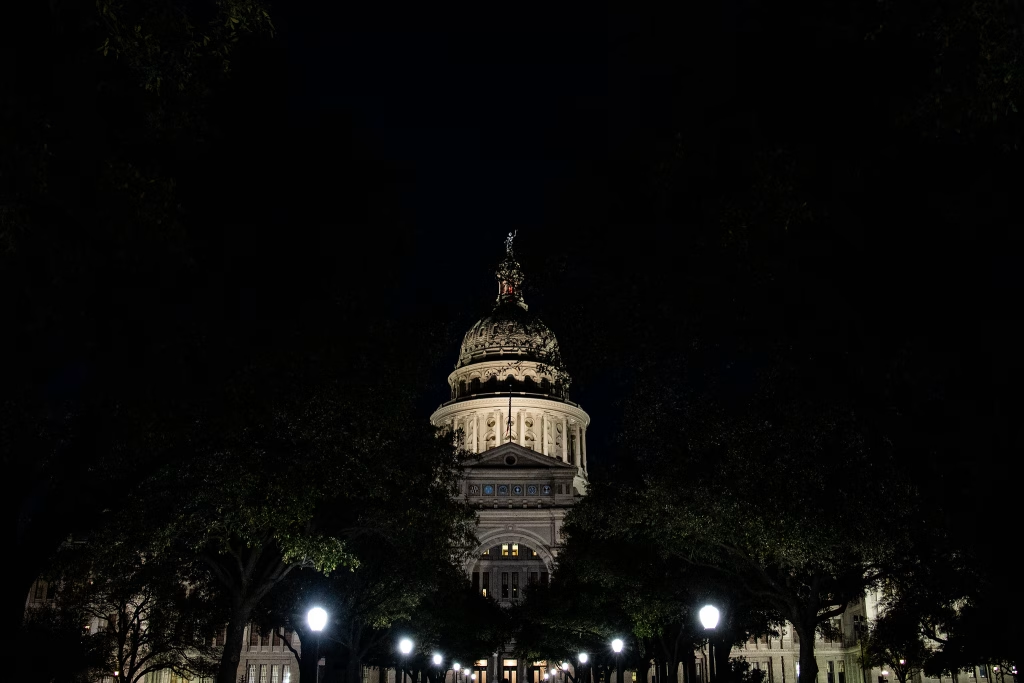
As has been inevitable since Texas Governor Abbott took up Trump’s request to engage in a mid-cycle redistricting of the state, the state’s House has passed the new maps, and the state Senate will soon follow suit. Attempts by the state’s Democratic legislators to flee the state to deny Republicans a quorum failed to stop this process. Such was the foregone conclusion of what was more about drawing attention to the situation than it was a real chance to stop the outcome.
The Texas Tribune reports: Texas House approves GOP congressional map after two-week delay from Democrats’ walkout.
Republicans have said the new districts were drawn purely to maximize their partisan advantage, arguing that the GOP’s margins of victory in 2024 supported new lines that entrenched their hold on power. They have also framed the effort as a response to Democratic gerrymandering elsewhere.
Rep. Todd Hunter, R-Corpus Christi and the map’s sponsor, emphasized in laying out House Bill 4 that Republicans were legally permitted to pursue redistricting in the middle of the decade and to maximize partisan gain.
“Redistricting can be done at any point in time,” he said. “The underlying goal of this plan is straightforward: improve Republican political performance.”
To create up to five Republican pickup opportunities, the map dismantles Democratic strongholds around Austin, Dallas and Houston and makes Democrat-held seats in South Texas redder — all without seriously jeopardizing any of the 25 districts Republicans already control. The proposed map also would push a handful of Democratic members of Congress into seats already represented by other Democrats, setting up possible primary battles between long-serving members of the Texas delegation and younger newcomers.
Emphasis above is mine. While I should acknowledge that, yes, in fact, SCOTUS has ruled that partisan gerrymandering is allowable under the US Constitution and that nothing in Texas law precludes redistricting whenever the legislature wishes to do so, there is still something chillingly brazen about a legislator simply stating that they are engaged in a power grab because, as was also said recently, because they can.
It is an honest and disturbing sign of the times that there isn’t even a token attempt at justifying this behavior. Trump demands more seats; the party provides.
This will likely spark other states to follow suit. In the abstract, I don’t think any of this is good for the health of American democracy, but I also fear we have crossed a threshold in which tit-for-tat is unavoidable.
I am normatively opposed to this kind of manipulation and empirically think it is bad for representative democracy. The next likely move is by California, which will require a referendum to amend the state’s constitution.
It should be noted that the core problem with US House elections is that, for a number of reasons, they are not competitive, but are instead foregone conclusions on balance (only about 10% of seats in 2024 were truly competitive). This is a huge problem for American democracy, to the point that even without this mid-cycle manipulation, there are days when I wonder how democratic things are/have been. Making elections even more predestination instead of competitive takes us in the wrong direction on that count.
Nonetheless, were I a resident of California, I would reluctantly vote in favor of Newsom’s plan. At this point, the choice seems to me to be the most likely way for the overall electoral outcome to reflect national political preferences. Unfortunately, it seems we have a better shot at a more representative outcome by having more uncompetitive elections (this was true of the post-2020 census map, see A “Fairer” Map for the 2022 House?).
The issue on the table to me, at this point, is not a debate about what is the best way to district; it is a question of whether one party should be allowed to further manipulate the system while the other party unilaterally disarms out of a sense of principle. And the context here is that the party seeking to further manipulate the system is actively supporting an authoritarian agenda.
As such, do voters in CA stand by and allow the pro-authoritarian party to further consolidate power, or do the voters of CA provide a somewhat anemic push to forestall that consolidation?
Given that Trump will have two full years to govern after the midterms, the question is, what can be done to at least slow him down? Democrats winning control of the House is probably the closest thing to a bulwark that can be generated against his onslaught on the system. Making an already highly flawed system to elect the House even more flawed, but in a way that fights authoritarianism and hopefully increases representativeness on the national level (even as it damages it on the state level), is worth the price, in my view.
Of course, I ultimately would prefer we move to multi-seat districts and PR elections. My fantasy is MMP, but I also favor modest-sized districts with OLPR, as I have discussed before here at OTB and also outlined in my recent Protect Democracy white paper.
I would also point readers to this piece in the NYT from a few days ago, Redistricting Push Would Further Divide a Polarized Congress. The focus of the article, which includes some interesting charts, is mostly focused on the increase in states represented by one party. While not unimportant, I think broader systemic issues are crucial.
For example,
More districts that overwhelmingly favor one party would further dilute the importance of general elections, since primaries are likely to be determinative, giving more extreme elements of the parties more influence.
This is already a major problem, in my view, in our democracy, and it will be exacerbated by this current bout of redistricting.
In addition, lawmakers would lack incentives to work with the other party and risk the wrath of primary voters.
“It truly is foolish to have a situation where we are basically trying to eliminate any bipartisanship at all,” Mr. Lawler said.
On the one hand, yes, these moves will deepen polarization in the House. On the other hand, that ship has already sailed. I would stress that the real problem is not a lack of bipartisanship (which is such an American fetish), but it is the lack of democratic responsiveness to voters and the general lack of real representation.
Consolidating power in the hands of one party also disenfranchises the thousands of constituents from the opposing party if they are mapped out of having a voice.
Again, this is not new and is one of many problems with single-seat districts. There is no incentive for an elected representative to actually represent all of their constituents. Ironically, one of the arguments deployed against multi-seat districts is that citizens won’t know who “their” representative is, but the reality of winner-take-all single-seat districts is that the winner only feels the political need to represent their co-partisans (or, worse, just the faction that can re-nominate them in the primary). There is a reason, for example, as to why so many Republicans see no need to hold town halls these days.
Another aspect of the piece that should be raised, the authors ignore the fact that prior to the 1994 “Republican Revolution,” the Democratic Party was a far broader coalition of liberals and conservatives, and was dispersed geographically in ways that are no longer the case. This is important to understanding why patterns seen before the mid-1990s are not directly comparable to patterns that emerge in the 2000s. See the following for more information.
- US Party System Evolution.
- More on the Evolution of US Party Politics.
- Partisan Control in the Congress.
Note: a portion of this post is adapted from a comment I left at this post at Fruits and Votes a few days ago.

This is all indeed depressing and, obviously, undemocratic. I listened to The Daily on the way in this morning, discussing the California process. The irony that the current redistricting commission was put in place under the leadership of Republican Arnold Schwarzenegger is really stark. But not moreso than the fact that the only way to represent the interests of the majority is to further disenfranchise the minority.
We continue to reap the rewards of minority rule, put in place to protect slavery from the popular vote.
Short of a constitutional amendment to incorporate multi-member districts, elected through ranked-choice voting, I don’t see how we ever fix this problem. There’s certainly no will to move to a more responsive parliamentary system.
But how do we persuade those who have gained power under the existing system to destroy it?
@Tony W:
Perhaps, mutual assured destruction?
One party has a powerful weapon – in this case unprincipled manipulation of the electoral system. The second party avails themselves of the same weapon and threatens to use it. The threats have enough credibility on their own, or the second party establishes credibility by actually using the weapon in some way to damage their opposition with equal fervor and lack of principle.
With both parties comparably armed, neither side has the same incentive to use their weapon. Negotiations can begin on a more equitable system of representative government.
I am wondering if we can use some financial muscle. We have a very clear notion that the president may not impound or withhold funds allocated by Congress. This is in the constitution, it has been upheld quite recently, during the Clinton administration.
So, I submit that by ignoring his mandate to spend funds allocated, the president has effectively breached a contract, and I do not see why I should pay my taxes.
The details could vary. What I would like to see is the ability to put my estimated tax payments in escrow, which is controlled by someone such as Elizabeth Warren, to be paid when the administration starts actually following the law.
There are other possibilities as well. I support the democratic process we have for figuring out how to spend money, and I deeply resent it when one guy thinks he can just ignore it.
Nobody else seems to be in position (or inclination) to stop him. SCOTUS could do it, but they love this, apparently. They care so much more about their political goals than upholding black-letter law.
Really sad. Who knows, someday Virginia will be controlled 8 to 3 with 75% of population making up the 3. The more we continue down this path, the closer to another civil war. All it took was time, ideology and the internet (Oh, and Trump). It is sad that so many cannot see what is truly right in front of their noses. So many in the country are just selfish and short sighted in their decision making. Hey, Chat GPT, “How do you save a failing Republic”….its funny that it starts by saying “Thinking longer for a better answer”
The gripping hand here is it looks increasingly unlikely that we have a fair election in 2026 regardless. Disenfranchisement, having the military seize ballots or simply declaring that Republicans won every close election are all on the table at this point.