


(This is the start of a broader conversation that I have been meaning to start for some time but comments today have brought this to the fore of my mind).
Some broad brushstrokes (all of which are complicated in their own right) that are needed background:
- The current Democrat-Republican duopoly has its origins in the period just prior to the US Civil War and was consolidated after the war.
- The party labels have persisted since the mid-19th Century, and the Democratic Party can arguably trace its roots back to Jefferson’s Democratic-Republicans as it evolved into Andrew Jackson’s Democratic Party.
- The Reconstruction Era in the former CSA led to long-term hatred of the Republican Party in the region, resulting in the Democratic Party being dominant in the southeast from the later 1870s until the 1990s (and beyond).
- The solid (or near solid) Democratic South meant that the main election was in Democratic primaries, not the general election.
- The evolution of two-party competition (and to eventual GOP dominance) in the South was a gradual affair that started at the presidential level and filtered to other federal offices and eventually to the state and local levels.
- While there are outlier examples (such as John Tower in Texas in 1961 winning the special election to replace LBJ in the US Senate) the real re-alignment event was the 1994 “Republican Revolution” in the House. This then led to party-switching by a number of conservative Democrats (such as Alabama Senator Richard Shelby).
The long-term historical points should help us recognize that the party labels have persisted for a long time as containers, even as the exact contents of the containers has shifted over time.
Any full examination of this shift would need to look at multiple levels, i.e., presidential, congressional, statewide executive and judicial, state legislatures, and then local office to see the whole picture. However, the key institution for looking at a national party system is typically the first chamber of the national legislature, which is, in the case of the United States, the US House of Representatives.
So, consider: from 1933 until the 1994 election (the 75th Congress to the 103rd), Democrats controlled the US House for all but two sessions (the 80th Congress, 1947-1949 and the 83rd, 1953-1955). A significant reason for this was that the Republican Party was nearly non-existent in the South (in terms of competitiveness). It also meant, therefore, that the Democratic Party in Congress was a coalition that spanned liberal to conservative. As such, when people look back with fond memories of how the House (and Congress in general) used to work together better than it does now, don’t forget this fact.
1994 was the watershed election that led to a substantial change in national party politics.
Note these maps for comparison (red is Rep, blue is Dem). Check out the southeast:
1992:

1994:

1996:

Note, for example, that Mississippi was solid blue in 1992. Look at AL, GA, TN and TX (and so forth).
Compare that map to 1970:
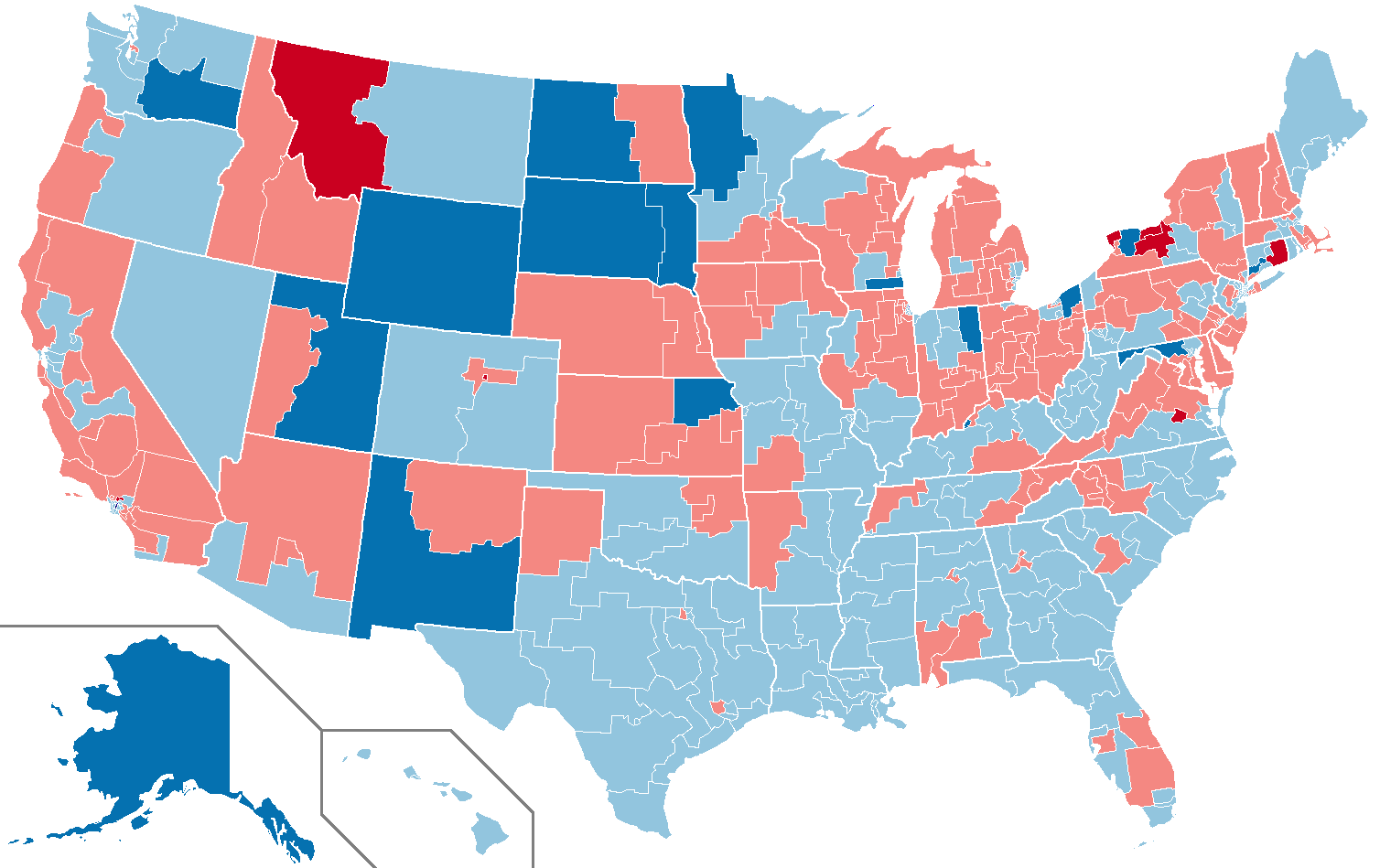
Note, too, that in many southern states, the GOP did not win control of state legislatures until the 2000s (that was true in both Alabama and Texas, for example). In the late 1990s one would find a lot of local southern elections being contested by Democrats only. These days it is more likely that this is true for Republicans.
There is a lot more to say about this, but this is as much time as I can afford during lunch.
But the basic point is this: the party system took a very significant turn in 1994 wherein ideology and party aligned more closely and set the stage for our current polarization. And this realignment has caused a lot of the stress on the constitutional order (such as checks and balances) because the Democrats are no longer a party that in the Congress contained a broad coalition. In simple terms, liberal Reps have become Dems and conservative Dems have become Reps.
More later.












