US Blows Alleged Drug Smuggling Boat Out of the Water
Who needs due process when you have drones?
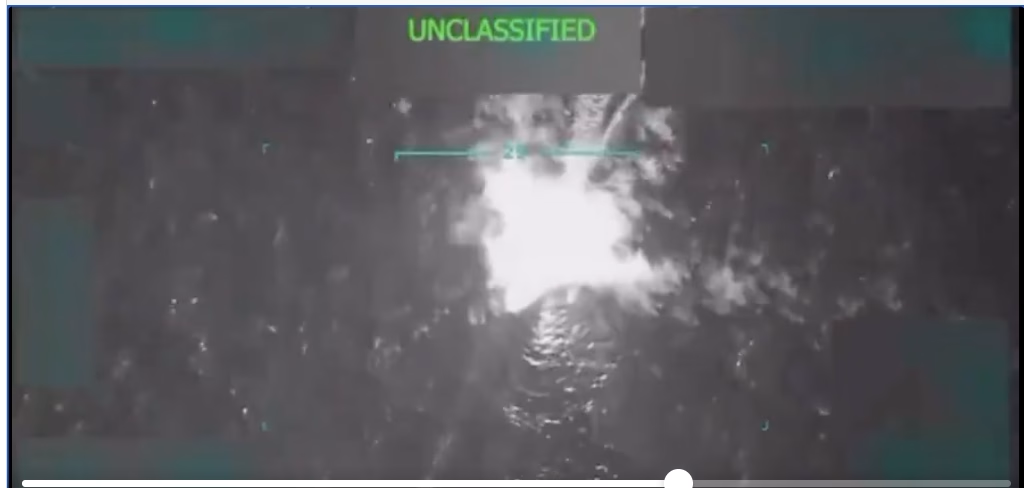
Via the NYT: Trump Says U.S. Attacked Boat Carrying Venezuelan Gang Members, Killing 11.
President Trump said on Tuesday that the United States had carried out a strike against a boat carrying drugs and killed 11 “terrorists,” the administration’s latest military escalation in Mr. Trump’s war against Venezuelan drug cartels that he has blamed for bringing fentanyl into the country.
Mr. Trump offered few specifics about the strike during his news conference on Tuesday, but later in the afternoon he posted more details on Truth Social.
“Earlier this morning, on my Orders, U.S. Military Forces conducted a kinetic strike against positively identified Tren de Aragua Narco terrorists,” Mr. Trump wrote. He said the strike “occurred while the terrorists were at sea in International waters transporting illegal narcotics, heading to the United States.”
My guess is that a lot of people will applaud this, and many others will just shrug it off. The administration has already created a patina of legality by declaring certain criminal gangs/cartels as “terrorist organizations.”
Like many of his domestic declarations of “emergencies,” what we have here is Trump pushing boundaries of his power to allow him to use violence with impunity. There is no concern whatsoever for due process of law by this administration. Rather, this is Trump declaring that merely being a member of a certain organization can be a death sentence without trial.
The strike is an astonishing departure from traditional drug interdiction efforts. In the past, U.S. authorities focused on seizing drugs and identifying suspects to build a criminal case. A second senior U.S. official, also speaking on condition of anonymity, said there would be more such attacks against cartel boats.
The action comes amid a major buildup of U.S. naval forces outside Venezuela’s waters. The administration has also stepped up belligerent rhetoric about fighting drug cartels and labeled Venezuela’s president, Nicolás Maduro, a terrorist cartel leader.
“The president is very clear that he’s going to use the full power of America, the full might of the United States, to take on and eradicate these drug cartels, no matter where they’re operating from, and no matter how long they’ve been able to act with impunity,” said Secretary of State Marco Rubio before boarding a plane in Florida to head to Mexico.
It is worth noting that drug smuggling is not a capital crime, and even if it were, a trial is required to establish guilt and assign punishment.
Recognizing that drug smugglers don’t deserve a lot of compassion, if the president can set aside the rule of law whenever he wants, then everyone is at risk lest their actions be deemed part of some other “emergency” or be declared “terrorism.”
It also seems worth noting that while I am sure many Americans will see this as a solution to the drug problem, it won’t be. I have noted many times that while anti-drug policy is not a primary area of expertise for me, it is impossible to have been a scholar of Colombian politics and not have learned a great deal about the subject (and I have taught master’s level courses on the topic).
The 1990s saw a literal war against drug cartels in Colombia, including billions spent by the US government. This did not stop the flow of cocaine into the United States. As long as there are literal tons of dollars to be made, there is going to be drug smuggling.
I would remind everyone how small a massive shipment of fentanyl is: a one-kilogram bag can contain 50,000 doses. Also, most fentanyl is smuggled over land borders by US citizens. Are we going to start raining hellfire missiles down on Corollas in line at the Ciudad Juarez/El Paso border crossing when we “know” drug smuggling is going on?
It seems worth noting that the likely result of these kinds of strikes is a decrease in supply, which, as any Economics 101 student knows, will increase the street price of that which does make it to market. This will increase the value of the drugs and therefore incentivize more smuggling. It can also lead to more violence in the US as gangs fight over lucrative supply and territories.
Violence like this can have a temporary effect on smuggling and supply, but decades upon decades of trying have demonstrated that stopping drug flows completely is essentially impossible. The demand is what drives all of this, not the supply.
(It seems worth noting that Nixon declared the first “war on drugs” and Reagan doubled down on it. For anyone keeping score at home, they were both presidents a loooong time ago. Clinton funded Plan Colombia–it didn’t work.)
Here’s the video and some commentary from Adam Isacson, who works on this topic for the Washington Office on Latin America.
In the thread, he does note the following regarding terminology (and provides a reminder of the time a family of missionaries was blown out of the sky because US intelligence thought it was a drug plane).

I assume, since Fentanyl can be mixed up in your kitchen sink, that Trump is trying to ‘re-shore’ the Fentanyl industry. I mean, why should Venezuelans get to poison Americans when Americans can do the job and collect the profits themselves.
The thing about fentanyl is that you make it in a lab. You don’t need to grow it like poppies or cocaine, and you don’t need to build this lab in Venezuela to bring it to the US. You just build the lab in a house in Mexico two hundred miles from the border.
I feel like they’re building up to have some spectacle coup/invasion of Venezuela. Like everything with Trump, knowledge will be held against you. Sure, it won’t do anything to stop the alleged flow of drugs into America, but what’s your plan to stop the very lucrative business of allowing Americans to escape reality?
Both Michael and Modulo are correct in noting that fentanyl is lab-produced. Once again, Trump is latching onto a problem (fentanyl is a problem, thanks Sackler family), and associating it with “foreigners,” knowing that for many Americans this will boil down to “at least he’s doing something about the problem.”
And, so it will continue, until they blow up a boat of a wealthy American couple or similar.
Imagine if we could’ve somehow tracked this ship until it landed, and then arrested those in the boat and also all the people waiting for it to land. Perhaps we could’ve even gone after those people’s bosses, etc.
Ah, well.
I would be curious where we go to confirm that this was really a cartel ship really shipping fentanyl to the US. It may well have been. It may also have been a generally non-nefarious boat with a nefarious passenger and his nefarious suitcase. It may also have been wealth Venezuelans out for a pleasure cruise. Blowing it out of the water makes any of these possible and yet unprovable.
@Jen:
Trump does performative because he has found it works in our post-fact world.
The method is so utterly predictable:
1. Misrepresent the threat
2. Do something flashy and/or bullying
3. Misrepresent the result
Just wait a short while for Trump to assert blowing up this boat “solved” fentanyl trafficking.
“…,heading to the United States?” Like, Puerto Rico, USVA, Florida,… Oregon? And how far are we expected to believe they were going in that boat? If they want the public to believe in and get behind a story, at least give a hint of credible details.
Oh, and “positively identified Tren de Aragua” has been overused recently without much to back it up.
@Michael Reynolds:
Stories about meth houses aren’t as common as they used to be. Those are houses where someone ran a methamphetamine lab and the house is so contaminated that it has to be demolished and disposed of as toxic waste. Given how small a fatal dose of fentanyl is (depending on the person, as little as 2 mg), I wonder if making it in the kitchen sink will create similar problems.
Besides the missionary example above there were numerous times in both Iraq and Afghanistan where US intelligence misidentified people and innocents were killed. While out intelligence is good it is not infallible. Absent some true emergency we shouldn’t be killing people. Grab the boat, arrest the people if necessary prosecute and if they did something meriting the death penalty then kill them, but not until then.
Steve
I’ve tried to come up with a way to steelman this, but can’t.
I couldn’t find a directly comparable historical precedent, despite spending time researching today, although it’s clear that Presidents enjoy wide latitude for ordering kinetic operations in a variety of circumstances.
– Reagan’s national security directive, which formally kicked off the drug war way back in the mid-80s, declared narcotics a national security threat, but only made the DoD a supporting player.
Congress under Clinton and Bush created Title 10 legal authorization for the US military to assist foreign governments in lethal counter-narcotics operations. And part of Title 10 does specifically authorize counter-drug missions for the military, but doesn’t authorize direct lethal action by US assets. This is what a lot of the support in Colombia, which Steven mentions in the OP, was based on – but it never authorized direct lethal action by the US.
Bush 41 invaded Panama for regime change, partly on the basis and rationale of counter-narcotics, but it wasn’t only that, and a regime change invasion is not the same thing as targeted strikes against non-state actors and had its own legal problems.
Obama issued policy guidance on his drone strike escalation, but this all fell under the authority of the AUMF, even if some of it was highly controversial, like authorizing the targeted killing of US citizens.
Obama’s intervention in Libya was also legally dubious to the extent that the administration kept calling it a “time-limited, scope-limited military action” to avoid the problem of the War Powers Resolution and the absence of any current or previous Congressional authorization. Instead, the administration relied on stretching the scope of the UNSC resolution to protect civilians.
Trump’s attack on Iran’s nuclear program – similar to Libya, it had little real legal justification.
Trump’s strikes on the Houthi’s in Yemen. The Houthis control most of Yemen but are not the recognized government, but the attacks are well justified as a response to Houthi attacks on civilian shipping in international waters (irony alert).
There have been many strikes justified under the rubric of self-defense, including preemptive self-defense.
– Reagan’s raid on Libya in El Dorado Canyon
– Clintons’s 1993 cruise missile attacks on Iraq
– Clinton’s 1998 missile strikes in Afghanistan and Sudan
– The 1998-99 US and UK strikes on Iraq were justified as enforcing UNSC resolutions
None of those really fit either. Historically, the US has done a lot of legally gray-area shit, but they’ve generally occurred under the umbrella of the 2001 AUMF or various forms of self-defense, or have been against state actors. It’s a major stretch at best to think of criminal narcotic smuggling as a justification for kinetic actions under those rationales, even the more legally dubious ones.
Alternatively, Presidents have historically issued Presidential Findings to authorize clandestine action – including kinetic action outside the bounds of what is legal – but those fall under Title 50 authority. Trump’s action is squarely not covert and is a Title 10 action. Trump issued a directive authorizing the Pentagon, specifically USSOUTHCOM, to use military force against the designated cartels, not a covert operation. But the directive is classified, so we don’t know what sort of legal justifications it’s based on besides the FTO designation, which doesn’t specifically authorize direct military action.
Anyway, legal minutae aside, I’ve thought for decades now that the “drug war” is stupid and the drugs won, and there’s been nothing that’s changed that assessment. I’m totally fine with going after criminal networks that do a lot of very terrible things that are far worse than drug running, but that ought to be done with non-military means.
@Scott F.:
The focus on Venezuela is the point, I think. I see our brain stems are being deliberately stimulated with that word “terror” again, and we all know what that means.
The forces deployed so far do not indicate anything big, however. A handful of destroyers and an MEU is not enough to accomplish much in terms of war, but certainly enough to get “Epstein” out of the headlines for a few weeks.
@Andy:
The drugs won long ago. Now they’re just running up the score.
the one relevant fact about this incident, is that El Taco is in the Epstein files.
This is the ‘best’ comment on the story at the New York Post:
It has almost a thousand upvotes. The vast majority of the thousands of other comments are equally rapturous. Trump’s move towards lawless totalitarianism continues apace with zero reservations among his supporters.
@Michael Reynolds:
Lolololol
@dazedandconfused:
He keeps trying but the headlines are still there. It’s not going away.
From the GAO–
Using proxies, the United States has been destroying drug transports without due process for almost 30 or so years?
This aviation accident* was a result of ABD program,
*- I’m a bit of aviation accident aficionado. At wikipedia I created over 40 articles on those accidents but not the Peru one.
@Bill Jempty:
Yep, crazy isn’t it? We’ve been accessories to kinetic action against cartels for a very long time, but now we’re pulling the trigger.
@Andy: I appreciate the research!
100% this.
@Bill Jempty: We have spent billions and have absolutely been an accessory to all kinds of violence.
And yet, drugs persist and will persist, even if we start blowing boats out of the water directly and without legal justification.
@Steven L. Taylor:
Who knows if we haven’t in the past?
Author Frederick Forsyth’s novel, The Cobra, was a portrayal of a very aggressive war on drugs. In it, planes were blown out of air and ships seized. All without any due process.
Some of Forsyth’s books (Fist of God and The Day of the Jackal for sure) had their roots in actual happenings. Did The Cobra? I don’t know but I wouldn’t be surprised if it did.
@Ken_L:
Well, that’s what they want, isn’t it? As long as Trump is the totalitarian, that is.
@Bill Jempty: I honestly don’t know what point you are trying to make.
Did any past presidents post about this kind of thing on social media?
@Steven L. Taylor:
You’re at it again, Professor. You make a post not laying everything out and I fill in more of the background. Trump and his administration are lots of things but some of their actions aren’t anything new. You’re the Colombia expert, it would surprise me if you never heard of the ABD program. That 2001 shootdown got lots of press coverage.
You criticize politicians for not getting the full picture then you mock me for reading publications with differing viewpoints. Even though your buddy James did or does the same.
The point was these killings aren’t anything new. Your hatred for Trump and his administration has you blind to some things.
As Oscar Wilde said “Hatred is blind, as well as love.”
@Bill Jempty: Let me try this.
1. I am not saying that the US has never engaged in extrajudicial killings. It rather clearly has. My ability to assess them would depend on the circumstances, but as a general matter, I am opposed to blowing up civilian boats or planes when trying to enforce criminal law.
2. There is a difference between “something like this may have happened before” and “it is now policy of the United States to kill people we think might be smuggling drugs.
If you can’t see the difference between, to quote you, “Who knows if we haven’t in the past?” and putting an attack on social media, I don’t know what to tell you.
3. Your sources for all this are novels combined with conjecture.
4. I recall the ABD program (although I would not have been able to conjure the name) and remember the downing of the missionaries’ plane. As I recall, questionable flights were first asked to land. We didn’t just blow them out of the sky on mere suspicion. And the point of noting the killing of the missionary family is to illustrate why blowing things up on mere suspicion is a bad idea.
What in the world are you talking about?
I suspect this is from some other thread, because you can never let anything go.
I will say: citing novels and inferring things in this thread is not good argumentation.
Again, you aren’t actually providing anything other than “Who knows if we haven’t in the past?” a link to a Wikipedia article, and inferences from some novels.
I hate to tell you, but none of that is especially persuasive.
You are not making solid arguments.
Moreover, you are comparing a concrete event with general, vague speculation about the past.
The conditions, nature, and publicity of this are new. This is a policy shift and an unwelcome one. See what Andy said if you don’t believe me.
The fact that maybe something you read in a novel happened is not an argument.
Look, man, if you are cool with blowing up boats of civilians because they might be drug smugglers, just say so.
I am not in favor.
@Bill Jempty:
Sadly, even your links don’t really give enough information about the ‘gotcha’ you’re trying to make. There’s no information about what sort of casualties the program caused, how many planes were forced down or shot down or anything. Even the one tragic accident that is documented shows a lot of confusion and miscommunication that caused it. What happened here just seems to indicate that the new policy is for the US armed forces to blow up any conveyance suspected of carrying drugs. And that the President will immediately boast about it. Given the ‘due process’ being administered within the country and the extensive history of erroneous bombings internationally, one has absolutely no reason to believe any detailed analysis was done.
@Assad K:
This.