Virginia Swears in First Woman Governor
Abigail Spanberger made history this afternoon.
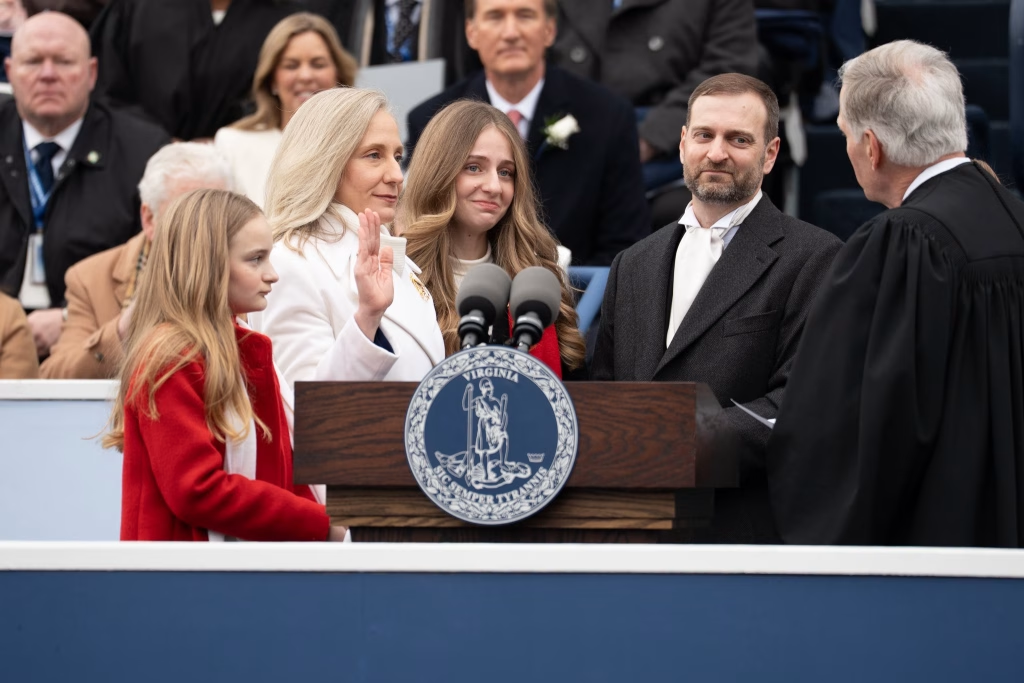
WaPo (“Abigail Spanberger sworn in as Virginia’s first female governor“):
Abigail Davis Spanberger, a former Democratic member of Congress and undercover operative for the CIA, became Virginia’s 75th governor Saturday as the first woman chosen to lead a state that waited until 1952 to ratify the federal amendment giving women the right to vote.
“We will not agree on everything,” Spanberger said. “But I speak from personal experience when I say we do not have to see eye-to-eye on every issue to stand shoulder-to-shoulder on others.”
Spanberger, 46, won a 15-point victory last fall after promising to address the rising consumer costs, job insecurity and lack of access to health care that she blamed on policies enacted in Washington and by the Republican administration of President Donald Trump.
But Spanberger also ran on a record of bipartisanship during her three terms in Congress representing a conservative district, with a reputation for pragmatism that pulled her to the political center at a time of increasing partisan division. Her sweeping win in a swing state drew national attention from Democrats searching for a message that could resonate broadly in the 2026 midterm elections and beyond.
I voted for Spanberger, which was an easy choice given her opponent. But her first acts as governor are decidedly not bipartisan, nor what she campaigned on.
WaPo (“Virginia Democrats advance redistricting, 3 other proposed amendments“):
The Virginia General Assembly gave final legislative approval Friday to a proposed constitutional amendment that would grant lawmakers the power to redraw congressional districts in time for this fall’s midterm elections, probably sending the issue to a statewide referendum sometime this spring.
The state Senate voted along party lines, 21-18, in favor of the amendment, with the Democratic majority pushing it through as Republicans protested that it was an abuse of power (one Republican was absent). The measure cleared the House of Delegates on Wednesday, the opening day of the 2026 General Assembly session — a quick action that underscored the importance of the issue to Democrats.
“None of us wanted to bring this to the floor, but circumstances beyond our borders have made it necessary,” Senate Majority Leader Scott Surovell (D-Fairfax) said during debate Friday, alluding to the efforts of President Donald Trump to push other states to create new red-leaning districts, to help Republicans keep their majority in the House of Representatives in elections this fall. States such as Texas and North Carolina have heeded his call, while California has responded by seeking more blue districts and Democrats are pushing Maryland to do the same.
[…]
Virginia’s congressional delegation consists of six Democrats and five Republicans; some Democrats have said they might pursue new maps that could result in a 9-2 or 10-1 blue advantage.
The power would expire at the end of this decade. At that point, a bipartisan redistricting commission — created by a constitutional amendment that Virginia voters overwhelmingly approved several years ago — would draw new maps as usual following the next U.S. census.
Accomplishing all this in time for this year’s elections would be a logistical sprint. Voters would have to pass a referendum as soon as April for there to be time to create new maps for primaries ahead of the November elections.
While the temporary nature of the proposed amendment is reassuring, and I understand the desire to fight fire with fire, there is no small irony in championing democracy by disenfranchising the voters of the state you ostensibly represent. While Democrats easily swept the low turnout off-off year contests that brought Spanberger to power, Trump won 46% of the vote here a little over a year ago. The current 6-5 split is an accurate reflection of the Commonwealth’s political split; 9-2 or 10-1 would be an abomination.

The abomination would be to not “fight fire with fire” and allow the arsonists to burn down the country. Our democratic system is under assault by unprecedented radical illiberalism. The side of liberalism can’t be squeamish when our opposition is threatening our allies in NATO and while masked agents of the state are shooting unarmed protesters in the head.
@Scott F.:
Give me any evidence based reassurances that 3-5 of the Republican Congresspersons from Virginia would work in a bipartisan matter to curb the excesses of the Trump adminstration if re-elected and I could be persuaded otherwise.
@Scott F.: My only objection to Democrats pushing through these redistricting bills and amendments is that each of them should be named the “Force SCOTUS to restrict partisan gerrymandering” bill/amendment.
The end goal is not to make every state a weird lopsided mess, but to end partisan gerrymandering nationwide. The only tool the state has, however, is to be part of the problem (balancing the other side of the problem)
It’s not a big deal, but it would just be a learning aid for the “both sides are the same” types with poor reading comprehension and a limited news diet. (40% of Americans?)
Well, many people despise MAD and hate Henry Kissinger because of it (and other things, too).
AND, it worked.
Unilateral disarmament, particularly a surrender to a party that has repeatedly demonstrated its contempt for democratic norms and processes, seems like a worse choice.
I don’t blame you for not liking the nation we live in these days. I don’t like it either. I’m not sure, though, that things are as bad as they have been before. We have:
0. Slavery was probably a necessary component of creating the United States as a political entity.
1. Andrew Jackson and Indian removals
1a* Polk’s manufactured war against Mexico to get California
2. An actual civil war, preceded by a caning in the Senate and terminated with an assassination.
3. Yellow journalism and the Spanish American War, another manufactured war, this time by media.
4. The Bonus Army and what happened to them.
5. The 90 years or so of Jim Crow, terminating with racial violence, black people getting shot in Chicago neighborhoods for walking through them.
5a Speaking of Chicago, the Daly Machine. Machine politics in general, in New York and other places. Not good for democracy, as such.
There’s a lot to not like. I would very much rather not have to experience this garbage again, but we are going to have to fight for it, and fighting is always messy.
“ Republicans protested that it was an abuse of power”
What did they say when Trump urged other states to do exactly this?
“ Trump won 46% of the vote here a little over a year ago”
I think this, disenfranchisement, is one of the things they voted for albeit they wanted the shoe to be on the other foot.
As I noted in my post about a similar action in CA, I do not like having to go this route and absolutely agree it is undemocratic on the state level. But, it is actually pro-democratic on the national level, which is why I ultimately suport to move.
Also, to Gustopher‘s point: this is, in many ways, SCOTUS’ fault for declaring partisan gerrymandering perfectly constitutional.
Maybe if enough people understand how absurd this all is, we can get some change on the subject, but I shan’t hold my breath.