When You’ve Lost Canada . . .
Our closest ally and trading partner is balancing against us.
NYT (“Canada Flexes on Global Stage With an Eye to Its Own Survival“):
Prime Minister Mark Carney of Canada delivered a stark speech in Davos, Switzerland, on Tuesday, prompting global political and corporate leaders in the audience to rise from their seats for a rare standing ovation.
He described the end of the era underpinned by United States hegemony, calling the current phase “a rupture.” He never mentioned President Trump by name, but his reference was clear.
The speech came as President Trump doubled down on his threats to take Greenland away from Denmark, saying he would slap fresh tariffs on European powers as punishment for their support of Greenland’s sovereignty.
Global leaders have been scrambling to find a unified response.
“Every day we are reminded that we live in an era of great power rivalry,” Mr. Carney said. “That the rules-based order is fading. That the strong do what they can, and the weak suffer what they must.”
And he warned, “The middle powers must act together because if you are not at the table, we’re on the menu.”
He would know.
Mr. Trump started his second presidential term making claims on Canada as the 51st state and threatening Canada’s previous leader, Justin Trudeau, whom Mr. Trump publicly derided, with unilaterally scrapping agreements that have governed the relationship between the neighboring countries for over a century.
He has imposed tariffs on Canada, which is one of America’s two top trading partners along with Mexico, that are crippling some of Canada’s key economic sectors, such as autos, steel, aluminum and lumber.
Mr. Trump’s allies, particularly Steve Bannon, have talked about the benefits of the United States annexing Canada to access its vast Arctic and natural resources, including critical minerals and rare earths.
Mr. Carney chastised other leaders too, many of whom would have been following his speech in Davos, for not standing up for their interests.
“There is a strong tendency for countries to go along to get along,” he said. “To accommodate. To avoid trouble. To hope that compliance will buy safety. It won’t.”
Mr. Carney made clear he is choosing a different path.
He wrote his own speech, according to a government official, who spoke on condition of anonymity to discuss the inner workings of his team, which is a departure since speeches of this magnitude are usually prepared by high-level staffers with the leader’s input.
Let’s stipulate that Carney’s and Canada’s options are limited. While he’s made overtures to China, that relationship would hardly be without its own risks.
Still, what a position to be in. Canada is our closest ally geographically and culturally. Canadian forces have fought side-by-side with Americans in both world wars and in Afghanistan. It’s a founding member of NATO. We have intertwined our national air defenses through NORAD for decades. It buys more American exports than any other country, accounting for almost as much as the entire European Union. It exports more to the United States than to any other country other than China and Mexico.
Yet threats to abandon NATO, use of bullying tactics to coerce it to adopt Trump administration policy goals, and even threats to use military force to take over land owned by another NATO ally have Carney legitimately frightened of what comes next. Sadly, he is not alone.
The Trump administration’s new National Security Strategy repeatedly refers to the value of American soft power. Yet, in both word and deed, they have squandered that power. It has taken just a year to put at risk what took generations to build.

It gets worse, it is being reported that the Canadian military is preparing a battle plan for a possible US invasion.
From the Bulwark
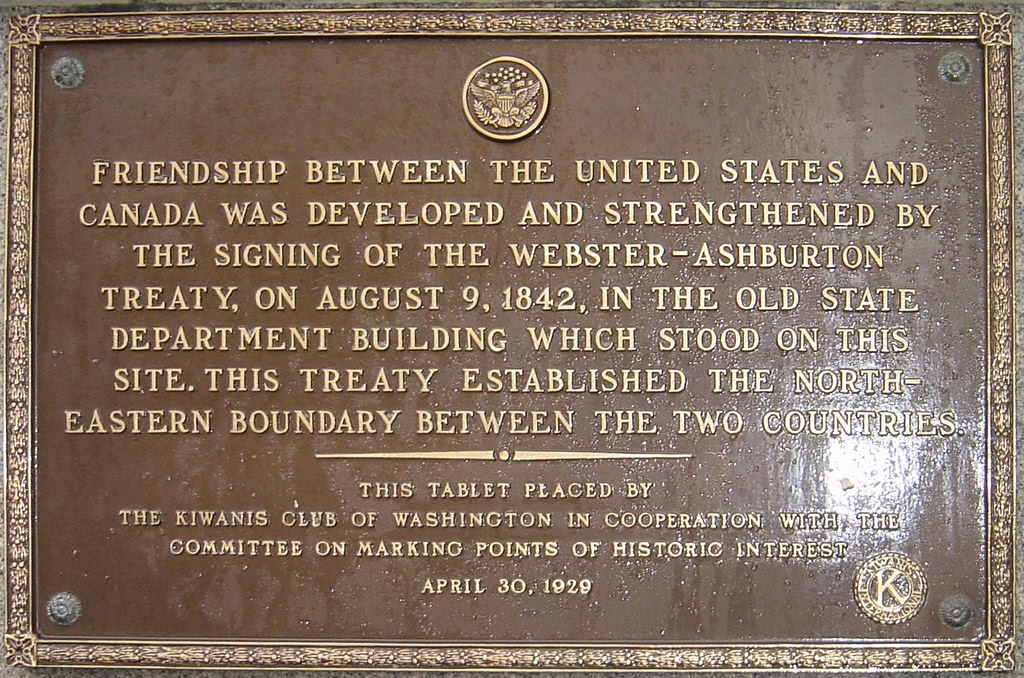
My home town is Blaine, WA, where the plaque in the photo is placed. Blaine is home of the Peace Arch, which sits on the western end of the US-Canadian border.
There is a park around it. Within the park one can walk from the US to Canada and vice-versa.
Within the arch there are iron gates, which are fixed to the interior sides, open. There are two plaques here, they say “Children of a common mother” and “May these gates never be closed”.
In 1965, I think, Lyndon Johnson visited the Peace Arch to commemorate 100 years of a non-militarized border with Canada (and to sign some sort of treaty involving rivers or something.)
We got out of 3rd grade to go see the president. We understood the significance of the Peace Arch and of our very friendly relationship with Canada.
In 2010, the Winter Olympics were held in Vancouver. The Olympic torch route went through Peach Arch Park, dipping into the US there, the only spot on its run.
I do not blame Carney one bit. Nor do I blame all the Canadians I have known and had as friends (which are quite a few). People in the region used to cross the border to buy gas, or have lunch, or go to a nice park somewhere.
Apparently this is difficult now, because CBP has started stopping people going into Canada. For no discernable reason. It has put enormous economic pressure on my home town.
Stomping on beautiful things is what Trump does. I’m sure it makes him feel powerful. I wish for a time where he no longer had any say at all about how things are in Blaine, WA.
This brings a lot of sadness to me. A good chunk of my family came from Canada. My great Grandparents are buried in Kitchener. Dad’s aunts and uncles and first cousins lived in Canada. We spent summers visiting close cousins on the lakes in Ontario. I’ve done a bit of canoeing on those lakes. Same goes for branches of my wife’s family.
US and Canada have the world’s largest unprotected border. I actually wish harm comes to Trump and his people.
@Jay L. Gischer: @Scott:
I live in Canada close enough to the border that I pass within a couple of hundred feet of the border crossing on my way to work every day. This situation saddens and angers me greatly. We have not crossed into the US in more than a year and we miss our trips to Maine, to the Outer Banks, to go to a football game, to visit family in the midwest. Now we question if we will ever go back. Trump is not permanent but too many Americans have shown that they wanted and support all of this. Those are people we don’t want to run into again.
@Pete S: I wouldn’t blame you, but I will miss you.
I think there is a very large group of Americans that simply do not know what is happening. Our means of getting on the same page fact-wise has been utterly wrecked. Deliberately so, in some areas.
There are others who maybe celebrate because it makes people they don’t like suffer, but they have no idea of the practical reality. You know, they don’t live near Canada and don’t know any Canadians (actually they do, but they don’t realize it).
…CBP has started stopping people going into Canada.
My only trip to Canada in the summer of 1970 involved a friend and I riding the rails from Carbondale, Illinois to Chicago then Chicago to Detroit where we rode a bus through a tunnel to Windsor. No passport needed to enter Canada at the time. I believe we exchanged our United States currency for Canadian money. May have had to show our drivers license. We boarded the Canadian National (?) in Windsor. Between Windsor and Toronto the train attendants made all their announcements in English that I remember. When we changed trains in Toronto and headed
to Montreal announcements were made in English and French. Changed trains again at Montreal and headed to our destination Quebec City. No English on this run. All the train crew spoke exclusively French. My friend was fluent in French so she would translate for me. The only one who spoke English to us the entire two day visit to Quebec City was the man who checked us in to the quaint rooming house inside the walls of the city where we stayed. Since we were limited to walking our touristing stayed close to our lodging. A minor quibble I had was the inability to order black coffee. Apparently they feed their milk cows coffee beans to serve up the mud they offered.
Return trip was the same route in reverse. I don’t think any of our train station stopovers were more than an hour or two.
I’m glad that I got to Quebec City when I did. Unless I find a big sack of cash under a rock somewhere it the closest that I will ever get to France.
The line in the Carney speech about Wisconsinites and the price of eggs…ouch.
It hurts cuz it’s true. The world has been rolling with the punches, numbing the pain with false narratives, to indulge increasingly unreliable US leadership. Our descent didn’t start with trump, but looks like he’s crash landing us.
@Pete S:
I’ve had a US visa since I was 3 years old. that one was permanent, but got discontinued in 2000. I got a new one then, and again in 2012. When that one expired, I decided to wait a few months until the wait time for a renewal wasn’t measured in years. That hasn’t happened, but I still won’t get another until 2027, if then, and I don’t see that I would be keen to use it anyway for a few more years hence, if then.
I am 2/3rds through listening to Carney’s speech via YouTube and holy cow, it is a speech for the ages.
I hope we are getting closer and closer to a critical mass of Americans being beyond embarrassed that we cheer on a President whose “speeches” sound like the ramblings of a bitter and spiteful old man.
Carney is one of the few individuals who appear to understand the current situation and who is taking appropriate steps to deal with it.