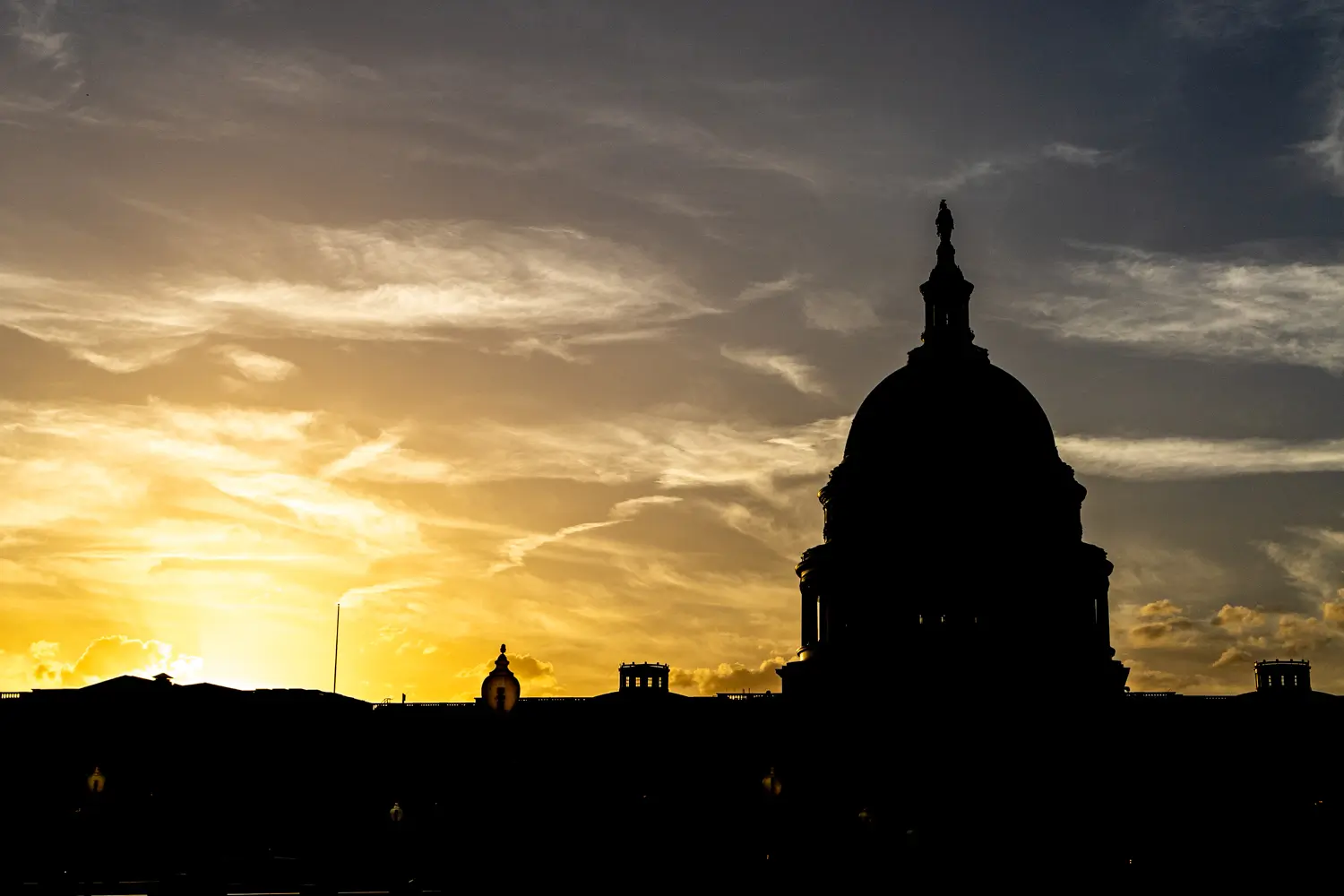
“Sun Going Down on Congress” by SLT

Yet More on the Problems of US Institutions

In this case, another author further solidifies the point.

2

Comments

Samantha Hancox-Li at Liberal Currents has a piece up that fits well into the major topic of conversation here at OTB for the last several days: Disordered Institutions Make Disordered Publics.

It is not enough to have ‘organizations.’ It rather matters whether these organizations have an intelligible connection with power. If the connection is unintelligible or nonexistent, disordered politics is the result.

[…]

Powerlessness is intellectually debilitating. If nothing you do can affect the outcome, then there is no need to discipline your actions. Policy becomes posture. Reason degenerates into social signaling. Why not simply take the most radical course?

[…]

People who believe their choices don’t matter choose poorly. Parties that know they will never be held accountable have no interest in educating or leading the people, no interest in facts and reality. They may give in to whatever fever dream suits them, tell whatever flattering lies they like, and remain intact.

Why can Trump and friends lie as they do? There is no accountability. Most elections are not competitive.

This reminds me of what I said the other day:

So, what do we see? Legislators who can’t legislate, but who want to keep their jobs. If legislating is not the gateway to re-election, then other behaviors are incentivized. Given that 90% of members of the House run in non-competitive races and therefore the key to keeping the job is the primary, is it any wonder that so many of our legislators focus more on being cable news stars or basically influencers?

This dovetails with Hancox-Li’s conclusion:

This dysfunctional institutional environment has of course enabled the malignant growth of social entrepreneurs. The most central of these, of course, is the right-wing disinformation machine, which spends all day pumping the people’s veins full of lies that flatter their egos, outrage their sensibilities, and provide convenient scapegoats upon which to heap all the fear and anger in the world.

The right-wing lie machine is itself a creature of a disordered ecosystem. We cannot outcompete lies with lies and evil with more gridlock. We need to do the simultaneous work of rebuilding institutions and publics on the basis of truth, accountability, and effective governance. Parties must lead the people, but they can only do so when they can put their ideas into practice while in power and then face the music at the ballot box.

Perhaps the most basic point I have been trying to make is that there is a profound disconnect between voters and outcomes. Most general election campaigns don’t matter, and the closest we get to getting a real chance to send a national signal is every four years with the presidential elections, and two of the last six have given the office to the popular vote loser. And presidents alone can do nothing unless they want to be dictators. Even holding a trfiects isn’t enough.

To quote myself again:

When does a party even get to really govern? The answer is: almost never. Even holding a trifecta is not enough; to have enough votes to actually pass legislation requires 60 seats in the Senate alongside a majority in the House. This almost never happens.

I will add in a comment James made: plus you have to have the approval of five Justices.

Where in our system is there a clear mechanism for real representation? Where is the chance for a clear signal of voter preference? Where do the rules incentivize governing? Where is the chance to collectively punish or reward our government for doing a bad/good job?

At any rate, go read the whole thing.

2 responses to “Yet More on the Problems of US Institutions”

  1. Not to take anything away from what you have written about the dysfunctionality of US political institutions, I still think that there are meaningful limits to the explanatory power of this observation.

    This passage from the quoted piece illustrates some of the limitations of the it’s-the-institutions approach, I think:

    Powerlessness is intellectually debilitating. If nothing you do can affect the outcome, then there is no need to discipline your actions. Policy becomes posture. Reason degenerates into social signaling. Why not simply take the most radical course?

    Arguably, Democrats have been more powerless than Republicans (the Senate en SCOTUS being what they are), yet intellectual degeneracy has manifested itself far, far more on the GOP side.

    As to this:

    Why can Trump and friends lie as they do? There is no accountability. Most elections are not competitive.

    Is Trump able to lie because elections are not competitive, or are many elections not competitive because a meaningful segment of voters don’t care about lying?

    And why aren’t Democratic candidates able to get away with similar lies?

    IMO, at some point, you got to look at the voters as well to answer these questions satisfactorily.

    Granted, shitty political institutions certainly don’t help, and wishing for better voters has never led to any improvement whatsoever.

    But if the goal is to understand why things happen as they happen, then voters deserve a good, hard look, too.

    I think the conclusion is pretty much inescapable that quite a few voters vote for the politician who says the things that they want to hear. And that’s it.

    For them, politics is about emotional gratification right now (reality be damned), rather than legislation that is going to make their lives better in the next four years or so.

    A meaningful lack of democratic responsiveness is certainly not going to make this better, but the more fundamental problem is that a significant part of the population thinks that things are true for the simple reason that they want these things to be true.

    (For the record: this is not something that the well-educated are immune to.)

    If I had to guess (and it’s certainly not more than a guess), Fox News and social media algorithms have done more to create the current mess than the fact that Wyoming gets to have just as many senators as California.

    Add to that the fact that the GOP thought it could bring the racists and the Christian nationalists into its coalition without paying the price, and that explains maybe just as much as “our institutions are outdated.”

    Which, of course, is not to say that remedying the democratic deficit would not be a constructive way to start tackling the problem.

    2
    1. @drj I mean, yes, complex social phenomena are, well, complex.

      I am not suggesting that our problems are monocausal, or that better institutions will give us rainbows and unicorns. Indeed, I often fear that I spend too much time throat-clearing in that direction (but maybe I need to spend more).

      Do I think that reactionary ideologies are more likely to succumb to the problems you note? Absolutely, I do.

      Mostly what I want is this:

      1. I need many, many more Americans to understand that we simply do not have a simple system wherein we all vote and we get what the majority wants for a time until we vote again. The system has major flaws.
      2. I want a system that would better reflect popular sentiment and create a clear democratic feedback loop.

      Right now we have a system that clearly empowers the minority and denies the majority. That has to be fixed before we can get to #2 above. But #2 ain’t happening unless #1 happens.

      And so I pound my head against the wall on an ongoing basis.

Leave a Reply

This site uses Akismet to reduce spam. Learn how your comment data is processed.