Trump and the Great Presidents
Washington, Jefferson, Lincoln, and both Roosevelts pushed the envelope, too!
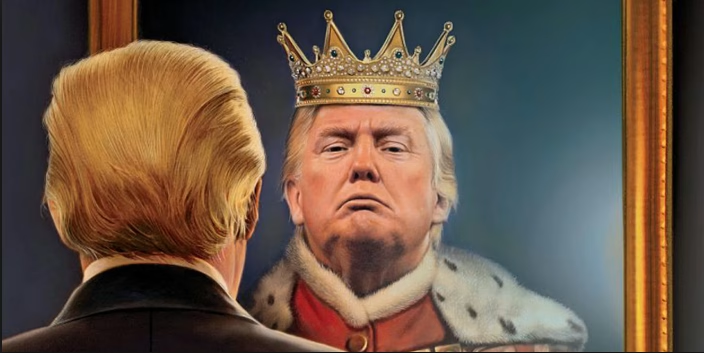
Jack Goldmith, a former senior official in the George W. Bush Justice Department and currently the Learned Hand Professor of Law at Harvard Law School, is the conservative legal scholar I pay the most attention to. His takes are sober and well-reasoned. He has an op-ed in today’s NYT that editors headlined “Can Trump Be a Great President?” But’s only tangentially about that.
He begins with a completely uncontroversial premise:
Donald Trump enters his second presidency, as he did his first, pledging to wield executive power in novel and aggressive ways. This is neither new nor necessarily bad. “Presidents who go down in the history books as ‘great’ are those who reach for power, who assert their authority to the limit,” the presidential scholar Richard Pious noted.
Goldsmith will flesh this point out later but he’s certainly right. All four of the Mount Rushmore presidents exercised power in ways that sparked controversy, if not outrage.
But pushing power to the limit does not guarantee presidential success, much less greatness, as Mr. Trump is about to discover.
One might think someone who served a full term as President, lost, and has had four years to reflect before getting a second term would have already had this discovery. But we’re talking about Trump here, a man not known for self-reflection.
Mr. Trump ran thrice and won twice on increasingly fervent claims that establishment institutions and practices were damaged, and on pledges to upend the way Washington does business. When he is inaugurated as president on Monday, he will have a second shot at fixing the institutions, policies and ideas that he has criticized: immigration, the “deep state,” wokeness, suppression of speech, government inefficiency, free trade, crime and education.
I don’t agree with many of Trump’s stated goals but he certainly has a right to pursue them, within limits. And Goldsmith argues those limits are broader than critics seem to think:
Some critics claim that Mr. Trump will be acting illegitimately in seeking to reimagine the nature and operations of the federal government, as if the way things have run traditionally, or during the post-Watergate period, are invariably good or set in stone. They are not.
Eminent presidents acting in new circumstances have since the founding taken a sledgehammer to the norms and constitutional principles thought to govern the executive branch and its relationship to other American institutions.
George Washington acted before there were executive branch precedents. But he unleashed controversy when he asserted an independent power to interpret the Constitution, unilaterally proclaimed America’s neutrality in the early wars of the French Revolution and denied the House of Representatives documents related to the Jay Treaty. Washington was widely accused of monarchical tendencies in his day.
As were his most distinguished successors. Thomas Jefferson changed the presidency to be openly (and effectively) partisan and agreed to the Louisiana Purchase even though he believed it was unconstitutional. Andrew Jackson deepened the spoils system and transformed the veto power. Abraham Lincoln suspended the writ of habeas corpus, among his many constitutional violations.
Theodore Roosevelt converted the presidency to a “bully pulpit” and acted on the theory that the president can do anything not specifically restricted by the Constitution or Congress. Franklin Roosevelt intensified the president’s direct connection to Americans, broke the two-term norm and expanded the federal government and presidential prerogative in unprecedented ways.
In short, the rules governing the presidency have never been static. The Constitution created an independent office with vaguely specified powers and few overt constraints. The office evolved into an immensely powerful institution over the centuries because domestic and international society grew more complex, energetic presidents asserted new authorities to meet new challenges, and Congress and the American people — with occasional exceptions — acquiesced in the new arrangements.
It’s hard to put myself into history, in that my attitudes and instincts were developed in relation to the time and circumstances I was in. And someone born in my circumstances in those eras almost certainly wouldn’t have become an officer and a professor. But I may well have thought all of those actions illegitimate at the time.
So, how have we come to view these actions as proper uses of Presidential power and, indeed, redefined the Presidency itself because of that? I think it’s because we’ve come to see the purposes to which that power was used—safeguarding the Republic, expanding its power, greater prosperity for the common citizen–as justifying bulldozing dated institutions and norms. (And FDR is a better example than Jackson in that regard, as the spoils system and other manifestations of his power have not held up well.)
While I didn’t like President Obama and President Biden’s use of executive orders to pursue policies they couldn’t get through Congress, I didn’t see them outrageous in nearly the same way I did many of Trump’s first term abuses. Partly, it was about style, in that they displayed more normal temperaments and regard for procedural and institutional norms. Mostly, though, it was that Trump seemed much more motivated by personal gain, rewarding allies, and punishing enemies than about advancing his policy goals.
Goldsmith is coy but seems to agree:
There is nothing illegitimate in this pattern. Bold presidential leadership has always been needed to make American democracy overcome the “perennial gap between inherited institutions and beliefs and an environment forever in motion,” as the historian Arthur Schlesinger Jr. put it.
The most successful presidents anticipated problems others did not see, understood the inadequacies of inherited institutions and prodded the nation to a new place in ways that defied prevailing practices and provoked enormous resistance. Think of Jackson and democracy, Lincoln and freedom, Franklin Roosevelt and equality.
“Owning the libs” just doesn’t have the same resonance.
But the heroic presidency runs the persistent danger of becoming craven or abusive, as Vietnam and Watergate taught. This is what so many critics worry about with Mr. Trump — that his transformations will be more resonate of Richard Nixon than of our most esteemed presidents.
At least Nixon did that thing only he could do, radically changing the Cold War balance of power in our favor. But both he and Trump tried to subvert democracy, Nixon by sending burglars into the Democratic headquarters to steal an election he was going to win in a landslide and Trump by trying to overturn an election he clearly lost, including by inciting an angry mob to disrupt the certification of the Electoral College vote. I don’t see how he can undo that in his second term.
Goldsmith skips past the elephant in the room, shifting gears completely:
But it takes extraordinary skill to wield executive power successfully throughout an administration. If past is prologue, Mr. Trump lacks the acumen to carry out his ambitious agenda.
The first problem is management style. In his first term, Mr. Trump was a poor administrator because of his mercurial, polarizing style and a general indifference to facts and the hard work of governance. There is no reason to think this will change in his second term. Mr. Trump also lacks the emotional intelligence that the great presidents had in various degrees — the self-awareness, self-control, empathy and ability to manage relationships that are so vital to steering the ship of state on the desired course.
Second is the question of whether Mr. Trump knows where he wants to go. “Great presidents possess, or are possessed by, a vision of an ideal America,” Mr. Schlesinger noted. Mr. Trump has a powerful slogan, “America first,” a robust agenda, and many discrete and often insightful political instincts. But he lacks a coherent sense of the public ends for which he exercises power. This will make it hard over time for his administration to prioritize challenges, a vital prerequisite for presidential success. It will also make his administration susceptible to drift and reactiveness, especially once unexpected events start to crowd the presidential agenda.
With the exception of deporting illegal Latino immigrants, there has been no steady policy goal. Trump has no “public ends” in mind.
Third, personal gain was neither a priority of the great presidents nor a guide to their exercise of power. There is every reason to believe that Mr. Trump’s personally motivated first-term actions — his insistence on loyalty over other values, his preoccupation with proclaiming and securing his personal power, and his indifference to conflict-of-interest norms — will persist. These inclinations will invariably infect the credibility, and thus the success, of everything his administration does.
One would think.
Fourth, Mr. Trump is unlike any previous president, even Jackson, in broadly delegitimating American institutions — the courts, the military and intelligence communities, the Justice Department, the press, the electoral system and both political parties. This will do him no favors when he needs their support, as he will.
His appointees to the courts have helped delegitimate that institution, unfortunately. Even if they rule in his favor using sound reasoning, critics will assume that the fix is in.
Mr. Trump is especially focused on eroding the capacity of federal agencies. At the same time, he has plans to regulate in areas including health, crime, energy and education, and to deport millions of people, all of which require a robust and supportive federal work force. Mr. Trump’s twin aims of incapacitating the bureaucracy and wielding it to serve his ends will very often conflict.
This will be the subject of several subsequent posts. He seems hell-bent on returning to Jackson’s spoils system, at least in some agencies. But this will require replacing competent people who slow walk his policy goals with sycophants who don’t understand how to navigate an intentionally complicated system.
Fifth, Mr. Trump’s obsession with hard executive power and an extreme version of the unitary executive theory will be self-defeating. If his stalwart subordinates carry out his every whim, as he hopes, bad policies will result. If the loyalists Mr. Trump is putting at the top of the Justice Department do not give him candid independent advice that he follows, he will violate the law and often lose in court, as happened in his first term.
Trump, like the octogenarian owner of my favorite professional football thing, somehow thinks he’s smarter than all the professionals despite mountains of evidence to the contrary. Professionals with long-honed instincts telling him that his ideas are unworkable will be viewed as disloyal, not helpful.
The great presidents used coercive unilateral power when they needed to, but only when they needed to — none more so than Lincoln and Roosevelt, who faced the most serious crises in American history. But these presidents also understood that hard power could go only so far and that persuasion and consent were surer tools to achieving lasting presidential goals in our democracy. This idea is lost on Mr. Trump.
Despite his manifold faults, Trump is a dynamic personality. He has an instinct for showmanship and can work a crowd. But he has not managed to significantly expand his base of support despite eight plus years as the leader of his party. In his mind, those who disagree with him are disloyal, so coercion, not persuasion, is required.
Finally, as Mr. Schlesinger noted, the great presidents all “took risks in pursuit of their ideals” and “provoked intense controversy.” And, except for Washington, they all “divided the nation before reuniting it on a new level of national understanding.”
Mr. Trump is a risk taker and a divider. But it is hard to see how his approach to the presidency ends in national reunion.
This is, to put it mildly, an understatement.
Reportedly, today’s inaugural address is reportedly going to aim in that direction, taking a more uniting tack than the “American carnage” rhetoric of the first. But we heard that after the assassination attempt, too, and he soon became more mean-spirited than ever.

I think you meant to say “While I didn’t like President Obama and President Biden’s use of executive orders to pursue policies they couldn’t get recalcitrant GOP Congresscritters to do their duty, consider the proposals and then vote on them honestly as opposed to resisting everything regardless just because the president was a Democrat.. ”
Fixed that for you.
I would add a question mark to the end of your headline. That seems to comport with the content of the post (or at least the commentary) better, because it avoids the implicit suggestion that Trump should be placed in the category of the supposedly great Presidents listed herein.
@Not the IT Dept.: In Biden’s case, he couldn’t even get all of the Democratic Senators to go along. Regardless, while I don’t like party-line voting, the Constitution requires that laws be passed by Congress. Many of the Obama and Biden executive orders were plainly outside the powers of the President.
Jerry Jones out here catching strays lol
Professionals are very seldom agents of change, though once inspired many will join the march. Trump is a man who doesn’t stay in the box and that horrifies the functionaries who see their future as sad little men in their sad little world. Life in the bureaucratic state which was seeded by FDR’s attempt at the German patter of socialism, the zwangswristchaft [compulsory economy] of the Nazis.
Trump has put change in the air, now with people inspired to reexamine the system from first principles like Elon Musk. With more of the tech minds moving to assist everyday.
Trump will not be a great bureaucrat president as most since Reagan have been. But he causes the bureaucrats to get moving in opposition, but once in motion, it takes far less force to alter their course.
Take for example what Trump has already done
China – Trump warned in his first term and businesses developed plans to reduce their dependency on China which proved useful in the pandemic as well as now.
NATO – Trump kicked the deadbeat EU NATO allies and they developed plans to meet their obligations. Plans that have proved useful when Ukraine didn’t just surrender like Biden pushed Zelensky to do in the early hours.
Greenland – Everyone now knows, and has thought about, the strategic interest the US has in Greenland. Selling it out to the Chinese for their move to have place in the Arctic is now questionable as the first question is “what will the US do if we make a deal with the Chinese”
Panama – same as with Greenland. First thought is about any deal with the Chinese provoking the US strategic interests.
Trump even got the high end chip manufacturer in Taiwan to build a factory in the US. It’s been slow walked for sure, but now if China moves on Taiwan, the high-end chips can be up and running in Arizona quite quickly. Only really needing to evacuate some of the skilled personnel off the island.
@JKB: “Greenland – Everyone now knows, and has thought about, the strategic interest the US has in Greenland.”
Yes, just as Trump’s predecessor signaled the strategic interest Germany had in Poland.
Would you make the same statement if you only looked at Trump’s first term up to election day 2020?
@JKB: “ Trump even got the high end chip manufacturer in Taiwan to build a factory in the US.”
I’m sorry, what? The FoxConn plants that Trump made a big deal about were huge, huge fiascos.
The TSMC plants that have opened have largely done so due to the CHIPS act, one of Biden’s signature accomplishments. Prior to the CHIPS act, yes, TSMC was clearly slow walking things, just as every other company that made a show of “bringing US manufacturing home” during Trump’s first term did. As long as he gets credit, he doesn’t actually care about the reality.
God, another four years of this nonsense.
Trump is fundamentally amoral, unethical, and mentally ill in ways the Roosevelts, Truman, Eisenhower et al were not. They may have been aggressive and pugnacious, but those guys were also mature, intellectual, and principled — aspiring to intelligent, moral leadership.
Tyranny weilded by a secular saint like Abraham Lincoln won’t look like tyranny weilded by an antisocial, maladapted liar like Epstein-bestie rapist Trump.
Trump and his supporters and enablers sneer at moralism and intellect. All their once and future failures will be downstream of that misguided genesis. Because decency and character do matter, and Donald J. Trump has none.
He is an insecure, pathologically dishonest, immature prick with textbook narcissistic personality disorder. According to the American method of sorting heroes and villains, Trump will always ultimately leave bankruptcy and failure. Just like he always has, with only the reliable supply of available suckers to bail him out.
The American myth will never rank Trump as a great president or rehabilitate his reputation a la Jimmy Carter, because Trump is too much of a hopelessly broken wretch, a sorry excuse for a man. Blame his parents.
@Kevin:
Trump promised giant Foxconn factory in Wisconsin that never materialized (WaPo)
I no longer have a Bezos rag Sx to gift link, but this 2023 article was a doozy. These days, Bezos would probably block this story.
Goldsmith is yet another person who ignores/sanewashes Trump’s first term to produce BS to fool people. Trump doesn’t want to fix anything; he wants to corrupt and steal things. James, as you noted, he looks at Jan 6, and averts his eyes and his pen.
@Fortune: “Would you make the same statement if you only looked at Trump’s first term up to election day 2020?”
‘Aside from WWII, the Holocaust, etc., wasn’t Hitler a good road builder?’.
@JKB: why the hell would the Danish sell anything on Greenland to the Chinese? Do you think everyone is a money grubber like your god-king?
@Fortune:
Anyone who read this blog during Trump’s first term knows that answer.
(Spoiler: the answer is “yes”).
@Thomm: I started to try and make sense of that post, but decided not to.
I will say this: it is profoundly weird how “conservatives” such as JKB can both deride FDR and the post-WWII modern state and still also pine for American Greatness as defined by the post-WWII era, the 1950s in particular.
It is as if they really don’t understand history, politics, or economics.
@DK: I seem to recall that there was the usual convention of historians during Trump I, they did the usual survey ranking presidents, and Trump came in near last. Unlikely to change.
Decades ago, pre-internet so I can’t find it, a historian did an essay on the then current historians’ prez ranking. He noted that the highly rated prezes generally had three things in common. One, unfortunately, was a successful war. Another was that they were for the most part professional pols who had come up through local politics and had learned to let everyone have a piece of the pie. The third was a serious amateur interest in history, which gave them a grounding in how things should work.
Trump may yet arrange a war, but the other two are beyond his comprehension, much less his accomplishment.
@Steven L. Taylor: Meow! But I was asking James.
China- China now exports less to us, so if the goal was solely to affect China then it’s a win. However, in context, it was supposed to lead to more US manufacturing which really didnt happen.
NATO- Every president has pushed NATO to increase spending as did Trump. NATO spending started to increase in 2014 after the invasion of Crimea, the slowed down until invasion of Ukraine. The numbers dont show any effect from Trump berating them, much as there was no effect for Obama or anyone else.
Greenland and Panama- Trump said he wouldn’t rule out military action to acquire them which was bizarre. That aside, US mining companies have shown little interest in Greenland. They own 1 of 23 mining licenses Greenland has issued (Canada and UK have the rest). China hasn’t really been interested in the place. We already have a military base there and the Russian Navy isn’t really a threat. As an early warning base against missiles there are other places to have one that will give as good or better warning. The Panama canal is essentially under our control anyway from a military POV.
Steve
@James Joyner
Comparing Trump to these Former Presidents in this way is non sequitur and might be construed as normalizing a malignancy.
Washington can be left out of any comparison immediately — he had no precedent, no former “envelope” and was forging this nation out of war.
Of the others, Lincoln and both Roosevelts, notably used their time in office to enact “progressive” improvements for the nation that furthered dignified humanitarian values essential for democracy.
Trump’s envelope pushing is more in line with “envelope stuffing” and any of his aberrant behavior that will be coming online shortly, does does not deserve the comparison.
Coincidentally, I just did a deep dive on Teddy Roosevelt, discovering and rediscovering facets about his administration that I had either missed or forgotten. He supported a good many progressive themes, more than my fixed memory recalled. In fact, it would be abominable for this Republican Party to claim Roosevelt as their own.
I see where, a day or so after this post, John F. Harris, the editor in chief of Politico termed Trump “great,” as in, has been consequential or had a tremendous impact regardless of benevolence or malevolence. So, the link hinted at by the headline to this post (“Trump And The Great Presidents”) has been explicitly connected by a political website often quoted in OTB. (Personally, I will be staying tuned to see who is the first to categorize Hitler and others throughout history as “great,” given this revised definition.)
https://www.politico.com/news/magazine/2025/01/21/harris-column-trump-great-president-00199564