Iran at an Inflection Point
We may be closer to regime change than any point since the 1979 Revolution.
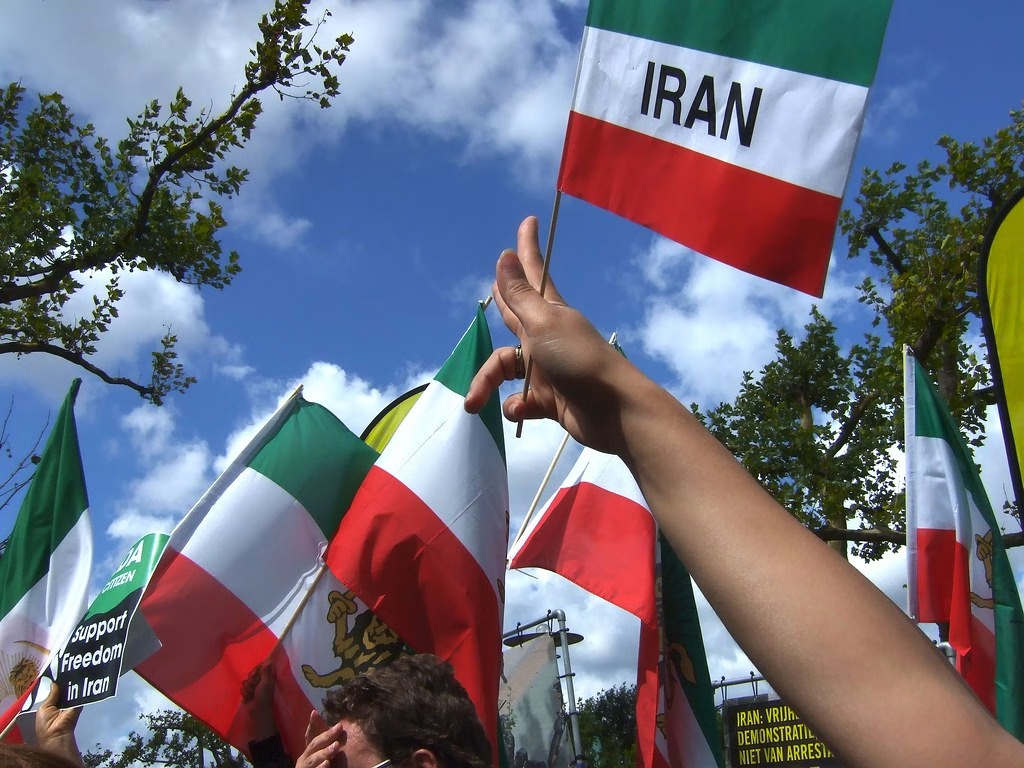
WaPo (“Iranian authorities struggle to contain growing demonstrations“):
The Iranian government is struggling to contain protests that began late last month with merchants in Tehran and have exploded into mass demonstrations and extended strikes in cities and towns across the country. Iran’s supreme leader, Ayatollah Ali Khamenei, said in remarks on Friday that the government would “not back down” against the protesters, whom he described as “vandals.”
In the modest city of Abdanan, a large crowd marched Tuesday night, shouting for the death of Khamenei. In the major city of Mashhad on Wednesday night, people tore down an enormous flag bearing the Islamic republic’s emblem and ripped it into shreds. On Thursday evening, masses of Iranians took to the streets following a call from Iran’s former crown prince. And in a new and potentially portentous turn, many businesses have shut down their storefronts, bringing much of the country’s already ailing economy to a standstill.
Security forces have responded with violence in many instances, including killing protesters, raiding hospitals and arresting thousands, according to human rights groups. Estimates of the death toll range from at least 27 to 36 people, according to tallies by human rights groups. The Center for Human Rights in Iran said Tuesday that six children have been killed by security forces.
Khamenei sought to downplay the Thursday evening mass demonstrations and smear them as directed by the United States: “Last night in Tehran, a bunch of vandals came and destroyed a building that belonged to themselves to please the president of the United States.”
[…]
Some videos shared online have shown the security forces at times overwhelmed by the size of the gatherings. And despite the repression and official announcements of modest economic changes, including monthly payments worth $7 to households for purchasing basic food items, the protests appear to be gaining momentum.
“They haven’t accepted the legitimacy of even the most basic demands of this people, so now people are at the edge,” said Omid, 55, a carpet store owner in the capital, Tehran, in an interview Wednesday. That day, security forces had countered protesters in the Tehran bazaar with tear gas, videos showed. Like other Iranians interviewed for this article, he spoke on the condition that he not be fully named for fear of government reprisal.
Large crowds took to the streets on Thursday night in the country’s biggest cities, including Tehran, Mashhad and Isfahan, as well as other cities from large to small after former crown prince Reza Pahlavi called on Iranians to protest. Pahlavi wrote in an op-ed in The Washington Post on Tuesday that he sees himself as a unifying figure to help Iran transition toward democracy, rather than a “ruler-in-waiting.”
The size of the crowds on Thursday night reminded some participants and observers of the 2009 Green Movement, when an estimated 3 million Iranians took to the streets on a single day in Tehran. In Iranian demonstrations since then, turnout has tended to be smaller and more scattered, in part due to the security crackdown. But not so on Thursday night.
NYT (“Iran Is Cut Off From Internet as Protests Calling for Regime Change Intensify“):
Iran plunged into an internet blackout on Thursday, monitoring groups said, as nationwide protests demanding the ouster of the Islamic government spread to multiple cities and grew in size, according to witnesses.
The internet shutdown came a day after the heads of Iran’s judiciary and its security services said they would take tough measures against anyone protesting. But the threats did not deter demonstrators.
In telephone interviews, more than a dozen witnesses said that they saw large crowds forming on Thursday night in neighborhoods across Tehran, the capital, and in cities around Iran, including Mashhad, Bushehr, Shiraz and Isfahan. They said the crowds were diverse, with men and women, young and old. The people interviewed inside Iran asked that their names not be published out of fear of retribution.
One resident of Tehran said that the crowds were chanting, “Death to Khamenei,” referring to Iran’s supreme leader, Ayatollah Ali Khamenei, and “freedom, freedom.” The chants could be heard from several blocks away in the affluent neighborhood of Shahrak Gharb in Tehran, which had until now sat out the protests.
[…]
As the protests grew, internet connectivity data showed an abrupt and near-total drop in connection levels in Iran on Thursday afternoon, according to NetBlocks, an internet monitoring group, and the Georgia Institute of Technology’s Internet Outage Detection and Analysis database. The data indicates that the country is almost completely offline.
Iranian officials did not immediately respond to questions about the cause of the shutdown, but the government has previously enforced internet blackouts during moments of crisis. During the country’s 12-day war with Israel last June, Iran blocked access to the internet, saying that it was a necessary security measure to stop Israeli infiltration. That measure also cut off the flow of information outward to the rest of the world.
“The Iranian government uses internet shutdowns as a tool of repression,” said Omid Memarian, an Iranian human rights expert and senior fellow at DAWN, a Washington-based organization focused on the Middle East. “Whenever protests reach a critical point, authorities sever the country’s connection to the global internet to isolate protesters and limit their communication with the outside world.”
Iranians have been protesting against the authoritarian rule of the Islamic clerics for decades, in wave after wave of protests that have been repeatedly crushed.
This is the biggest protest since the Green Movement, and quite possibly since the 1979 Revolution. Regime security forces have already killed dozens, and the protests continue to grow. Will they be willling to kill hundreds, even thousands?
If so, will President Trump follow through on his promise to rescue them? Will that help or hurt their overall cause, given decades of anti-American propaganda?
Even if the protestors are successful in ousting Khameini, it’s not at all clear what a follow-on government would look like. I’m highly dubious that there’s an appetite to bring Pahlavi in, even as a transitional leader.

I’ve read several analyses–one by an Israeli, the other by an Iranian in DC–and they both have stressed that the opposition has no actual leadership or route to power. Neither took Pahlavi seriously. The Iranian suggested that Khamenei could be removed by the regime who would then reach out to Trump to lift sanctions in exchange for oil rights and staying in power. Both emphasized that the protests are about standard-of-living, and that’s not fixable in the way that granting freedoms is.
@Modulo Myself: That seems about right. The protestors know what they’re against, but that doesn’t mean they have a plan for What’s Next. And I suspect they’d be quite divided on that score. At some point, though, it becomes impossible to control the crowds if the IRGC isn’t willing to just mow them down.
@James Joyner: It has been a while since I paid serious attention to Iran, and even then I was no expert, but I will confess that I agree with you about Pahlavi. I have never known any indication that there was a serious pro-royalist faction in Iran. And to your other point, the pivotal actor is the military. An ouster of the Ayatollah and replacement with another, or with direct military control, seems more likely than a Shah restoration, but I base that more on my general understanding of how this kind of thing can play out than any specific knowledge of the case in question.
The question is whether the foot soldiers of the Revolutionary Guards are willing to pull the triggers, the leadership would issue the orders. As others have said, it is which way the regular military breaks, not that they have more influence than the guards, but they are a potential countervailing force.
This:
“Borzou Daragahi”
“Badlands“
I am quite interested in the internet blackout that the regime has imposed.
It appears that people have learned a lesson from the Arab Spring. Shutting down the internet is a good way to stop any opposition from organizing.
So what are folks doing about it? What new comms pathways will they find?
Also, is this possible in the US, or in Europe, say Hungary, or Germany or Italy or the UK? Can the government shut down the internet? I think that’s it’s quite a bit more complex of a task, so I don’t know the answer.
If it appears possible, if it happens, it won’t be a good thing. So maybe we need to make contingency plans?
For instance, maybe the cell system will continue to work, and SMS messages will still work?
@Jay L. Gischer: Hamm radio, like Independence Day!
The protests are huge, and indicate a massive level of popular discontent.
But it’s often sensible to be cautious about the possible resilience of a regime whose rulers have the supportof a large number of heavily armed, well organised, and brutally effective security forces whose incomes, and possibly survival, depends on continued regime power.
See eg Syria.
The most likely outcome seems to be a cycle of protest, repression, continued economic collapse, and iterate the cycle until, eventually, anarchic disintegration.
I hope I’m wrong.
@JohnSF:
All those considerations are discussed inn detail, complete with Iranian context, in the badlands link I posted, this:
https://borzou.substack.com/p/protests-wont-bring-down-the-iranian
@charontwo:
Thanks for that.
A reasonable anaylsis.
Mine was based my own relections, and on some comments by Oz Katterji, who is reasonably familiar with this sort of thing in the region.
I alternate between hope and anxiety on this.
otoh, the protests are big, widely supported, and attacking major symbolic targets.
othoh, they are NOT seizing effective control and setting up alternative governance, and seem to lack any structured leadership.
Reza Pahlavi is not it, by a long chalk, just a symbol of defiance, it seems.
My fear is that the regime will hunker down in its compounds, let the protests “burn out”, then let the security police loose on those it’s identified as protest leaders.
Similar methods to Syria before the regime went into decay spiral.
Or the Cuban/Chavista model in Venezuela.
Or maybe the regime will collapse tomorrow?
I honestly haven’t a clue.
What Trump could do to “rescue the protesters” is a mystery. However any attempt by the US to intervene with military action would probably make matters worse for them.
Qatar, which seems to have appointed itself Chief Global Mediator, is reportedly trying to reduce tensions between Tehran and Washington. Given Trump’s impulsive, erratic decision-making, it would not be a shock to read that Witkoff and the Iranians had reached one of those “framework deals” he loves, marking yet another war he’d ended.
@Ken_L:
Probably an implied threat of a B-2 “decapitation strike” on the leadership.
Which might actually give said highest leadership cause to pause; otoh, the Pasdarani command structure is probably too large and dispersed to be effectively eliminated.
The Qataris may be on to something: a messy deal to install a compromise government that satisfies the protestors. and prevents their mass killing by yhe security forces on the one hand.
But leaves the IRGC leadership and the mullahs with their ill-gotten and their hides secure on the other.
Tricky, but a US threat may be a valuable element in achieving it.
Assuming Trump can be cozened into being sensible.
In which regard, the Kushner/Witkoff factions love of sweet, sweet, Gulfie money may actually be beneficial, for once
@Ken_L:
Most likely he’ll drop bombs and shoot missiles at Iran. If we’re lucky, it will be at military targets. If we’re not, add regime strongholds and government facilities all over, especially in Tehran.
Having their cities bombed not only will kill protesters, it may get them to favor the regime out of nationalism and anger at the clueless Taco wrecking their homes and killing their families.
I doubt he plans something like landing or air dropping troops who can take on the organs of repression, which is nowhere near as simple as it sounds.
Of course, it’s all bluster, probably without concrete military plans designed and vetted by experienced military personnel. Bu, as is his usual practice, he’ll double down several times, until he either puts up or chickens out.
@Kathy:
More likely a “decapitation strike” aimed at leadership bunkers, perhaps also key communications sites.
General bombing of urban areas is not likely to be an option, assuming the Orange King does not go nuts, which of course is never off the table.
But Rubio, though a lickspittle, is not a fool.
And Hegseth is likely to just present the plan options the USAF have already worked out.
@Kathy: @JohnSF: After the collapse of the Assad regime, the Venezuela strike and muttered threats against Cuba, Putin must be getting somewhat alarmed about being exposed as an impotent friend and ally. Iran has been a steadfast backer of his war on Ukraine. I’m not saying he’s in any position to oppose it, but watching America take out the Iranian government while Russia does nothing would be a bitter pill for him to swallow.
@Ken_L:
The US actions re the Bella 1 aka Marinera are the icing on the cake.
Plus the other US tanker seizures.
Insurance on such tankers will have gone through the roof and into orbit.
The dodgy shipping folks will be very nervous now, and therefore massively increasing their prices for operations.
Russia can still try to run them directly, but that’s not necessarily easy: buying the tankers from third-party operators is going to be expensive and create trails
Perhaps part of the reason for the Oreshnik strike on Ukraine?
“I am still Vova! My power is great!”
Or alternatively:
“I haz V-2. Fear me!”
Interestingly, the Trump administration, dumb as it may often be, may have opened up a major flaw in the Russian and Iranian network of operations, that Biden failed to act on.
Especially combined with obvious Ukrainian operations and European actions against ships taking the piss.
Another factor in the “Russia is a weak reed” calculus of potential cooperators is the blockage of a uranium shipment in Niger, despite Russian mercs.
And the ongoing collapse of Mali, despite Russian mercs.
All things considered, Russian assistance is at a discount.
Xi must be rolling his eyes at the failures of his mini-me.