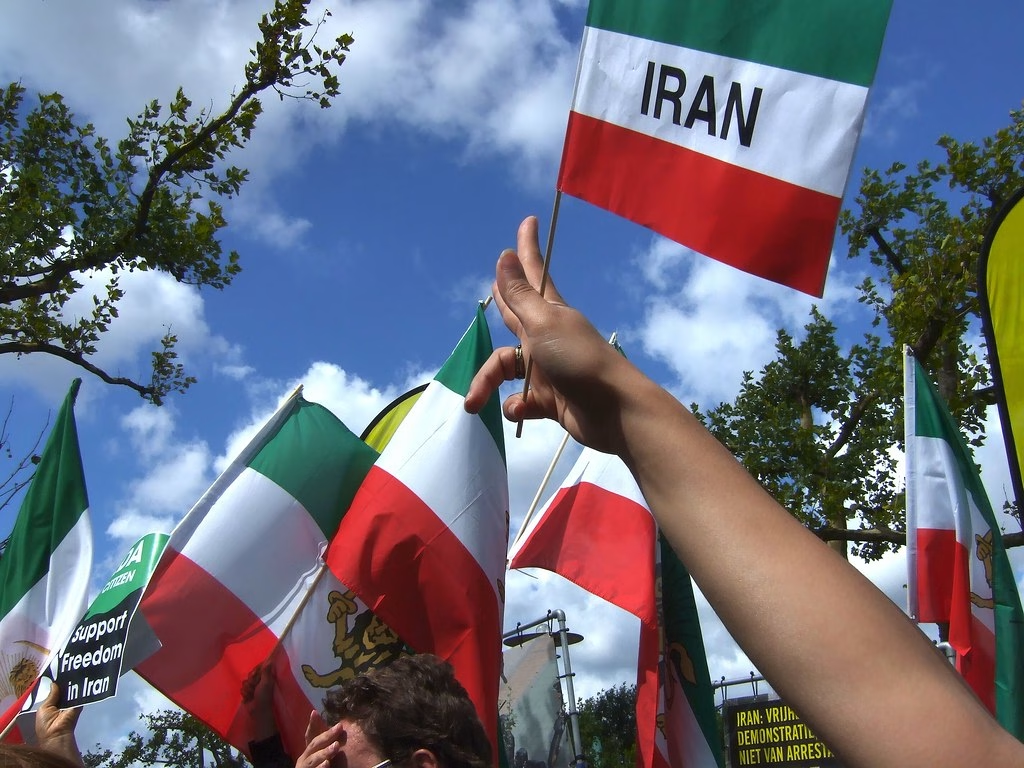
WaPo (“Iranian authorities struggle to contain growing demonstrations“):
The Iranian government is struggling to contain protests that began late last month with merchants in Tehran and have exploded into mass demonstrations and extended strikes in cities and towns across the country. Iran’s supreme leader, Ayatollah Ali Khamenei, said in remarks on Friday that the government would “not back down” against the protesters, whom he described as “vandals.”
In the modest city of Abdanan, a large crowd marched Tuesday night, shouting for the death of Khamenei. In the major city of Mashhad on Wednesday night, people tore down an enormous flag bearing the Islamic republic’s emblem and ripped it into shreds. On Thursday evening, masses of Iranians took to the streets following a call from Iran’s former crown prince. And in a new and potentially portentous turn, many businesses have shut down their storefronts, bringing much of the country’s already ailing economy to a standstill.
Security forces have responded with violence in many instances, including killing protesters, raiding hospitals and arresting thousands, according to human rights groups. Estimates of the death toll range from at least 27 to 36 people, according to tallies by human rights groups. The Center for Human Rights in Iran said Tuesday that six children have been killed by security forces.
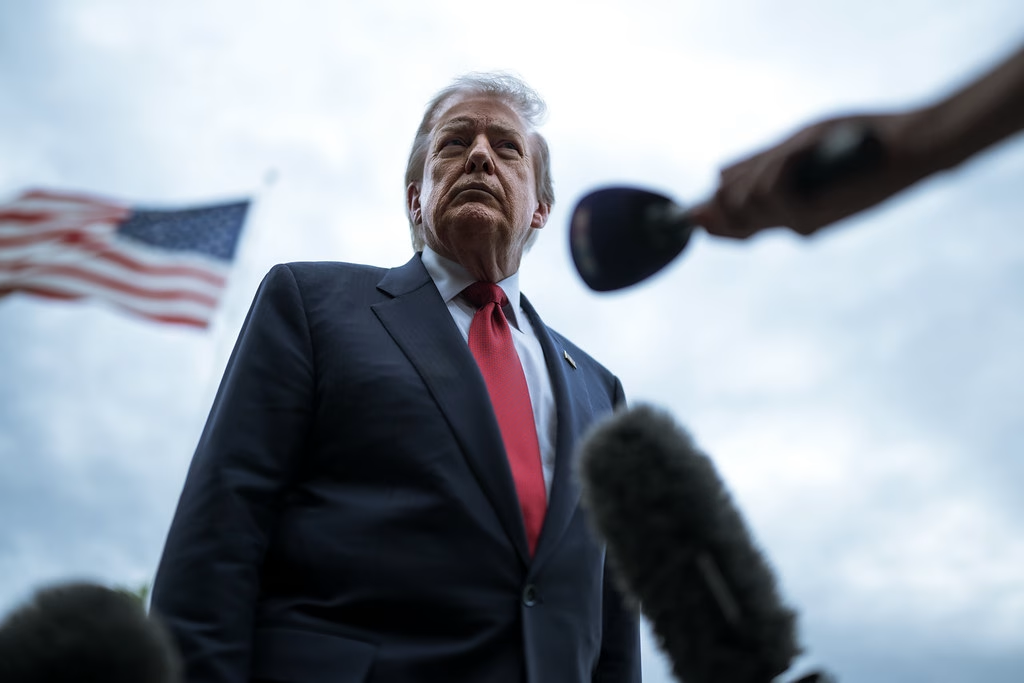
Khamenei sought to downplay the Thursday evening mass demonstrations and smear them as directed by the United States: “Last night in Tehran, a bunch of vandals came and destroyed a building that belonged to themselves to please the president of the United States.”
[…]
Some videos shared online have shown the security forces at times overwhelmed by the size of the gatherings. And despite the repression and official announcements of modest economic changes, including monthly payments worth $7 to households for purchasing basic food items, the protests appear to be gaining momentum.
“They haven’t accepted the legitimacy of even the most basic demands of this people, so now people are at the edge,” said Omid, 55, a carpet store owner in the capital, Tehran, in an interview Wednesday. That day, security forces had countered protesters in the Tehran bazaar with tear gas, videos showed. Like other Iranians interviewed for this article, he spoke on the condition that he not be fully named for fear of government reprisal.
Large crowds took to the streets on Thursday night in the country’s biggest cities, including Tehran, Mashhad and Isfahan, as well as other cities from large to small after former crown prince Reza Pahlavi called on Iranians to protest. Pahlavi wrote in an op-ed in The Washington Post on Tuesday that he sees himself as a unifying figure to help Iran transition toward democracy, rather than a “ruler-in-waiting.”
The size of the crowds on Thursday night reminded some participants and observers of the 2009 Green Movement, when an estimated 3 million Iranians took to the streets on a single day in Tehran. In Iranian demonstrations since then, turnout has tended to be smaller and more scattered, in part due to the security crackdown. But not so on Thursday night.
NYT (“Iran Is Cut Off From Internet as Protests Calling for Regime Change Intensify“):
Iran plunged into an internet blackout on Thursday, monitoring groups said, as nationwide protests demanding the ouster of the Islamic government spread to multiple cities and grew in size, according to witnesses.
The internet shutdown came a day after the heads of Iran’s judiciary and its security services said they would take tough measures against anyone protesting. But the threats did not deter demonstrators.
In telephone interviews, more than a dozen witnesses said that they saw large crowds forming on Thursday night in neighborhoods across Tehran, the capital, and in cities around Iran, including Mashhad, Bushehr, Shiraz and Isfahan. They said the crowds were diverse, with men and women, young and old. The people interviewed inside Iran asked that their names not be published out of fear of retribution.
One resident of Tehran said that the crowds were chanting, “Death to Khamenei,” referring to Iran’s supreme leader, Ayatollah Ali Khamenei, and “freedom, freedom.” The chants could be heard from several blocks away in the affluent neighborhood of Shahrak Gharb in Tehran, which had until now sat out the protests.
[…]
As the protests grew, internet connectivity data showed an abrupt and near-total drop in connection levels in Iran on Thursday afternoon, according to NetBlocks, an internet monitoring group, and the Georgia Institute of Technology’s Internet Outage Detection and Analysis database. The data indicates that the country is almost completely offline.
Iranian officials did not immediately respond to questions about the cause of the shutdown, but the government has previously enforced internet blackouts during moments of crisis. During the country’s 12-day war with Israel last June, Iran blocked access to the internet, saying that it was a necessary security measure to stop Israeli infiltration. That measure also cut off the flow of information outward to the rest of the world.
“The Iranian government uses internet shutdowns as a tool of repression,” said Omid Memarian, an Iranian human rights expert and senior fellow at DAWN, a Washington-based organization focused on the Middle East. “Whenever protests reach a critical point, authorities sever the country’s connection to the global internet to isolate protesters and limit their communication with the outside world.”
Iranians have been protesting against the authoritarian rule of the Islamic clerics for decades, in wave after wave of protests that have been repeatedly crushed.
This is the biggest protest since the Green Movement, and quite possibly since the 1979 Revolution. Regime security forces have already killed dozens, and the protests continue to grow. Will they be willling to kill hundreds, even thousands?
If so, will President Trump follow through on his promise to rescue them? Will that help or hurt their overall cause, given decades of anti-American propaganda?
Even if the protestors are successful in ousting Khameini, it’s not at all clear what a follow-on government would look like. I’m highly dubious that there’s an appetite to bring Pahlavi in, even as a transitional leader.