NYT (“What to Know About Friday’s Nationwide Ground Stop“):
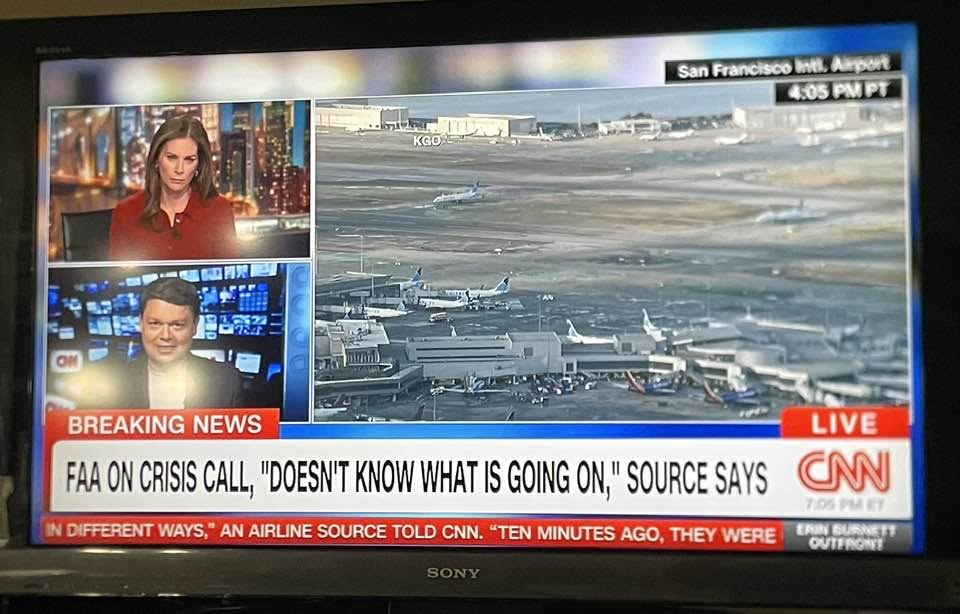
The Federal Aviation Administration issued a rare nationwide ground stop Friday afternoon, after outdated air traffic communications equipment became overloaded with data and began to fail, officials said.
The outage stranded thousands of passengers and caused widespread delays from which airlines and airports are still struggling to recover. It also highlighted persistent vulnerabilities in the aging U.S. air traffic infrastructure and a funding fight, as administration officials demanded lawmakers approve tens of billions of dollars more to accelerate systemwide upgrades.
[…]
Sean Duffy, the transportation secretary, told reporters at the White House Friday night that the radar and other air traffic communications started to falter at 3:36 p.m. when old routers became overloaded with data. While the failures were not universal, they were pervasive enough to prompt officials to issue the unusual nationwide moratorium on takeoffs, Mr. Duffy said.
Appearing alongside him at the White House, Markwayne Mullin, the homeland security secretary, stressed that there was no evidence that nefarious activity had triggered the technology failures.
“We’ve seen zero evidence that this was a cyberattack,” Mr. Mullin said, suggesting that new equipment and new technology the Mr. Duffy’s department had added to the old infrastructure was what had overwhelmed it.
Mr. Duffy insisted that the failure was caused by the antiquated, legacy communications equipment, not recent upgrades to the system.
“What we have is an incredibly old air traffic control system,” Mr. Duffy said, predicting that until significant upgrades are made, “it’s going to continue to fail.”
That is less than reassuring.
The equipment didn’t just get old overnight. We dumped literally trillions of borrowed dollars into the economy in the aftermath of the COVID pandemic. Why didn’t we make the investments then?
This is also not great:
Mr. Duffy warned that it would take “some time” for air travel nationwide to recover from the ground stop, predicting flight schedules would be fully back to normal by the time the Thanksgiving travel season begins.
“I believe that it’s going to take us some time to get back to capacity,” he said, adding: “We’re going to have some makeup to do.”
I don’t know when “Thanksgiving travel season” begins. The holiday itself is twelve days away, though. Surely it’s not going to take that long to recover from a four-hour stoppage.
The NYT is live-blogging updates, and it’s a mess right now, at least.
Travelers across the United States and beyond were still facing delays and uncertainty on Saturday as airlines and airports sought to recover from the ground stop the day before that brought air travel to a halt for hours.
Thousands of passengers were stranded on Friday after the Federal Aviation Administration ordered the ground stop. More than 8,200 flights — or over 31 percent of those scheduled for Friday — were canceled nationwide, according to Cirium, an aviation data firm, though some international flights received permission to take off.
Early Saturday, the aftermath of the ground stop still appeared to be rippling internationally. The departures board at London Heathrow Airport — Europe’s busiest hub and the largest gateway for flights between Europe and the United States — showed that a few dozen trans-Atlantic flights had been delayed or canceled. Around 5 a.m. Eastern time, 19 flights between Heathrow and the U.S. had been canceled, and 22 delayed, according to the flight-tracking service FlightAware.
It’s also wreaked havoc on today’s sporting events. The Athletic:
With a busy slate of college football and basketball games scheduled for the weekend, along with NBA games, NHL games and a full NFL Sunday, the stoppage put plans at risk as teams scrambled to figure out ways to get to their respective destinations.
[…]
In college football, No. 2 Utah, No. 6 Texas, No. 8 Tennessee and No. 19 Ole Miss were among those whose travel for Saturday games was impacted. Ole Miss’ travel situation was precarious enough that the SEC moved its game at Oklahoma to Sunday, over the Sooners’ “strong objection.” Amid the temporary uncertainty, teams including Auburn and North Texas decided to take to the road in buses.
Among NBA teams, the Brooklyn Nets were moments away from taking off from the New Orleans airport when the ground halt went into effect. They are scheduled to play in Memphis on Saturday.
One of the biggest early-season showdowns in women’s college basketball — No. 1 South Carolina vs. No. 3 Southern California — was briefly imperiled after Trojans coach Lindsay Gottlieb told The Athletic the team hadn’t made it out of Los Angeles. The semi-neutral-site game is set for a 1 p.m. tipoff Sunday in Greenville, S.C., so the Trojans had cushion to account for the travel woes. But instead of having the opportunity to practice in Greenville on Saturday morning, they now plan to fly that day.
[…]
Several schools took off before the ground stop, including Florida, Nebraska, USC, Texas Tech, Wake Forest, Missouri and South Carolina, according to program sources and public information from teams.
Alabama reportedly took a bus to Nashville, Tenn., where the Crimson Tide are scheduled to play Vanderbilt. Auburn (at Mississippi State), Purdue (at Iowa) and North Texas (at UTSA) also opted to take buses to their games after their flights were grounded.
The travel disruption led to several Saturday kick times being moved, including four games in the Big 12 and the Ole Miss-Oklahoma game getting pushed to Sunday.
The latter was not without controversy. In a statement released late Friday night, Oklahoma athletic director Roger Denny said the SEC told the school that if the school didn’t play Sunday, it would result in a forfeit.
“Put simply, this decision isn’t fair to our athletes, our institution, or to Sooner Nation,” Denny said in his statement.
Alabama always travels to Nashville by bus, so there was no impact to that game.
Moving the Ole Miss-Oklahoma game to Sunday has outraged a lot of Oklahoma fans. It turns out that it’s not easy to arrange to get a hundred-odd folks and their equipment from Oxford, Mississippi to Norman, Oklahoma on short notice. It’s only an eight-hour drive, but one images there aren’t fleets of tour busses just waiting for such an event.