Politics Makes Very Strange Bedfellows
The Nick Fuentes phenomenon.
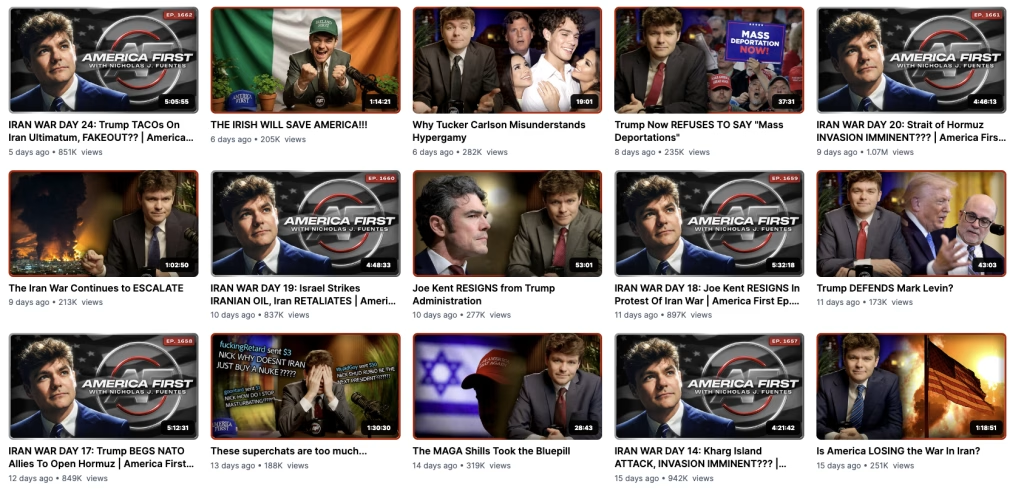
Shortly after finishing my post on the unsurprising programmatic incoherence of the No Kings protest movement, I came across Amogh Dimri‘s Atlantic essay, “Nick Fuentes’s Strategy is Working.” It’s quite something.
Nick Fuentes, a 27-year-old white-supremacist influencer, is notorious for a political outlook that he summarizes succinctly: “Jews are running society, women need to shut the fuck up, Blacks need to be imprisoned, for the most part.” For Ericson Contreras, a left-leaning 23-year-old Afro Hispanic man from New York, Fuentes is not a natural ideological guru. So when Contreras was scrolling Instagram at 3 a.m. recently, he was surprised to find himself served a clip of a Fuentes monologue. More surprising still, Contreras was nodding along.
“Trump is better than the Democrats for Israel. For the oil and gas industry. For Silicon Valley. For Wall Street. Is he really better for us? I don’t think so,” Fuentes declared while gazing at the camera in one of these fan-uploaded clips. “Biden made it so that medical debt doesn’t go on your credit report—that was good for me. Biden tried to forgive the student loans—that was good for me.” Retouched in a tasteful black and white, the video featured an orchestral soundtrack that crescendoed as the fast-talking, besuited polemicist delivered his final punch: “The free market says that Republicans have enough money to bomb Iran but not enough money to pay for my student loans. And I’m going to vote for that ’cause I’m an idiot.”
Fuentes’s economic populism resonated with Contreras. “I’m like, Y’know, he kinda has a point,” Contreras told me. He flicked through more Fuentes reels and was impressed to find jabs at President Trump, Vice President Vance, and other leading conservatives, as well as a full-throated takedown of America’s attack on Iran, which has moved Fuentes to encourage voters to back Democrats in the midterms: “We need, in 2026, for this administration to be shut. The fuck. Down.” Contreras admitted, however, that finding common ground with a self-proclaimed racist can be disorienting: “I get mad because I agree with him.”
That a man spouting racist venom that would make David Duke blush is gaining enthusiastic support from liberal Afro-Hispanics (whom he’d presumably like to mass deport) is shocking, indeed.
The explanation, it turns out, speaks to two issues we’ve been discussing at OTB for years: the problematic nature of a binary political system and the fragmented nature of our information ecosystem.
There is increasing concern on the left and in parts of the MAGA right about the rise of Groypers, a term for the growing number of people, most of them conservative young men, who follow Fuentes, a man who has denied the Holocaust, defended Jim Crow, and argued that women should be denied the vote and that many of them “want to be raped.” But Fuentes also appears to be gaining a following on the left. Thanks to an army of fans bent on broadening his audience, clips of Fuentes sounding well mannered and oddly agreeable now regularly go viral on the very social-media platforms that have officially banned him for his hate speech and anti-Semitism. The clip in which Fuentes praises Joe Biden, for example, has more than 5 million views.
Many left-wing social-media users are as mistrustful of mainstream-media outlets as Fuentes’s usual fans, which may prime them to reconsider a figure the usual gatekeepers have dismissed. People on the outer edges of the political spectrum also tend to share anti-elitist, anti-establishment views, which can shade into the hatreds that Fuentes is so skilled at tapping.
As our two parties have sorted, voters (to the extent they even live in the handful of states or localities where the outcome of the party primary isn’t the de facto election) face All Or Nothing choices. Most of us are in sharp disagreement with parts of both the Republican and Democratic platforms, but nonetheless have to choose between them.
Fuentes may be loathsome, but he’s nonetheless expressing some of the frustrations of young leftists like Contreras more energetically than the likes of Chuck Schumer, Hakeem Jeffries, Kamala Harris, and Gavin Newsom. Moreover, while Duke may have pioneered the well-mannered Klansman, Fuentes is operating in an information ecosystem that allows parts of the message that resonate to go viral outside the context of the vileness of the person delivering it.
Yet if some of Fuentes’s leftist converts are the by-product of horseshoe politics, others seem a product of the peculiar new mechanics of social media. His show, America First With Nicholas J. Fuentes, streams for hours every weeknight on Rumble, but few of the converts I spoke with had ever watched it. They had, instead, encountered Fuentes through brief, selectively edited videos that cropped up in their feeds. Social-media “clippers” rely on algorithms to circulate the cherry-picked content they post, which is how these videos are reaching people who, like Contreras, are bewildered to find themselves agreeing with a man who once said, “My problem with Trump isn’t that he’s Hitler. My problem with Trump is that he is not Hitler.” (Fuentes did not respond to multiple requests for comment.)
Cut from his show, these snippets handily capture Fuentes’s appeal to his followers—his charisma, humor, and willingness to throw punches—while leaving out most of the racism and misogyny that might trigger censors or alienate viewers. In many clips, Fuentes channels his anti-Semitism into criticisms of Israel that may resonate with young progressives. The Fuentes in these videos, which have been appearing in my feeds, too, is an ideological chameleon. In one, he decries “the MAGA movement as the biggest scam in American history”; in another, he derides neo-Nazis for lionizing “a racial supremacist,” adding: “If Hitler had it his way, they would’ve killed and enslaved millions of people. Like, what the fuck are you talking about?”
Other progressives have expressed similar surprise in finding themselves charmed by this deceptively scrubbed-up Fuentes during their late-night scrolls. As a 23-year-old Jewish anti-Zionist leftist from New York told me, “He could be your homie.” (A number of sources declined to be identified to avoid professional blowback or harassment for praising Fuentes.)
Some two decades ago, my co-blogger Steven Taylor observed that the real impact of presidential speeches and debates did not come from the live viewing but rather in the tiny sound bites that were reported the next day. The latter reach a much larger audience and are naturally the pithiest moments. And those watching live tend to be hard-core news junkies who are harder to sway, anyway.
That was long before the rise of the social media “influencer” and social media algorithms. Carefully packed video “shorts” can go viral in a way that was next to impossible when OTB got started. Charismatic performers can gain tens of millions of viewers who don’t have the time to sit around and watch a two- or three-hour show and, indeed, most of whom would turn it off once the host started spewing his racist venom.
“Finally getting it Nick,” former Representative Jamaal Bowman commented on the viral clip of Fuentes praising Biden. A New York Democrat who ran on taxing the rich and defunding the police, Bowman added, “It’s us, against the oligarchy. Now no more racist bullshit from you.”
I know little about Bowman, but he’s not a dumb man. He’s highly educated and spent decades as an educator before entering politics. And, presumably, as a Black man, he’s no fan of Adolph Hitler. Yet, here he is gushing over a clip that resonates with him.
TikTok, YouTube, and Meta all maintain bans on official accounts belonging to Fuentes. These companies told me that they prohibit hate speech and remove it when they can. Yet most social-media platforms have loosened moderation standards since Trump’s reelection in 2024, and they are clearly unable to keep up with all of the fan-uploaded clips. In response to questions about the videos I was seeing in my feeds, Meta asked for the relevant links on Instagram, which Meta owns, and promptly erased them for violating their guidelines. Within minutes, I found identical clips on Instagram.
Because Fuentes’s monologues tend to rattle on for hours without focus or consistency, clippers have little trouble finding messages that appeal to different users. “You can show 90 seconds to one person, and 90 seconds to someone else, and 90 seconds to a third person. Each of those people will say, Yeah, I agree with that,” Laura Edelson, a Northeastern University professor who studies online extremism, told me. She added that social-media algorithms amplify these clips by using speech-to-text transcriptions to group similar content together. So leftists who “like” videos that praise student-loan forgiveness and criticize MAGA may find themselves served with a snippet of Fuentes making similar points.
Clippers can further game social-media algorithms by adding left-wing hashtags, such as #liberal and #lgbtq, to their captions. Instagram served me one video of Fuentes expressing admiration for Stalin over a caption that read: “😭 his silliness knows no bounds (hashtags bc i want left wing ppl to react to this so im seeing if i can bait them into watching this clips)” and included #marxism, #leftist, and #anticapitalist. Unlike TikTok and Instagram, YouTube lets users manipulate algorithms with back-end tags, too, which viewers don’t see.
Interestingly, this feeds into the discussion we had on Friday on the social media addiction verdict against Meta and YouTube: the algorithm is powerful, indeed. At the same time, it shows the value of Section 230: these companies have a hard time quashing these videos even when they’re actively trying to do so.
One 21-year-old Christian nationalist who runs the @womenforfuentes fan page on Instagram told me that she spends hours each week carving out clips of his softer, funnier side to better spread his message. Fuentes is “right about everything,” she insisted, citing his takes on immigration, Israel, “neocon foreign politics,” and “the catastrophic harms of modernity and feminism.” She said that she clips for fun and to make new friends online, but noted with pride that “Nick loves his clippers.” He reposts “his favorite edits,” and once “liked” one of her posts on Telegram.
Joan Donovan, a professor at Boston University who studies algorithmic radicalization, told me that Fuentes deliberately makes it easy for clippers to spin his message differently for different demographics. “It’s part of his communication strategy to get algorithms to pick up this content and serve it to wider audiences,” she explained. “Fuentes definitely knows that when he’s playing into the left or praising Biden.”
A 24-year-old medical researcher with isolationist views told me that he agreed with a video he saw in January in which Fuentes criticized America’s intervention in Venezuela, likening it to the war in Iraq—and “look at how that turned out,” Fuentes said in the clip. The researcher was shocked when I told him that Fuentes energetically backed the Venezuela attack in another episode, saying: “We will kill all of you. Our military will come in and wipe out your regime, and we’ll take your oil.”
Which, of course, would seem to indicate that Fuentes is, above all, a grifter rather than an ideologue. He’s about the clicks, not the agenda, first and foremost. But that doesn’t mean he doesn’t have an agenda or that that agenda isn’t dangerous.
Fuentes claimed in a December 2025 episode that recent moves to embrace more freedom of expression by social-media platforms and a proliferation of fan-uploaded clips may be “the biggest” reason why his show blew up last year. Since his return to X in May 2024, Fuentes’s following on the site has grown from less than 300,000 to 1.3 million. “It used to be the case that if you posted any clip from my show, your whole channel will get deleted,” he said. “All of a sudden, starting this year, you’re able to post the clip without it getting taken down.”
Some of Fuentes’s fan accounts include a kind of call to action in their Instagram bios: “1,000 clippers > 10 news outlets,” meaning they believe that their aggregate work in disseminating his message reaches more viewers than anything that might run in a prime-time broadcast.
They’re almost certainly right.
Snippets that intentionally soften or distort Fuentes’s views to appeal to more users worry researchers who study radicalization online. “Partial, agreeable exposure lowers friction,” Don Shin, a professor at Texas Tech University, told me. “That makes people more likely to watch another clip, click through to a full stream, or simply stop actively avoiding the creator—which is often the first step toward deeper algorithmic exposure.”
Shin led a 2024 study that found that TikTok’s algorithm gradually radicalized users by nudging them toward incrementally more extreme content. Small actions such as rewatching a clip or scrolling the comments led to more dramatic recommendations to maintain attention, a phenomenon called the “loop effect.” Within a matter of months, participants who experienced constant exposure to certain views began to adopt them.
It’s an interesting phenomenon, to be sure. So far as I know, I’ve never seen one of Fuentes’ clips, even though I’m on both Facebook and YouTube a fair bit. For whatever reason, the algorithm really doesn’t feed me much political content. But, presumably, given how many followers he’s built up, he’s charismatic and likeable in curated doses.
Videos of the white nationalist that lean into mistrust of the mainstream media have inspired some viewers to make excuses for Fuentes’s more outlandish statements and views. “He just seems like a normal, funny dude who you would want to have as a friend,” the 23-year-old New Yorker, who voted for Kamala Harris and Zohran Mamdani, told me. This young man said he was entertained by Fuentes’s controversial appearance on the show Piers Morgan Uncensored in December—particularly when Fuentes responded to a question about his racist commentary by citing his friendship with Kanye “Ye” West, whom Fuentes insisted was untroubled by his use of the N-word. (Ye and Fuentes dined with Trump at Mar-a-Lago in 2022.)
“Nick kind of dominated,” the young New Yorker said. “Piers Morgan expected to have a debate or be like: Ha! See, I proved it. You’re racist.”But, he added, “Nick was five steps ahead.” As for clips in which Fuentes used racist slurs and tropes, this young man insisted that they were all a provocative performance, not a sincere expression of beliefs. “A lot of the time, he’ll backtrack,” he said. “All streamers do that. They’ll clip-farm”—say something outlandish in the hopes of going viral—“and then they’ll clarify after.”
Being intentionally provocative and inflammatory has been part and parcel of the attention ecosystem going back at least as far as Rush Limbaugh’s early days. But, even in the voice-only medium that is radio, Limbaugh was clearly being tongue-in-cheek.* Fuentes’ white nationalism is clearly deep-seated.
A “pretty left-wing” 17-year-old was similarly inclined to apologize for Fuentes. He told me that the Fuentes in his social-media feed wasn’t the “bad guy” the mainstream media had made him out to be. This teenager said he often found himself agreeing with Fuentes, particularly when the pundit bashed Trump, criticized the political power of wealthy Americans, and lamented the starvation of children in Gaza—all clips the teen shared with friends. As for Fuentes’s description of Hitler as “really fucking cool” and his claim that “mass migration” to the United States is creating a “white genocide,” those were clearly jokes, the teen insisted. “There’s some stuff he says that, it’s just like, there’s no way any human believes it. Those I try to just dismiss,” he said. “He’s just engagement baiting. He’s trying to get viewers; he’s trying to make money.”
Two things can be true at the same time.
Kurt Gray, a psychology professor at Ohio State University, told me that Fuentes’s appeal to the left might, in part, reflect the theory of “optimum distinctiveness,” or the inclination of people to differentiate themselves from their group. In this case, lefties watching Fuentes may think: “Yeah, I’m left-wing, but I’m a free thinker. I listen to Nick Fuentes,” Gray said. “Everyone wants to think of themselves as Neo”—the hero of the Matrix films. “Everyone else is a sheeple.” Gray added that controversy can encourage people to work harder to justify their views, so that someone begins to think, “I must really believe Nick Fuentes because now my sister’s calling me an idiot for believing him.”
Instead of dismissing Fuentes’s odious views, some of his more recent and ideologically diverse followers contort themselves to justify them. Sure, Fuentes has said, “We need white men running everything,” but he was just being ironic, right? When he claimed recently that the “No. 1 political enemy in America is women,” obviously that was for the clicks.
This is what makes Fuentes so successful—and, to anti-radicalization researchers, so insidious. He’s relying on the shield of irony and the spear of clipping to win the battle to widen his audience. And it’s working.
Apparently so.
* He did seem to get nastier as the years went on—after I’d grown tired of his schtick but well before I stopped voting Republican. I attributed it to having to escalate as the competition for right-wing infotainment space stiffened, but it’s possible that he was simply letting the mask slip.

The Trump promise is that he stands up for bigots and grifters. Otherwise, you are on your own. They don’t give a shit about you. They just don’t care. That’s the American thing: we can debate forever how much Trump voters are not responsible for their votes, but if you start gambling on an app and get 50K debt that’s on you pal. Ripping people off and racism, that’s Trump’s America.
Meanwhile. Fuentes was given a game to play. He didn’t invent saying outlandish things and getting away with it. People have been saying crazy racist about Islam forever and what’s the issue? During 2020, everyone in the center was calling college protesters Maoists. If you can do that, why can’t you crazy things about Hitler? What’s the difference?
And it’s not very hard to develop a schtick that plays off. Young people like a certain type of honesty. It’s easy to appear honest against a media backdrop of bland people who are of course against racism and militarism but are always offering weird apologies for everything. If I were black I could listen with more respect to an honest white supremacist against two decades’ worth of balding impotent Andrew Sullivans who are utterly against white supremacy but just have these questions about IQ.
I think the degree to which we will see (and are seeing to a point) people on the anti-Trump left find common cause with some pretty odious people on the right on the topic of Iran in particular, will help illustrate a lot of arguments I have made about how the binary nature of the system shapes political attitudes. Specifically, those who have often argued that Dems are simply more virtuous than Reps may find out that those virtues are more flexible than some have claimed.
We have already seen, as a general matter, some increased sympathy for MTG after her split with Trump.
BTW: to be clear, cozying up to people like Fuentes is a bad idea full stop.
@Steven L. Taylor:
I doubt many Democrats are going to cozy up to Fuentes. He just appears on the algorithm and says something and random people will give a truncated version a like.
This Atlantic article isn’t really about Fuentes. It’s about the Democrats and where they’re going. The same Democrats who yelled at the left for not thinking Joe Rogan is great are now yelling the left for thinking Hasan Piker is not terrible. These people are on the way out. The party is going to end up more woke and anti-racist but with the caveat that the young people who fall for Fuentes might be reachable. The Democrats who are on the way out believe it’s okay to be politely anti-trans, Islamophobic, and racist, but anti-semitism of any type is not permissible. This is not a viable message for anybody who isn’t totally complacent.
Sounds like a very “Boomer” misunderstanding of how social media functions.
I think Joe Rogan is a meathead, like most of these Limbaugh-descendant “manosphere” podcasters and streamers left, right, and indifferent — Fuentes, Piker, Ross, Vonn, Schultz, Maher, Peterson, Stephen A. and on and on. To me, they’re all rich, annoying losers manipulating suckers and incels. I truly feel sorry for misguided young men who take these clowns as a model for anything.
I also shared a clip to my Instagram story a couple of weeks ago of Rogan criticizing Trump on Iran with the silly caption “Even Joe Rogan is sick of the warmongering pedophile. Thank you Joe!”
I can imagine some reporter pitching this to Bari Weiss: “Die-hard anti-Trump liberal, 33, now a millennial Rogan convert, gushing over the Rogan clips he shares with his friends…”
It would make for good copy. But it would also be an alarmist, overheated misrepresentation. The reporter would be deploying the Fuentes model itself: exaggerating for clicks and attemtion.
The nature of social media is that it’s easy to reshare decontextualized clips — thus easy for grifters and clever content creators to exploit, to increase their reach and name recognition. Yes, this can be problematic when the influencer in question is malevolent, and the doomscroller weak and impressionable. This bug in our feeds is well known from long ago. So this story strikes me as another interesting data point in that old discussion, just overly dramatized.
A leftist or liberal occasionally or mindlessly hitting like or rewtweet on a clip of a racist or rightwinger bashing Trump or Netanyahu may be unwise, but does not make them “converts” who’ve reneged on their virtues in some grand show of common cause.
I still don’t listen to Broken Record Rogan’s podcast and still think he’s a douchebag.
@Modulo Myself:
No doubt, but that wasn’t my point. There will be some level of sympathy for far-right anti-war types because the enemy of my enemy is my friend, especially in a polarized, binary system.
@DK:
33 lol. +2 years. I’m really losing it.
@Steven L. Taylor:
We ought to coin a new figure of speech: “The enemy of my enemy is useful to my friends.”
Fuentes doesn’t need to be or deserve to be a friend of lefties, but if he can draw votes away from Republicans, he’s welcome to have at it.
@Steven L. Taylor:
I mean, if a white supremacist says that America and Israel are acting as aggressors in this war, I wouldn’t disagree with them. Not sure where that gets anyone. My opinion and Pat Buchanan’s opinion about the invasion of Iraq in 2003 were roughly aligned but that doesn’t mean I thought it was a globalist conspiracy. And in the long run, did the Buchananites end up having any influence on anti-war Democrats? Nope.
The larger issue is that Fuentes is doing what everyone else in social media who is allegedly provocative does, but he’s not limiting it to feminists or trans people or Islam. There’s a lot of guilt to go around in the creation of an environment where saying a slur the right way is transgressive and edgy, and none of it can be placed on the usual suspects: the people who are the targets of the slur. If people are sympathetic to Fuentes’ audience it’s because they grew up in a world rewarding idiots and assholes.
I don’t think the leftists and progressive folks like Bowman are finding common ground with Fuentes as much as they are competing for a same slice of disaffected Americans.
Populism is very much an Us vs. Them mentality, as much as a set of political goals and some of these people are more flexible on the definition of “them” if they can get the goals, while others are far more flexible on the goals so long as there is a “Them”.
It’s very dumb to listen to Fuentes and come away thinking anything other than “this is a racist incel shithead who will say anything if it means he gets to hurt the people he hates.”
He may not be a dumb man, but he’s doing a very dumb thing. You do not have to hand it to Fuentes when he says something you agree with — he says a lot of things, often contradictory, all to steer people towards antisemitism, racism and/or misogyny (depending on the day of the week and the message… but they all serve as a stepping stone to the other, so it doesn’t matter which he leads someone to first)
He also dated a catboy. Because he hates women so much that the way to make a better woman is to get a guy to wear cat ears and say “UwU”. This is very different from how other people date catboys.
I’d say his recent praise of Biden is like how he dates catboys — weirdly malevolent.
@Steven L. Taylor:
I think I linked last week to Ezra Klein’s NYT interview (gift) with Naomi Klein. She threw out a term I find useful, “diagonalism”. She describes it in the context of anti-vax:
Horseshoe theory, but with specific, not necessarily fringe, issues.
I tend to cynically assume that differences on the right will be overwhelmed by tribal ID in your “polarized, binary system”. But Trump has handed us some “diagonal” issues we may be able to use: Iran with the isolationists, tariffs with whatever free trader Republicans may still exist, NATO and Ukraine with any neocons, the economy with everyone. The biggest “diagonal” is that MAGA feel they’re being screwed by elites. We agree, we just have more sophisticated ideas on how, and which elites.
Actually, sometimes the enemy of your enemy is just another enemy.
Steve